



 A fourth edition of new feature “My Take On::” Short reviews from New York shows by Nunzio Michael Lupo, veteran journalist and an insightful appraiser of the arts. Some of these are still running for you to see on your next trip; other have closed but remain interesting for his assessment.
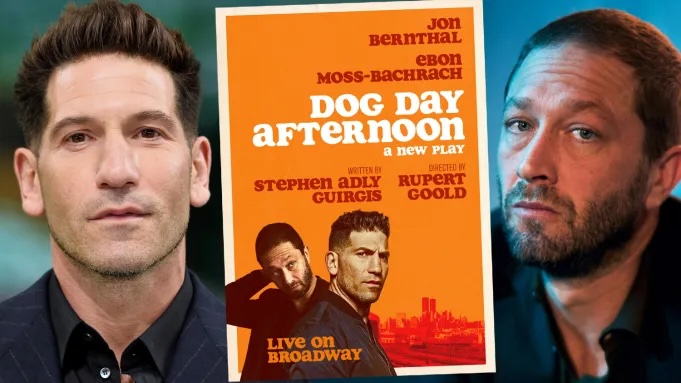
Dog Day Afternoon, August Wilson Theatre, March 25, 2026
There’s a new version of the Dog Day Afternoon story on Broadway.
In this iteration, the tale has become a full-on comedy. To be sure, there were comedic aspects of the botched robbery of a Brooklyn bank on Aug. 22, 1972. The gunmen planned poorly, carried it out in broad daylight in a busy area, and had two weapons; one was non-functional and the other had a single bullet. By the time they got to the bank, the cash on hand was a mere $9,000.
 And then there was the motive that inspired laughs then but might not now: one of the men wanted money to fund his trans girlfriend’s surgery.
What transpired in real life and on the screen in the 1975 film was comedy borne of absurdity and mixed with real pathos and desperation. What’s on stage here is a comedy stacked sideways with intentional laugh lines penned by playwright Stephen Adly Guirgis. It feels odd, forced and unbelievable.
Faced with having to deliver this material, much of the cast postures and shouts as if they were staging a broad farce like a Saturday Night Live sketch. Both in real life and in the film, the boss of this operation, Sonny (Jon Bernthal in the play), takes to the streets to shout to a sympathetic crowd about the little guy who’s screwed by the rich and powerful. But his message is buried by the playwright, so the audience joins in the shouting and just laughs louder. The whole enterprise sinks.
No Singing in the Navy, Playwrights Horizons, March 20, 2026
Playwright Milo Cramer, in an author’s note in the program, says that this show aims “to honor and frame the little songs we all make up to get through (survive) every day: the weird ditties you trade with your lover cooking breakfast, the mighty operas you compose with your niece while watching crabs.” This turns out to capture the experience; no composer or lyricist is credited in the program, but the sailors do sing songs.
Sort of. Mostly, a lone pianist hits a single key or chord, and a trio of actors intones over the notes. There isn’t a bum-de-dum tune in the bunch. The aural window dressing is layered on a familiar musical theater trope: sailors on 24-hour liberty in a city live out their hopes, fears and dreams. That is, when they are not disobeying the captain by learning to sing from a crab – yes, the kind with claws – that has escaped from the crab bucket and is also at liberty.
At some point, they meet the ants – yep, that kind – who can’t figure out whether to commit to each other. The absurdity of this “musical” is watchable thanks only to the cast, Cramer’s graduate school buddies, for whom he wrote the show: Bailey Lee, Ellen Nikbakht and Elliot Sagay. Playing the sailors and a range of other characters, they enthusiastically commit to the bit, even at its most nonsensical. One wonders what they could do with better material.
The Balusters, Manhattan Theatre Club, Samuel J. Friedman Theatre, March 31, 2026
Balusters are the upright posts that structurally hold up the handrail of a staircase, balcony or deck. They are the perfect metaphor for the Vernon Point neighborhood association members in this comedy by David Lindsay-Abaire. This is particularly true of Eliot (Richard Thomas), the lifelong resident who fancies himself the unrivaled support for the historic enclave of stately houses and verdant streets. As the association president, Thomas exudes an understated charm that initially masks his desire to wield the gavel and maintain control. Naturally, he becomes a foil for Kyra (Anika Noni Rose, restrained but excellent). Kyra is new to the board and favors erecting stop signs for safety over preserving Eliot’s sepia-toned childhood memories. Their clash plays out with the rest of the board, a mosaic one might find in such a gentrified neighborhood. They differ by race, age, income, class, sexual orientation and gender identity. This setup takes the normal dysfunction of a community board and supercharges it with slights – real and imagined – that infect the proceedings. In the hands of a talented group of New York character actors, the association members come off well in all their petty and sometimes-noble humanity. Besides the laughter, this play is bound to generate PTSD for anyone who’s served on such a board. It’s messy work, but someone’s got to do it.
Becky Shaw, Second Stage, The Hayes Theater, March 22, 2026
At one point in this comedic take on William Makepeace Thackeray’s 1848 novel “Vanity Fair,” finance bro Max (Alden Ehrenreich, hilariously abrasive) explains the way things really work to Suzanna (a fine Lauren Patten), whose family adopted him as a child. “There are two kinds of trouble,” he tells her. “There’s sexy trouble and there’s boring trouble. You have boring trouble. Becky Shaw is sexy trouble.”
Indeed she is. From the moment Becky shows up for a blind date with Max – presumably demure and all hyper-feminine in a floral print dress and open-toe heels – she takes a wrecking ball to the lives of everyone around her. In Madeline Brewer’s capable hands, this Becky is wonderfully subtle. Is she a victim or a victimizer? Both perhaps? Whatever the truth, she’s clingy to Max, catnip to Suzanna’s barista/ski bum husband (Patrick Ball), and disloyal to Suzanna. The only person who seems to see her clearly from the get-go is Suzanna’s mother (Linda Emond, deliciously caustic).
All of them are aided by a taut script by Gina Gionfriddo that leavens laughs into the classic tale of class, manipulation and control. It’s the kind of sexy trouble that goes down well.
The Wild Party, New York City Center Encores! March 21, 2026
The first thing to notice in this revival is the music and lyrics by Michael John LaChiusa. From the first blaring notes, the hot jazz songs are syncopated, driving, propulsive, frenetic, brassy, raw and raucous. An hour and forty-five minutes of that can be a lot. You may find yourself longing for a quiet moment or two, but that is not what happens at a “wild party.”
The show takes its title and plot from the 1928 narrative poem by Joseph Moncure March, which chronicles a gin-and-sin bacchanal during the jazz age. With an ample serving of polyamorous sex (vividly depicted here), drug use, rape and violence, it’s not a show for the fainthearted. And yet, it is hard to look away.
The cast is onstage nearly throughout, creating tableaux that live up to the name. It is stacked with talent: a magnetic Jasmine Amy Rogers as Queenie, the party’s dissolute host; a commanding Adrienne Warren as her nemesis and rival, Kate; and a volcanic Jordan Donica as Burrs, the violent lover caught between them. The show has no ensemble, so they are joined by others who play smaller roles, but each with a standout moment: Jelani Alladin, Claybourne Elder, Tonya Pinkins and Lesli Margherita.
They’re all so good at being bad that you might invite them to your next party. What could possibly go wrong?
The Reservoir, Atlantic Theater Company, Linda Gross Theater, March 13, 2026
Josh (a fine and animated Noah Galvan) is passed out drunk onstage as you are taking your seats. From the minute he wakes up, groggy and injured, he is in a desperate tug-of-war with his thoughts, fears and emotions. Chief among them are his failures – as an acting student, as a bookstore shelver, as a son to his exhausted single mother and as a grandson to aging grandparents who are losing their faculties. Perhaps if he can help them stave off aging’s inevitable decline, he can save himself, too. It doesn’t work that way, of course, and all Josh can do is hit bottom.
Fortunately for him, he’s got a tart, kickass grandmother (a wonderful Caroline Aaron as Beverly) to…well…you know. In different ways, all his grandparents contribute to his redemption – and definitely to the show. Hank (an embittered Peter Maloney) teaches him that actions have consequences; Irene (a sweet Mary Beth Peil) teaches him a softer side of love; and Shrimpy (Chip Zien, hilarious and somewhat raunchy) teaches him that spirited victory is possible even as the body and mind wither. Through them he learns the most important lesson: Life brings pain for everyone; suffering comes when you keep tugging and can’t drop the rope.




 A PaperStreet Web Design