




 By Bill Hirschman
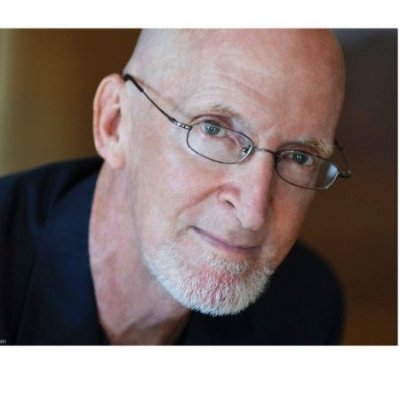
Louis Tyrrell, one of the core visionaries transforming South Florida theater from safe predictable fare to a birthplace for new plays challenging intellect as well as emotion, died Friday afternoon.
As a director, producer, actor, teacher and mentor, Tyrrell founded or co-founded a procession of groundbreaking Palm Beach County companies including Theatre Lab, Arts Garage and Florida Stage (originally known as the Theater Club of the Palm Beaches and later the Pope Theatre Company.)
Tyrell, 75, of Lake Worth Beach, had been ill a short period. There are no immediate plans for a service, but Theatre Lab is dedicating its 2026 Owl New Play Festival opening this weekend to his memory and a celebration of his life is planned in the in the coming month.
His guiding goal was to develop and produce world premieres or plays that only had a few previous productions — laser-focused on intellectually and emotionally stimulating dramas, comedies and musicals.
“Lou Tyrrell was a visionary who changed the face of theater in South Florida and ultimately across the country,” said Nan Barnett, executive director of the National New Play Network and who served as Florida Stage’s managing director throughout its run.
“He saw an opportunity in the late ’80’s – realizing that the Palm Beaches were filled with sophisticated, experienced theater goers who did not have access to the contemporary, excellent new work by established and emerging playwrights they had been used to seeing in their northern homes and answered that need with Theater Club of the Palm Beaches, which became Florida Stage.”
Further, “Lou built a family of artists with a sense of adventure and a culture of excellence. These people – actors, directors, designers, technicians, administrators, and writers – now are seeded throughout the American theater. “
Tyrrell himself said in a 1999 interview, “We strove to ensure that the audiences (are allowed) to truly be at the forefront of great new American theater.”
“What we do is typically not for everyone…. If what everyone is looking for is a thoughtless evening of entertainment, then …” He paused, then added, “We certainly hope to entertain, but much more than that, we think that theater needs to be at the heart of our whole life, social life, political life – the heart of our community and all the considerations that make our community work well.”
Imagination melded with technique and passion in his stagings. Duncan Macmillan’s Lungs at Arts Garage examined the fragility and tensile strength of relationships. With only the subtlest of lighting changes Tyrrell had his actors convey the passage of time — minutes, months, even decades — simply by slight inflections in speech or changing body language.
In one coup de theatré, he had an actor chart several days simply by walking across the back of the stage, stopping and uttering a single sentence fragment and then moving to a different station like a film montage.
He told Sun-Sentinel theater journalist Jack Zink in 1996, “We’re drawn to the process which by its nature should be based on exploration – on original thought and the constant re-evaluation of ourselves and our expression of who we are. Then, by nature we will not be able to do Pajama Game for the 16th time.”
Of that musical, he said, “In that process, there is no journey, no exploration. There’s nothing that reflects the life experience that we all share when we get up in the morning and meet a brand new day.”
But he was famously devoted to discovering and developing artists.
Matt Stabile, producing artistic director at Theatre Lab at Florida Atlantic University in in Boca Raton, said, “I’ve been on the phone with hundreds of people. And every person I call has some version of a story that is equal to ‘Lou was the first person who believed in me, Lou changed my life, who gave me my career.’ Then not just believed in them, but then to continue to support them throughout the journey of their career.”
Professionally, he was instrumental in creating a new generation of local theater thespians, such as veteran actress Beth Dimon who worked with him often. “I owe him everything. Lou and Nan. I came to this area in 1990 and they gave me my first job and they gave me my start in my career.”
But the bonds were personal as well. When Dimon brought her husband home from the hospital, she asked Tyrrell to meet her at the house because it was raining. “Lou was there at the bottom of the stairs to my driveway with an umbrella, and he helped me bring my husband into my house.”
Stabile recalled, “He wore his heart on his sleeve every single moment of the day. I watched him one time break down in tears because somebody on campus had hit an Egyptian goose.”
In Tyrrell’s 55-year love affair with theater, especially 43 years in Florida, he located, encouraged and attracted loyal audiences, even more loyal artists and earned the approbation of excellence awards and critical raves.
The work that he and his colleagues created was honored with scores of nominations and awards including the Carbonells’ most prestigious George Abbott Award in 1994.
Plaudits came from the South Florida Critics’ Association, the Ubertalli Award for Artistic Excellence from the Palm Beach County Cultural Council, a Florida Arts Council Individual Artist Fellowship, the Fallon Award for Excellence in Professional Theatre, and the Florida Atlantic University Palm Beach County Cultural Leader Award.
Other than the founders of the current M Ensemble, Tyrrell was one of the last of the generation that helped build the modern Florida theater community. A few among that roster of those gone: Jan McArt, Brian C. Smith, Ruth Foreman, Vinnette Carroll, Hap Erstein, Jack Zink, Christine Dolen, Charlie Cinnamon, Iris Acker, Tony Finstrom, Jay Harris and Michael Hall.
But a major goal was engendering the next generation including mentoring programs for young developing artists. Some became the backbone of today’s theater, such as Stabile.
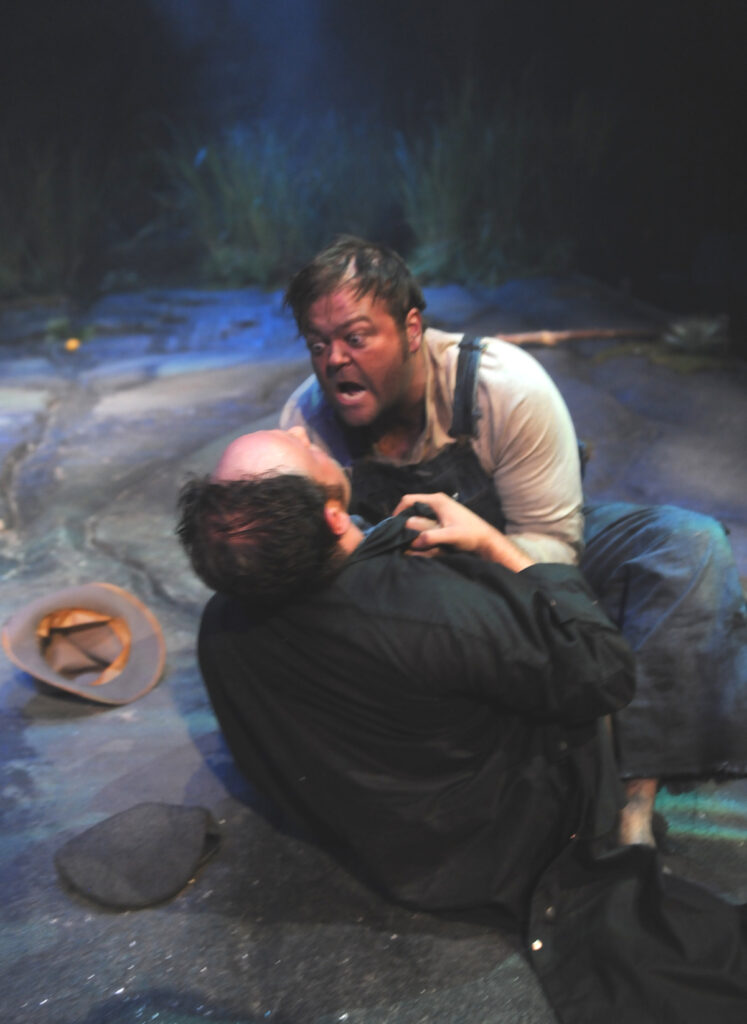
David Nail and Greg Weiner in one of Florida Stage;’s last shows Cane in 2010
Raised in New York, he also studied at the Guildhall School of Music & Drama in London from 1971 to 1973, and then mime and improvisation at the Ecole Jacques Lecoq in Paris in 1973 and 1974. He came to Florida in 1974 and led a theater-in-the-schools program connected to the University of Florida. Commuting from Gainesville, he acted in several Florida companies including the Caldwell Theatre Company, Stage Company of the Palm Beaches and Florida Repertory Theatre.
He moved to Palm Beach County in 1983 and worked in a schools program called The Learning Stage.
But in 1987, he co-founded Theater Club of the Palm Beach based at Palm Beach Community College for four years dedicated to work written in recent years.
Something clicked with the patrons even though most had not even heard of the titles of shows and had never seen them. Yet performances were often 90 percent sold out in advance.
In 1993, the company was retitled The Pope Theatre Company for its benefactress, Lois Pope. Her funding helped move the company from a rented lecture hall to a 258-seat playhouse in a Manalapan shopping center. With an annual budget of $2.25 million and almost 7,000 subscribers, the troupe became the fourth-largest nonprofit regional theater in South Florida.
But internal board squabbles with the board and its chairwoman Pope led her to back away and forced the retitling to Florida Stage in 1997.
A crucial decision came in the summer of 2010 to move into the large black box Rinker Playhouse at the Kravis Center for the Performing Arts in West Palm Beach – a nine-mile drive from its longtime home. The rent was less, the upkeep was cheaper, and supporters and grants paid much of the retrofitting bill.
Problems became apparent when some patrons balked at driving further north. Residents around its new home downtown did not pick up the single-ticket sales as was hoped. By 2011, the acclaimed company declared bankruptcy. By that time, it had produced more than 150 productions.
But he could not be deterred. Remaining committed to his vision intact, Tyrrell became founding artistic director of Theatre at Arts Garage in December 2011, a multi-disciplinary hub for visual artists, musicians, performers, film presenters and arts educators.
Much like Florida Stage’s philosophical thrust, Arts Garage focused on challenging new works from established voices, sometimes world premieres, and undiscovered works from emerging artists — essentially a scaled-back version of Florida Stage.
He dealt with a significantly tighter budget and simpler space in a renovated office on the floor of a parking garage in Delray Beach. But he reached out to playwrights he knew like William Mastrosimone and John Guare to aid readings and productions of lesser known works. Among them, the company hosted the world premiere of Israel Horovitz’s Gloucester Blue.
The new company won staunch supporters among a cadre of theatergoers, but number-wise, it struggled to find a steady audience, especially a subscription audience.
Artistically, The Theatre at Arts Garage was well-respected among professionals and critics for the high quality of much of its work. He favored works with only one or two other outings.
He also developed chamber musicals such as Daniel Mate’s heartfelt song cycle about a wide variety of relationships The Longing and the Short of It and The Trouble with Doug about a young man turning into a slug.
Arts Garage productions often had minimal sets and lights, and a tiny band when it wasn’t just a piano. For instance, Lungs had no sets at all and relied on Tyrrell’s staging and the actors’ inventiveness. It was emblematic of Arts Garage to pay all performers Equity wages whether they were union members or not.
When he left in March 2015, the space continued with other performances and productions, but not much theater.
He said he was proudest that the Arts Garage experience helped him discover and refine “a new model for producing new work…in both the artistic and financial sense.” Among the key lessons was focusing on modestly-budgeted productions that emphasize a solid script and skilled performances — rather than scenery and other production values that often drive undertakings into the red.
That thinking led to what he termed his “third act:” creating Theatre Lab in 2015, a professional resident theater at Florida Atlantic University in Boca Raton.
One attraction was being “on a college campus where they’re developing the next generation of theatergoers and theater artists… to nurture new work, to have an impact on students and to get people to come onto the campus.”
The company has grown under his leadership along with Stabile, earning unqualified praise and admiration for its quality and courage.
Last December, Theatre Lab announced it would spend the next season at the nearby Marlene Forkis Studio One Theater to be shared with its current occupant, the FAU Department of Theater and Dance complete with real rehearsal space and the luxury of actual dressing rooms. But the plan is to have a brand new facility on campus in the future.
He once said, “The most important aspect in this business is to give fully of oneself.” This weekend, scores of colleagues affirmed that was exactly what he did.
Barnett said, “His legacy will continue to ripple across the American theater for years to come.”
He is survived by his wife of 46 years, Kathleen Holmes, his three brothers, Arthur Smadbeck of Martha’s Vineyard, Paul Smadbeck of New York, and David Smadbeck of California. He was preceded in death by his parents, Louis Smadbeck and Justine Tyrrell Smadbeck.
Lou became a first time pet dad when he met Kathleen. Over the next 46 years he opened his heart, home, and bed to an endless parade of four-legged rescues, foundlings, and opportunists






 A PaperStreet Web Design