





Ann Morrison as Kimberly, Marcus Phillips as Seth, and Jim Hogan as Buddy in the national tour of Kimberly Akimbo playing at the Broward Center (Photos by Joan Marcus).
By Aaron Krause
The words appear in big, colorful letters: “Happy Birthday, Kim.”Those celebrating Kimberly Levaco’s sweet 16th wear party hats as balloons and illuminated stars hover nearby. The mood is festive and buoyant as Levaco, her family, and friends ice skate at a rink in 1999 New Jersey. The upbeat, carefree atmosphere offers no hint that, although she has just turned 16, Levaco likely has little time left. She possesses the spirit of a vibrant teenager, but resembles a senior citizen because her body is rapidly deteriorating.
While Levaco’s situation is undeniably tragic, neither she nor the musical about her indulge in self-pity. Kimberly Akimbo refuses to wallow in sentimentality or sorrow. Instead, it confronts weighty subjects such as mortality and family dysfunction through an unexpectedly bright, playful, and often humorous lens—without denying the underlying pain.
The Tony Award-winning Best Musical in 2023 is touring the country in a vivacious, touching, and funny Equity national production at the Broward Center for the Performing Arts in Fort Lauderdale, where it runs through Sunday. South Florida audiences who miss this engagement can catch the show in Orlando from April 14–19.
A cheery, playful optimism characterizes much of this show, with music by Jeanine Tesori (Fun Home, Caroline, or Change) and book and lyrics by David Lindsay-Abaire (Rabbit Hole, Shrek). The musical invites us into a bright world that feels increasingly rare in a dark, often unsettling time, reacquainting us with a sense of hope without ignoring life’s harsher realities. It fully immerses us in its happy-go-lucky universe without pretending that its characters are free of worry.
With sensitivity and precision, director Jessica Stone guides a talented cast that fully embodies these hopeful, quirky characters. The performers, all possessing strong, clear voices, deliver Tesori’s melodic score with assured backing from a small onstage band. It may be more modest than those found in large-scale Broadway spectacles, but the accompaniment remains rich.
While the show features a song titled “How to Wash a Check,” Tesori and Lindsay-Abaire are not endorsing criminal behavior. Instead, the number plays as mischievous, theatrical fun, recalling “You’ve Got to Pick a Pocket or Two” from Oliver! In this context, the scheme functions less as a serious offense and more as a metaphor for risk-taking—stepping outside one’s comfort zone and embracing life’s fleeting opportunities.
Without preaching or talking down to the audience, the musical suggests that shifting one’s perspective can transform challenging or seemingly mundane situations into something meaningful. In the show, the title character’s friend, Seth Weetis (Marcus Phillips), who is interested in “puzzleistic arts,” uses anagrams to reshape ordinary words into something new. The show’s title stems from rearranging the letters in Kimberly’s full name, Kimberly Levaco, to form “Cleverly Akimbo.”
In the charming song “Anagram,” Seth and Kim bond while playfully manipulating language. As the number unfolds, Kimberly (Ann Morrison) begins to recognize her growing feelings for Seth, underscoring their connection and shared intelligence. A reprise of the song later finds Kimberly reflecting on those feelings after Seth invites her to Skater Planet, where he works.
While Kimberly is the show’s central focus, the musical also offers glimpses into the lives of her friends and family. In the bright, yet wistful opening number, “Skater Planet,” we learn that many of these characters are outsiders grappling with familiar adolescent concerns, including unrequited affection and a desire to belong.
In contrast, the lullaby-like “Hello, Darling” begins tenderly before taking on a more uneasy tone. In the number, Kimberly’s mother, Pattie (Laura Woyasz), addresses her unborn child, revealing her longing for connection and her emotional distance from her daughter.
The song recurs throughout the musical, functioning as a bittersweet motif that underscores the family’s instability. Woyasz reinforces this duality with physical choices such as gently touching and cradling her belly, suggesting tenderness even as the character’s shortcomings remain evident. The decision to touch and massage her belly conveys that Pattie is more focused on the future than her relationship with Kimberly. The performer also motions with her lips as though she’s about to kiss her unborn baby. Woyasz’s Pattie sounds happy and peaceful at times, but in other moments, it is clear that she is not at ease. These acting choices suggest a woman convincing herself that all is right with her world, when in reality it is not.
Kimberly’s father, Buddy, may inhabit a grown man’s body, but his demeanor evokes that of an immature, hyperactive teenager. Early in the show, he bursts into the action with childlike energy, and one might easily mistake him for Kimberly’s brother rather than her father. On opening night in Fort Lauderdale, Benjamin Camenzuli stepped in for regular performer Jim Hogan. Camenzuli’s vitality and comic timing were spot on (think Daniel Stern or Jim Carrey), particularly during the patter song “Happy for Her.”
In the number, the dysfunctional dad drives Kimberly and her friend Seth to school while aggressively questioning their relationship, ultimately embarrassing his daughter by yelling at Seth and tossing his muffin out the window. Camenzuli delivers the rapid-fire lyrics with clarity and precision, never missing a beat. The song’s breathless, tongue-twisting quality neatly complements the musical’s broader fascination with language and wordplay.
While Kimberly’s father conveys chaotic affection, her Aunt Debra brings a different brand of eccentricity to the family. She infuses the action with mischief, humor, and boundless energy. Kimberly’s Aunt Debra may not be a saint, but she’s endlessly entertaining – and so is Emily Koch, who brings the fast-talking, confident, and comical character vividly to life. Koch injects Debra with boundless charisma, evoking Fagin from Oliver! This is especially apparent in the song “How to Wash a Check,” when Debra teaches Kimberly and her friends to perform this playful forgery, much as Fagin instructs his young pickpockets. She is loud, unpredictable, and forceful, like a spirited coach driving her team to victory. Significantly, Koch’s intensity never feels forced.
Phillips is another cast member who infuses his character with impressive realism. He lends Seth an endearing sensitivity, brightness, and affability. The teen can seem insecure and awkward at times, yet his heart of gold shines through, especially in his chemistry with Morrison’s Kimberly. We wish Kimberly had more time so the two could form a lasting relationship. As pure as Seth seems, he questions the value of his goodness in the quiet, introspective number “Good Kid.” Singing of his obedience and self-discipline—“My brother played with nunchucks, I liked playing chess. My brother broke the knick-knacks, I would clean the mess. I ate my peas and carrots…As my mother died, I promised to be good”—Seth wonders, “What has it gotten me, being good? Maybe a little bad could do a lot of good.” With sly literary references to Frodo Baggins and Robin Hood, the song underscores Seth’s desire to test morality’s boundaries and experience life more fully.
Clearly, Kimberly also wants to live life to the fullest despite her illness and dysfunctional family. Morrison, speaking in a high-pitched voice that sounds a bit nasal, endows Kimberly with a dreamy longing to experience life. Watch as Morrison’s Kimberly spreads her arms wide, as though, carefree, she’s flying or dreaming—a girl in fantasyland. She doesn’t let the brutal reality of what she’s facing get her down for long.
Her vibrant movements and physicality suggest youth and vitality. In one scene, she lies on her stomach, her feet up. Yet Morrison also conveys her character’s frustration: after describing her condition as a science project in school, Kimberly, clearly upset, runs out and slams the door. She’s downcast and disappointed, yet resolute, describing the “ghost of a girl I’ll never be.”
But she’s tender and hopeful during family moments, holding hands with her parents. Later, she walks slowly, looking weary, but still possesses a strong spirit. Toward the end of the show, she spreads her arms out again while on a road trip with Seth. Against the backdrop of a clear, blue sky, they see the world while staying in the moment, the future far from their minds. During the life-affirming closing song, “Great Adventure,” the lyrics include: “No one gets a second time around.” The song conveys this sentiment without a drop of morbidity, expressing hope and joy rather than doom.
The award-winning Lindsay-Abaire’s lyrics occasionally veer toward the trite, but more often they are clever and heartfelt. He blends emotional depth with sharp humor, finding comedy in serious situations. The playwright and lyricist based Kimberly Akimbo on his 2001 play of the same name, and the musical’s book remains consistently engaging, funny, and deeply moving. Lindsay-Abaire previously collaborated with Tesori on Shrek, a heartfelt, high-energy musical adapted from the 2001 DreamWorks Animation film and William Steig’s 1990 children’s book. Tesori has said that Lindsay-Abaire’s original play “sings,” prompting the pair to adapt it into a musical.
Tesori, a pioneering contemporary composer, is celebrated for her versatility across musical theater, opera, and film. A two-time Tony Award winner for Fun Home and Kimberly Akimbo, she often blends genres such as jazz, blues, and folk. In Caroline, or Change, her sophisticated score builds tension while incorporating a wide range of styles, including gospel, blues, jazz, traditional Jewish melodies, and contemporary Broadway. In Kimberly Akimbo, the music is lighter and more whimsical, drawing from contemporary musical theater, pop/rock, and folk-influenced sounds. Instruments such as ukulele, banjo, dobro, and steel guitar help create the show’s quirky atmosphere; at times, the distinct sound of a lone guitar or banjo stands out.
The action moves fluidly, thanks in part to sets that slide onto the stage and drop down from above, ensuring smooth transitions. Scenic designer David Zinn creates settings that feel realistic, detailed, and versatile. For instance, school lockers appear in some scenes and rotate to reveal library bookshelves. In Kimberly’s room, bright colors such as yellow reflect her enthusiasm, while set pieces such as a stuffed animal reinforce her youth.
Jeanette Oi-Suk Yew’s atmospheric lighting, Sarah Laux’s character-defining costumes, Lucy Mackinnon’s scene-setting projections, and Kai Harada’s clear sound design all contribute to the production’s vibrancy and realism.
During a heartwarming—and heartbreaking—scene, Kimberly’s family replaces the teen’s bed with the unborn baby’s crib. Her parents seem to understand that her time is limited and are looking ahead to the future. But in the end, Kimberly Akimbo rejects melancholy and self-pity. Instead, it concludes on an emotional high, with Kimberly and Seth exploring the world and embracing the present moment. It reminds us to savor the time we have and live life to the fullest, however short it may be.
Kimberly Akimbo runs through Sunday at the Broward Center for the Performing Arts’ Au-Rene Theater, 201 S.W. 5th Ave. in Ft. Lauderdale. For show times and tickets, visit www.browardcenter.org. For more information about performances at other venues, visit https://kimberlyakimbothemusical.com. 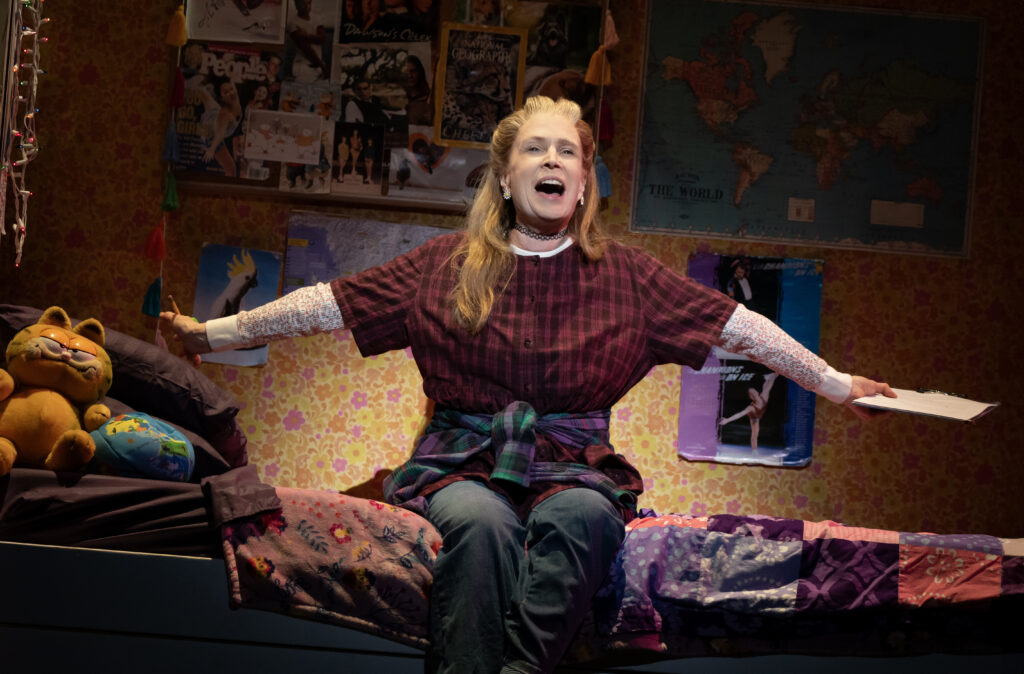






 A PaperStreet Web Design