





The beginning of a troubled royal relationship: Ally Rosenblum and Alex Martinez in Wick Theatre’s Camelot (Photos by Amy Pasquantonio.)
By Britin Haller
There are musicals we enjoy, and then there are the ones we feel compelled to tell everyone within earshot about, so sound the trumpets because we’re so convinced you’ll love the old-school revival of Lerner & Loewe’s Camelot, now playing at The Wick Theatre, we’ll stake our reputation on it. This is definitely your parent’s Camelot.
Veteran Director Norb Joerder brings a steady assured hand to this masterpiece of a Camelot, with a clarity of vision throughout from the casting to the pacing to the performances. The result is a production that speaks to years of experience and must surely stand among the highlights of his career, if not the pinnacle. If this isn’t Joerder’s magnum opus, we want to see what is.
And well it should be because Joerder has been involved with Broadway revivals of the musical Camelot for over forty-five years, first on stage as a knight in 1980, then as the director and choreographer in 1993, even working with Richard Burton, Richard Harris, and Robert Goulet among others along the way.
Full of spectacle and warmth, and sure to produce what’s known as theatrical joy in the harshest of critics, Joerder’s Camelot is a richly-staged extravaganza capturing both the grandeur and the humanity of this enduring legendary tale. If you ever needed a reason to wonder why people still talk about Camelot over six decades later, this is it. And with a cast this strong, particularly an exquisite Guenevere who anchors them, this becomes more than a revival, it becomes canon.
Camelot doesn’t start at the beginning of King Arthur’s life. Based on the novel The Once and Future King by T.H. White, we are dropped in after the legend has already been in motion for a while. We are walking into a story where Arthur has already pulled the sword from the stone, become king, built Camelot into a shining ideal, and made at least one “mistake” that has been prophesized to be his downfall.
When our story opens, Arthur is about to lose his long-time mentor, a wizard named Merlyn (White’s spelling, same beloved wizard) and meet-cute with his intended bride Lady Guenevere, a true damsel in distress who’s arriving by carriage.
Before the story ends, Arthur makes Guenevere his queen, gains a “best friend” in Sir Lancelot, reunites with another mentor named King Pellinore who has misplaced his own kingdom, creates the Knights of the Round Table, and is forced to confront that “mistake,” a thrown-away fly-in-the-ointment illegitimate son named Mordred who has come to Camelot for his revenge.
Let’s start with the obvious. This is simply a beautiful show. Visually, it embraces the storybook quality of Camelot, with lush costumes and a sense of pageantry sure to soften the hardest of hearts. And with a stellar cast, an incredible score, and a surprising emotional depth, the almost three-hour runtime flies by. It’s not often we leave wanting more, but want more we did.
And the energy! There’s a palpable sense that the actors are genuinely enjoying themselves, something that isn’t just a bonus, it’s essential. They’re clearly having a wonderful time, and that enthusiasm radiates outward, creating the kind of connection with the audience that musical theater thrives on.
At times it feels like everyone is running into everyone else, and that’s the point. Theater thrives on moments where the characters crash into each other emotionally and physically, and this production leans into that to great effect, creating a stage that feels constantly alive, and more importantly, constantly in motion.
At the center of it all is Queen Guenevere. This is not an easy role to land. Guenevere has to move from girlish anxiety to queenly composure to emotional unraveling, all while convincing us that she could inspire devotion in two very different men.
That entire arc lives or dies on casting, and here it absolutely lives. Has there ever been a more perfect Guinevere than Allyson Rosenblum? We think not. In fact, they could’ve searched far and wide over kingdoms and realms and not found anyone more ideal.
Rosenblum brings a lightness and intelligence to the early scenes, making her initial resistance to her marriage feel understandable rather than petulant. We feel her growing love for her husband day by day, and so by the time we reach the climax of the story, there’s a real sense of consequence in her choices. We understand how she got there, even if we wish she hadn’t.
Arthur is equally well-served by Alex Martinez who brings a thoughtful precision to Arthur that feels reminiscent of the classic Lerner & Loewe leading man, where the challenge lies not in bravado, but in revealing the humanity beneath it. It’s very easy to play him as either overly noble or vaguely dull, but in the hands of master thespian Alex Martinez, Arthur comes across as thoughtful, slightly awkward, and deeply human in the best possible way.
The early scenes in the forest, where Arthur meets Guenevere without revealing who he is, and wins her over with an owl, are handled with warmth and just enough humor to make their connection believable. More importantly, as his kingdom begins to fracture, Martinez carries the weight of that collapse without tipping into melodrama. His final moments land exactly as they should, not as a grand tragic spectacle, but as something quieter and more reflective. It’s a performance that deserves to be applauded come awards time.
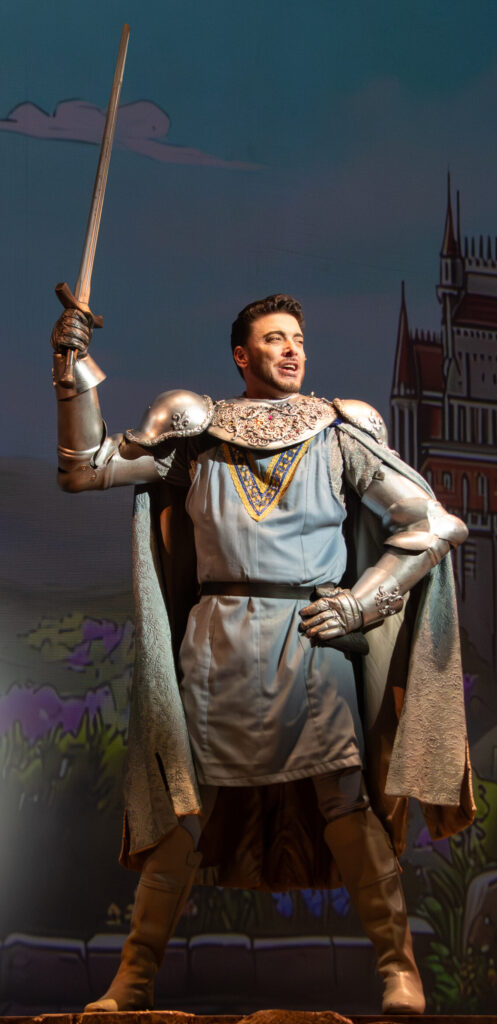
Jesse Luttrell
And look at Jesse Luttrell quickly becoming the name on everyone’s lips in the small world known as South Florida theater. After fabulous turns as the cape-wearing El Gallo in two different regional productions of The Fantasticks, Luttrell dons another one here as the swashbuckling Sir Lancelot.
There’s an elegant full-circle moment for Luttrell, who is certainly having a moment as the go-to Robert Goulet in town, first playing El Gallo and now Lancelot, two of Goulet’s most beloved characters. Lancelot, aptly named as it turns out, makes his entrance with all the conviction of a man who fully intends to live up to a moniker Monty Python would be jealous of (Lance-a-lot). Stepping into the part requires a certain physical presence, and yes, Luttrell is handsome, but thankfully not only that.
As the passionate stranger who comes in from out of town, Lancelot’s journey from a man who’s so vain he checks his appearance in his sword to a lover possessed by so much vulnerability that he would betray his best friend can sometimes feel abrupt, but in Luttrell’s capable hands, it unfolds with enough nuance that the shift feels real. Lancelot’s chemistry with Guenevere is subtle at first, allowing their relationship to grow slowly, and by the time it ignites, you understand both their attraction and the danger.
The supporting cast is equally strong, with Mark Fishback in the dual roles of Merlyn and King Pellinore. As the absent-minded “Pelly” as they call him, Fishback provides much-needed comic relief without becoming a caricature. It’s a tricky part, because the jokes can feel out of step with the rest of the show if pushed too far, but here they’re grounded in character. We were a tad disappointed that the dog playing Pelly’s pet Horrid was unavailable for the performance we attended, but what a creative and clever idea it was to use a rope as an empty leash.
Fishback as Merlyn, though briefly seen because the fairy Nimue traps him with no escape, makes a distinct impression as Arthur’s friend who lives life backwards, and so knows things others cannot. So don’t walk in expecting a Merlyn-centered story, because Camelot is about Arthur after Merlyn is gone.
We feel his absence, as we do for Aaron Bower as the ethereal Nimue, who likewise, leaves us wanting more. It is admittedly, one of the peculiarities of the show that such striking characters as Merlyn and Nimue appear so briefly, yet leave such a mark on us.
When Bower returns again as Nimue in Act Two, our excitement is short-lived because she is not there to return magic to the world, rather just as a stark reminder that it is gone forever.
On the evening we attended, Nate Colton played young Tom of Warwick beautifully, although we have no doubt that Zoey Madden brings the same lovely innocent spirit on her rotations.
And then there’s Mordred, a character we feel needs some love because he never got it in life, especially from his real father, Arthur, who abandoned him. As Mordred, Elliot Mahon seizes the cartoon villain aspect of the role, and that works, because it’s fun and keeps the tone consistent with the show’s lighter, more whimsical moments. Mahon gives us a Mordred who is played like a serpent with a devilish grin and an obvious passion for causing chaos.
It’s almost like he’s Snidely Whiplash rubbing his hands together while Nelle is tied to the train tracks.
There’s a wicked glint behind everything Mordred says, like he’s already three moves ahead and can’t wait to watch Arthur’s world fall apart. Mahon doesn’t just play the bad guy, he delights in him. You find yourself drawn to Mordred even as he’s setting the world on fire.
Mordred is not a new problem for Arthur, rather an old consequence finally stepping into the light. The legend of Mordred is dark, because Arthur doesn’t become a father in a normal sense. It’s tied to deception and taboo, and in some versions he even tries to prevent the child’s existence because of a prophecy that the boy will ultimately destroy him.
Mordred’s stepfather hated him so much that when Mordred was nine he was given a potion to take ten years off his life. We laugh when Mahon speaks this “throwaway” line, but we feel the pain behind this and want to give him a hug.
And that’s where it gets tragic. Because Mordred isn’t just evil for the sake of it. He’s aware he was unwanted, aware he was feared before he even arrived, and he’s been shaped by that rejection. So his bitterness and chaos don’t come out of nowhere, rather they’ve been cultivated his whole life.
Mordred is the embodiment of everything Arthur tried to forget, now here looking him straight in the face and refusing to stay buried. We know on some level there’s a more layered, more unsettling version of Mordred just beneath the surface that never quite comes into view. But that’s okay because we’re here for entertainment, not a deep dive into the psyche of a flesh-and-blood justifiably-wounded son who’s upset with his deadbeat dad. It’s a delicious performance from Elliot Mahon.
We love an energized ensemble and wish to thank the following cast members for giving it their all: Mya Bodnick, Matthew J. Brightbill, Brandon Campbell, Madeline Dunn, Santiago Garza, Austin Gladstone, Erica Kaylee Gouldthorpe, Amanda Lopez, McKay Marshall, John Luis Mazuelos, Ben Muckenthaler, Julian Perez, Cameron Pomeroy, Daniel Sanchez, Cameron Scott, and Samara Shavrick.
Musically, the production is in excellent hands with the always terrific Musical Director Bobby Peaco. “I know you’re gonna know the songs. Don’t sing them,” Executive Producer Marilyn Wick said as she greeted the crowd, getting a big laugh. Growing up with a mother who played the original Broadway cast Camelot album on repeat (it was America’s top-selling record for six weeks), this was not an easy ask, but we managed to resist.
Peaco treats Lerner & Loewe’s score with respect, allowing the songs to breathe rather than rushing through them. If we didn’t know the instrumentals are pre-recorded at The Wick, we would think there was a ten-piece orchestra playing nearby, thanks to Justin Thompson’s incredible sound design. The score is allowed to unfold with clarity and intention, giving both the performers and the audience room to fully inhabit each song and feel the emotion in the lyrics. And whom do we thank for the overture because we could literally kiss you.
The songs themselves are the stuff of legends.
As Arthur, the potential groom waiting nervously to meet his bride, Alex Martinez hams it up perfectly in a terrific “I Wonder What the King is Doing Tonight.” And his “How to Handle a Woman” can’t help but call to mind Henry Higgins, another well-meaning Lerner & Loewe man utterly baffled by the very concept of the opposite sex. This song carries that same amused frustration, but with a gentler edge, making it one of Martinez, and Camelot’s, more charming moments.
The song “C’est Moi” is a French phrase meaning “it’s me,” and is essentially Lancelot’s grand introduction as a preening man who is convinced of his own perfection, but still deeply sincere about it. Director Joerder wanted to give Lancelot a physical way to express his vanity (show, not tell), and the sword-as-mirror is theatrical catnip because a Lancelot who checks himself out mid-song is already in on the joke.
Baritone Jesse Luttrell also outdoes himself with “If Ever I Would Leave You,” a soaring ballad that Luttrell gives an emotional weight and vocal richness to make it a standout, further tapping into his manifestation of Robert Goulet who made this his signature song.
The haunting “Follow Me” as performed by Aaron Bower as Nimue as she whisks Merlyn away is enchanting. “The Joust” reminds us a more playful “Ascot Gavotte.” “Fie on Goodness” which loosely means “damn goodness” entertains with shirtless knights and fight choreography by Julian Perez, an expert in stage combat training. And “What Do the Simple Folk Do?” with Martinez and Rosenblum as Arthur and Guenevere is clever and cute as Martinez whistles, and they dance together like children.
Mordred’s big number, “The Seven Deadly Virtues” is a showstopper, a song that invites us to revel in mischief disguised as righteousness. Elliot Mahon gets into the impish spirit, delivering each virtue like he has a bad taste in his mouth. Mahon’s physicality does half the work as he punctuates lyrics with exaggerated almost-storybook gestures that make Mordred feel like he just stepped out of a Grimms’ fable, resulting in a controlled but gleefully cartoonish villain who never tips the scale too far.
There’s a personal note woven into “The Simple Joys of Maidenhood” which once served as this critic’s audition song in musical pursuits. It’s a number that looks light and playful on the surface, but requires precision and personality to truly land, and Allyson Rosenblum delivers on both. It’s not an easy number to pull off, but she makes it look easy.
Rosenblum gives us chills during “Before I Gaze at You Again,” and “I Loved You Once in Silence.” She and Martinez deliver the title song “Camelot” with the sense of wonder it deserves generating our smiles as Arthur wins his intended bride over to the wonders of Camelot.
But it’s the “The Lusty Month of May” which is, without question, the star of the show. Choreographed by Madeline Dunn, who also acts as dance captain, “Lusty Month” is staged with pastel dresses and flowers that burst with color to please the eye. But what really elevates it are the harmonies. There is a fullness to the sound that fills the space beautifully, creating a moment of joyful abandon that takes us to church.
Costume designs by Kimberly Wick are stunning. Highlights include, oh who are we kidding, they’re all highlights. Nobody, and we mean nobody, does costumes like the Wick family who also own Costume World, one of the preeminent collections, and rental companies, in the business. Wigs by Tanner Pippert accentuate the natural beauty of Allyson Rosenblum and Aaron Bower.
The production design by Kimberly Wick and Ann Cadaret is subtle and effective, allowing the actors to play downstage while giving them room to move around, and reminding us that less is often more because our minds can fill in the rest. A simple platform with stairs, and stunning background visuals by projection designers Josieu Jean and Kacey D. Koploff place us in the middle of a forest, on a hillside outside the castle, or in a fiery explosion. Our only suggestion would be showing us time jumps somehow, like was done in The Wick’s recent A Christmas Carol, because not everyone follows along in the Playbill like critics tend to do.
Any production of this magnitude does not happen in a vacuum. Like a well-oiled machine, the behind-the-scenes designers and crew work tirelessly to create the world we see onstage, and we would like to shine a spotlight, so to speak, on a few people who may traditionally get overlooked when reviews run long.
Many of us know the name Clifford Spulock as one of the preeminent lighting designers in the area, but did you know his head electrician, Desiraé Merritt, actually runs the boards during the shows? Or that two of the best spotlight operators in the business, Douglas Walker and Leslie Wolfe, are ready at the whip to make sure the actors are illuminated with teardrop precision? Or that Stage Manager Naihla Mancuso, who is assisted by Micaela Mercado, is the glue who holds them all together?
History Lesson: Launching Camelot for the first time proved to be plagued with problems including major medical issues for both the director, Moss Hart, and Alan J. Lerner and a runtime of over four hours. After significant trimming, it finally opened on Broadway in late 1960 starring Richard Burton, Julie Andrews, and Robert Goulet, winning four Tony Awards including Best Actor for Burton as Arthur, but losing out to Bye Bye Birdie for Best Musical. Sadly, Hart died a year later.
Camelot has since been revived on Broadway in 1981, 1993, and 2023, although the latter version sported a new book by Aaron Sorkin that included a modernized take and was licensed for a small cast. It received mixed reviews and although nominated for five Tonys took none home, and touring plans were axed. A 1980 limited-engagement revival at Lincoln Center with Richard Burton celebrated the show’s twentieth anniversary.
A 1967 film starring Richard Harris was reportedly supposed to feature Rock Hudson as Arthur, but after the project was delayed for years, the role was recast to Harris, who then went on to appear in the 1981 Broadway revival also filmed for HBO. Hudson, meanwhile, did eventually portray Arthur in a 1977 regional tour.
While at The Wick, don’t hurry past the costume display near the entrance where a vivid green, kingly outfit, said to have been worn by Hudson during his turn as Arthur, offers a regal echo of Camelot’s past.
So in the end as the lights come up, you may find yourself asking practical questions like Who ends up where? What happens next? Why did this character vanish? And this is as it should be because the ideals of Arthur (justice, equality, chivalry) really are too good to be true, and so it’s only fitting that Camelot drifts into its ending like a kingdom dissolving into mist.
Director Norb Joerder calls Camelot a “magical fairytale and love story,” and it is, although without a happily ever after, but his vision of this timeless legend is so much more. His vision doesn’t just revisit that classic, it reaffirms why it continues to enchant audiences generations later. It’s effortless (or appears to be), and deeply satisfying, leaving its’ audience with a rare sense of having witnessed something special, that mystical quality that only live theater at its best can truly provide.
Don’t let this carriage pass you by. Long live Camelot, indeed.
A note to theater owners in general: In nearly every production we attend someone’s cell phone goes off. So we’ve come up with some suggestions for you. Make the “no cell phones” announcement impossible to tune out by having a recognizable voice deliver it, a recording specific to each show, like in this case, Merlyn or Lancelot. Or better yet, Queen Guenevere. Train your ushers like jousting knights.And if worse comes to worst, just have Douglas Walker pinpoint them with his laser-focused spotlight. We guarantee they’ll learn their lesson.
Camelot plays through April 12 at The Wick Theatre & Museum Club 7901 N. Federal Highway, Boca Raton FL; 7:30 p.m. Thurs-Sat; Matiness 2 p.m. Tues, Wed, Thurs, Sat & Sun. Running time approximately 165 minutes includes an intermission. Tickets starting at $99. Call 561-995-2333, or visit thewick.org.
Britin Haller is a journalist, editor-for-hire, and an author who serves on the board of directors for the Mystery Writers of America Florida Chapter. As a celebrity wrangler, Brit regularly rubbed elbows with movie, sports, and rock stars, and as a media escort, she toured with NY Times bestselling authors. After appearing in local musicals and all-state choir, Britin studied theater at Indiana University (a Big 10 college) and the University of Evansville (Rami Malek’s alma mater).

The Lusty Month of May






 A PaperStreet Web Design