



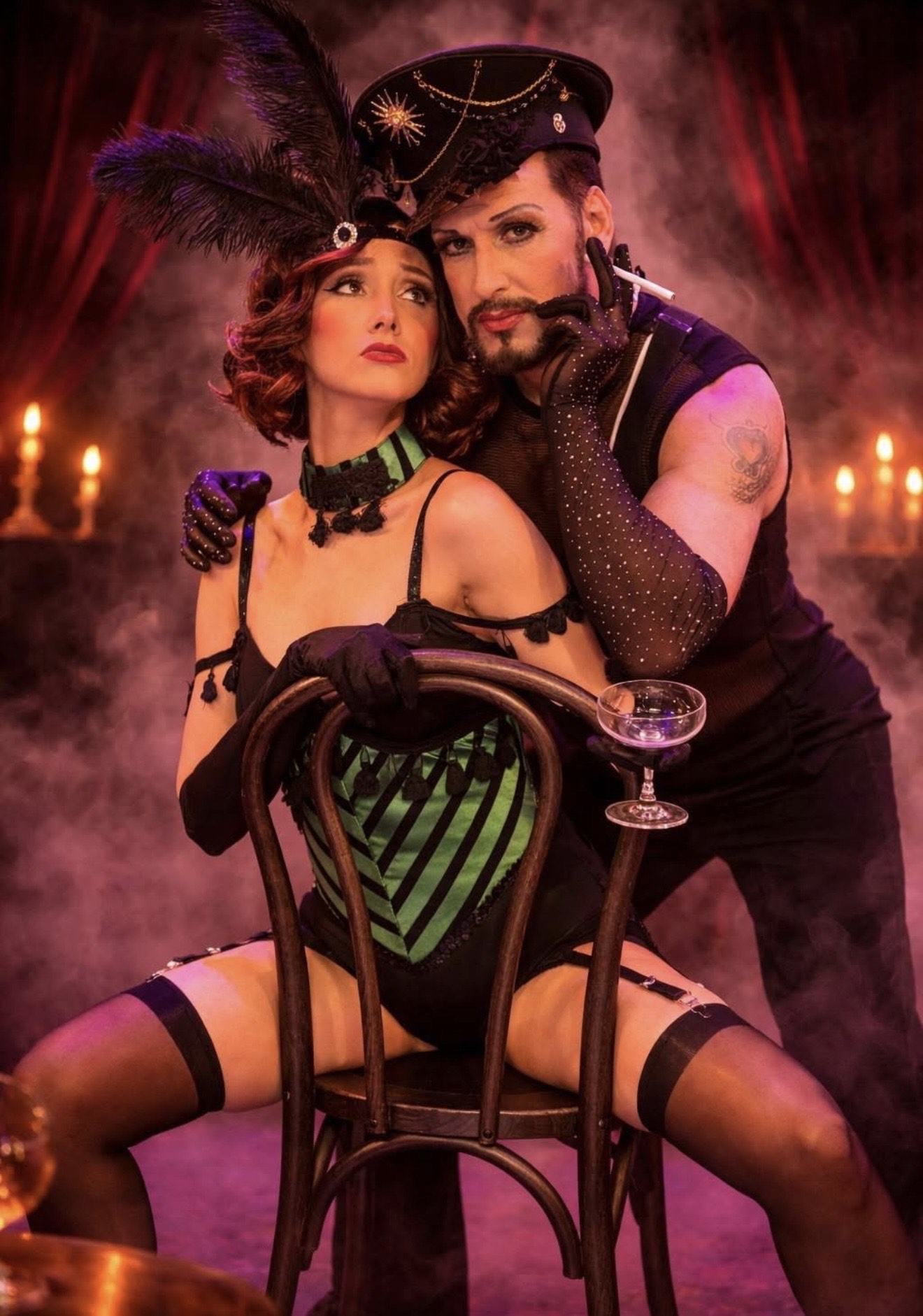
Alexandra Van Hasselt and Larry Buzzeo in ArtBuzz Theaztric’s Cabaret (Photo by Patty Kopelman)
By Britin Haller
Think you know the musical Cabaret? Well, think again, because there’s a new Kit Kat Club in town, and this one will shock and surprise you. Now playing at the Empire Stage in Fort Lauderdale, ArtBuzz Theatrics and Florida Theatrical Events bring us Sam Mendes’1998 Broadway revival version that starred a very sexual Alan Cumming as the Master of Ceremonies, a.k.a. the Emcee, and is widely known as the “dark one.”
After that revival, it became nearly impossible to stage Cabaret as a charming period piece as some view the film version because the darkness had been let in.
It’s hard not to compare any stage production of Cabaret to Bob Fosse’s legendary 1972 film because hello, Joel Grey, Michael York and Liza Minelli. But this is not that story. Here, Larry Buzzeo’s direction is masterful, showing us a world that’s not just collapsing, but one that says “Welcome, the collapse is here, and you’re in it. Also, have another drink, darling.”
If the original production merely suggested that fascism might be something worth paying attention to, this Mendes’ revival lights a cigarette, stares directly into our souls, and asks us why we think we would have been one of the good guys.
In other words, this interpretation strips away any lingering sentimentality while dragging us into the alley and smearing our lipstick.
And we like it.
It’s 1930’s Berlin during the end of the Jazz Age, and entertainer Sally Bowles is performing nightly at a local cabaret when her world is rocked by the appearance of a handsome, young American novelist named Clifford Bradshaw. Before too long, the couple is dealing with financial issues, an unexpected pregnancy, and the rise of the Nazi Party.
Not light-hearted themes at all, so thank goodness for the Emcee, and The Kit Kat Club, to help us forget that Adolph Hitler is not going away, and the enemy, in fact, may be closer than we think.
They say there’s no such thing as an overnight success. Usually what is thought to be that is actually the result of years, or decades even, of consistent work. What we do know is that Larry Buzzeo, a longtime staple in our community and founder of ArtBuzz Theatrics, is having quite the year. After bringing down the house as Jacob Marley and Bob Mackie in two recent local productions, Buzzeo is not missing a beat in another demanding part seemingly made for him to occupy, that of the Emcee at The Kit Kat Club.
Joel Grey’s Emcee in the original was almost childlike, while Alan Cumming turned the role into something openly sexual and almost feral. Buzzeo resembles more of Cumming, but nevertheless puts his own spin on the character giving us an Emcee who’s brazen, tawdry, and slick, yes, but also seems otherworldly, and all-knowing, with great eye-liner. Like he already knows how this is all going to end. It’s another phenomenal performance by Buzzeo, and we can’t wait to see what he does next.
Well done to Buzzeo also for turning what was a minor costume malfunction into a clever bit while not only staying in character, but adding a nice touch to the action on-stage. We wish all actors would have this “show must go on” attitude when something unexpected happens, and not simply stick their heads in the sand. It’s a mark of a true professional.
In the role Liza Minnelli made famous and won an Oscar for, Alexandra Van Hasselt fills Sally Bowles’ high heels admirably while painting a completely different portrait of her. Van Hasselt’s Sally is a contradiction, tough but also needy, and willing to do almost anything to survive. She wants love, but also love is messy.
This Sally is not a star, although she wants desperately to be one. She’s fragile, selfish, funny, and totally unequipped for life. In other words, she’s heartbreakingly human.
Van Hasselt holds us in the palm of her hand with her raw rendition of “Maybe This Time,” a number that exposes Sally’s true hopes and vulnerabilities. Van Hasselt lays it all out there, holding back nothing, and the result is so mesmerizing, we could have heard a pin drop as the audience held their collective breath. Surprisingly, “Maybe This Time” was not in the original Broadway score, but fun fact, it actually predates the stage musical, having been recorded by Minnelli in 1964.
And look out South Florida because Chad Raven (and his Michael York jawline) is here to steal your heart. Raven possesses the sort of old Hollywood magnetism that made women swoon when Marlon Brando and James Dean walked by, but Raven is so much more than a pretty face.
When we last reviewed him elsewhere, we recognized his leading-man potential, saying “We would love to see Raven perform after he has a few more roles under his belt.” That day has come, because while last time we saw promise, this time we saw proof.
Raven brings a newfound confidence and maturity to the role, and as his presence onstage continues to grow, so too will his ability to claim the major roles he is proving he can carry. Raven has undeniable star quality, a name that sounds like it was invented by Central Casting, and the cheekbones of a romance novel hero who smolders near a cliffside manor. In short, Raven was born to have his name lit up on a marquee.
As Sally’s love interest and leading man Clifford Bradshaw, Raven commands us as the struggling American novelist in Berlin to finish his book. A brief encounter with a man teases that Cliff may swing both ways, or is it more he kissed a guy and liked it? What we do know is that Cliff remains fiercely loyal to Sally and her baby, regardless of whether he is the child’s father.
Most of the action takes place in one of two places, the sleazy Kit Kat with cabaret acts sure to titillate, and the downtrodden boarding house run by an older spinster, Fräulein Schneider, who has a lot of rules for her renters. Mostly don’t have sex within her walls.
Meanwhile, her downstairs elderly lodger, Herr Schultz, romances her by bringing schnapps and fruits from his grocery store while trying to convince her he’s dateable.
As Fräulein Schneider, Elissa D. Solomon is dynamite in a small package, barking out orders to Fräulein Kost, a “working girl” who brings home the occasional sailor and needs this income to pay the rent. Abbie Fricke, who has a beautiful voice and an angelic look with pin curls, appears as Kost, who is surprisingly much deeper than she appears on the surface. As Clifford’s “friend” Ernst, Charles Page is the perfect blend of savior and traitor.
But it’s the man of a thousand faces, character actor Michael H. Small as Herr Schultz, a kindly old German Jew longing for love again before he dies whom we remember long after the lights have dimmed. His slow-building romance with Fräulein Schneider, along with their duets (one over a pineapple!) are a glorious highlight.
Alexandra Van Hasselt’s mother Melanie Moore Van Hasselt wears a multitude of headpieces as producer, choreographer, set/wardrobe design, musical production and staging. The set is sparse, but we don’t feel deprived because we’re immediately thrust into the illusion of a Kit Kat Club that’s a sweaty, dangerous, sexually-charged underworld, and to be honest, a hell of a fun place to be.
Bringing that fun are Anthony Lobo, Caroline Macchiarola, Laura Swartzendruber, Abbie Frick, and Charles Page as the Kit Kat girls and boys (a boy is canon to the OG 1966 Broadway musical, but not the film.) Dance Captain Lobo is most hilarious in turns as a costumed monkey, Helga the Kit Kat boy with striking drop earrings and tasseled pasties stuck over his nipples, and wearing a tutu in “Don’t Tell Mama,” an energetic dance number with the Kit Kat dancers mimicking a bumpy car ride.
Now about those incredible costumes on loan from the Van Hesselt’s private collection. Playing dress-up must take on a whole new meaning when you grow up with a mom like Melanie because apparently the family attic contains the sort of treasures most theaters can only dream about. While the rest of us were fashioning crowns out of construction paper and tape, Melanie’s kids were surrounded by garments ready for their own Broadway curtain calls.
The extraordinary and haunting Kander and Ebb score includes songs that might seem playful on first listen, but take on sharper edges in context, like “Money,” where the Emcee takes turns paying the Kit Kat dancers for acts of depravity, the sinister “Willkommen” in which he greets us with a wink and a smirk, and his solo “I Don’t Care Much,” where we in fact think he cares very much. Buzzeo’s falsetto is lovely here.
There’s a playful rebellion in “Two Ladies,” with the Emcee simulating sex behind a curtain with a girl and boy dancer tressed in blonde braided pigtails. “Mein Herr,” which along with “Money” was brought in from the film version, is a sexy dance with chair choreography.
And then there is the title number.
“Cabaret” remains one of the greatest eleven o’clock numbers in the Broadway Playbook because it should function simultaneously as liberation and surrender. Sally insists life is a cabaret. Life is beautiful. Life is for living. And yet the harder she pushes that narrative, the more obvious it becomes she is trying to outrun herself.
The song is both triumphant and tragic, and Alexandra Van Hasselt made us feel every feel of Sally’s aching denial that she didn’t just ruin the thing she claimed to desire the most.
Musical Director Bobby Peaco created pre-recorded tracks that work beautifully in the small venue and with the big voices. Lighting and sound design by Preston Bircher and David Hart, respectively, work in tandem to turn the intimate venue into a bustling cabaret club of the 1930s. And as usual, the man we like to refer to as “The Wizard of Empire Stage,” Stage Manager Patrick Vida, plays his light, sound, and music boards like a fiddle from a corner of the room, never missing a cue.
Few musicals have undergone as dramatic an identity crisis as Cabaret. Depending on when you saw it and who directed it, it’s either a glittery, decadent musical extravaganza with a warning tucked into the final moments, or a full-scale descent into moral turpitude with sequins. But the version that changed everything, and arguably became the definitive interpretation for modern audiences, is this one, a jarring reminder that Cabaret was never supposed to make us comfortable.
Because Director Buzzeo wants to leave us speechless as we exit the theater, he’s decided to forgo the traditional curtain call, instead opting for a powerful image from the Emcee, and a fade-to-black. While we may not necessarily agree with that decision, we respect it. But to everyone involved with this production, please know we are clapping and cheering for you now.
So, who is the Emcee really, and what does he represent? We spoke with Larry Buzzeo about his character, and we agree that the Emcee is everyone, and no one, in particular. The Emcee’s job is to entertain and humor us with his wild antics, many sexually suggestive, but also to hold a mirror to us (which he literally does at one point) asking us to ask ourselves “Wait, are we the villains here?”
But the real genius of Cabaret lies in its refusal to provide easy villains. Certainly, the Nazis are villains, yet again and again, complacent characters convince themselves that things aren’t that bad. It will all blow over. Someone else will intervene.
Because beneath the fishnets, jazz hands and smoky eye makeup lies one of musical theater’s most unsettling observations about human nature — that people generally don’t recognize history while they’re living through it.
Cabaret isn’t Mamma Mia! where a critic’s biggest challenge is finding fresh ways to say “Everyone looks like they’re having a marvelous time.” Cabaret practically screams “Here’s why this particular production matters right now. Here’s why audiences should care.”
Subsequent productions have varied, but most owe an enormous debt to Sam Mendes’ willingness to trust the audience with discomfort, recognizing that Cabaret’s enduring relevance isn’t accidental. Every generation believes it would recognize danger in time. Every generation congratulates itself on being more enlightened than those who came before.
Cabaret suggests otherwise. To quote George Santayana, Cabaret reminds us that “Those who cannot remember the past are condemned to repeat it.”
Cabaret asks you to ask yourself, “What would you have done?” What would you have ignored? What compromises would you make? What jokes would you laugh at?” Suddenly, we are forced to ask ourselves, what did we just laugh at for two-hours plus?
Cabaret continues to resonate sixty years after its’ Broadway debut. It entertains brilliantly. It seduces shamelessly. It features an extraordinary score by Kander and Ebb that veers effortlessly between humor and heartbreak.
Certainly, this review was not intended to become a dissertation on the death of democracy, the seductive danger of complacency, or whether art has a moral obligation to confront audiences. Then again, neither was the original Cabaret.
And yet, here we are.
“Life is a cabaret, old chum.”
So, in the end, there is no good sitting alone in your room when The Kit Kat Club beckons. Go be thoroughly entertained by Larry Buzzeo and his motley crew, just be prepared to confront truths about yourself that may surprise you. Get there early to enjoy an immersive experience.
This production is dedicated to the memory of Alexandra’s grandfather, Edward Van Hasselt, a Dutch Jewish entertainer who played European cabarets like The Kit Kat Club during the 1930s. Tragically, Edward’s immediate family perished in a concentration camp.
“First, they came for the socialists, and I did not speak out because I was not a socialist. Then they came for the trade unionists, and I did not speak out because I was not a trade unionist. Then they came for the Jews, and I did not speak out because I was not a Jew. Then they came for me, and there was no one left to speak for me.” — Martin Niemöller
Cabaret plays through Sunday, June 28 at Empire Stage, 1140 N. Flagler Drive, Ft. Lauderdale (two blocks north of Sunrise, east of the railroad tracks); Thursday, Fridays and Saturdays at 8 p.m.; Sundays at 5 p.m. Some performances are already sold out. Running time approx. 150 minutes includes an intermission. General admission tickets are $45. Call 954-678-1496, or visit empirestage.com.
Britin Haller is a journalist, editor, and author who serves on the board of directors for the Mystery Writers of America Florida Chapter. As a celebrity wrangler, Brit regularly rubbed elbows with movie, sports, and rock stars, and as a media escort, she toured with NY Times bestselling authors. After appearing in local musicals and all-state choir, Britin studied theater at Indiana University (a Big 10 college) and the University of Evansville (Rami Malek’s alma mater).
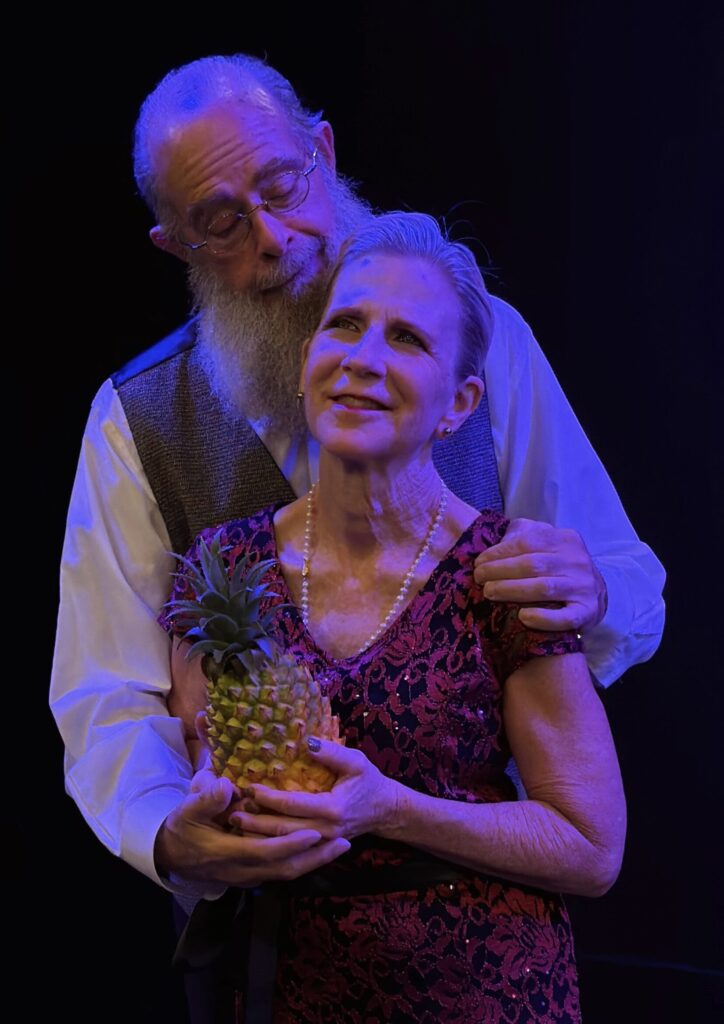
Michael H. Small and Elissa D. Solomon (Photo by Caroline Macchiarola)





 A PaperStreet Web Design