







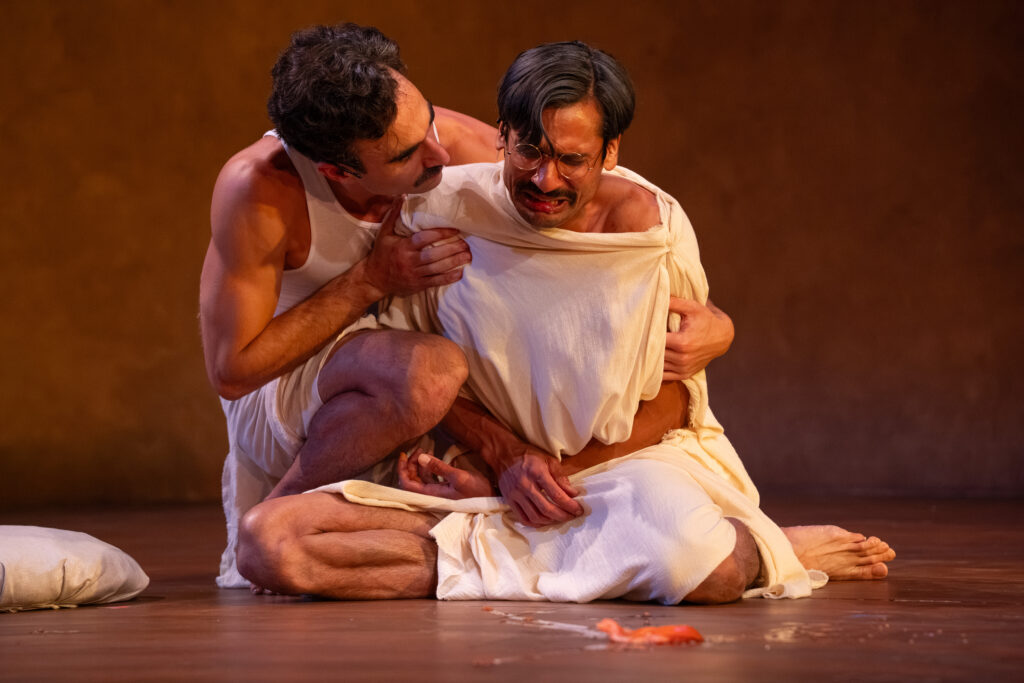
Max Katz as Kallenbach and Keshav Moodlair as Gandhi in Miami New Drama’s world premiere Gandhi and the Jew (Photo by)
By Bill Hirschman
Gandhi and the Jew certainly achieves one of its goals in investing humanity and recognizable dimensions on an otherwise revered icon in a message play often infused with wry humor.
But perhaps its real worth lies in depicting the resonating similarities and yet crucial divergence of idealistic ideologies that have transformed world-wide schools of thought. It paints earnestly evolving revolutions rooted in brotherhood and mutual humanity colliding without a resolution.
That may sound like a dry esoteric lecture, but Harley Elias’ world premiere at Miami New Drama embraces dry wit, searing outrage, profound love, compelling political philosophizing – all passionately propelled by director Margot Bordelon and cast Max Katz and Keshav Moodliar.
Based on hundreds of their unpublished letters, it portrays Mohandas Karamchand Gandhi, an Indian civil rights lawyer in South Africa, and Hermann Kallenbach, a Jewish Lithuanian refugee architect in Johannesburg in 1904.
They start out as roommates sounding reminiscent of a college dorm, bantering quipping, joking and arguing how to wash clothes. They even dub nicknames: Upper House for Gandhi and Lower House for Kallenbach, riffing on the two chambers of the British Parliament.
They are bright, witty and vibrant young men grinning as they plot protests such as Indians burning their restrictive registration cards.
But over time they articulate their separate evolving searches in a fusion of moral and political precepts. Their overlapping aspirations bond them personally but also as close allies in Gandhi’s growing nonviolent campaign to force the racist post-British rule of South Africa to end segregation and to grant India residents equal protection rights.
The first act tracks their intensifying efforts to achieve their goals through nonviolence, disobedience and profound personal commitment in the face of imprisonment and physical retribution.
Both men pointedly sacrifice careers, family and, notably, pure sex. In Gandhi’s case, he confides in a heart-breaking scene how ungovernable lust drove him to have sex with his pregnant wife when the father he was nursing was in the last throes of dying.
With self-disgust, he says, “I was playing my role, in a world that taught me to privilege my lust over everything. Over her desires. Over my father’s life. … Can you imagine the filth that has always been on me? I… killed my father. I cursed our family.” A scene and an entire sensibility missing from Richard Attenborough’s film.
One of the most intriguing aspects is depicting how profoundly these two men loved each other. Perhaps not sexually, but undeniably in this production they have an emotional, physical and spiritual intimacy rivaling that in many marriages. They call each soul-mates, and they often end up face to face inches from each other or in each others’ arms.
But the two disconnected when Gandhi agreed to return to India in a political exchange for those rights being enacted. For 23 years, the two lose all contact for reasons are not quite clear here.
Then in the second act in 1937 on the eve of Kristallnacht, Kallenbach returns to the now transformational luminary Gandhi in India. Their evolution is reflected in the names they now use for identity: Gandhi now accepts the honorific title Mahātmā, meaning great-souled. Kallenbach reverts to his given Hebrew name Chaim, meaning “life.”
Kallenbach has come from Palestine where Jews are trying to create a homeland of their own and divest themselves of British rule, especially given the closing nightmare that Hitler has begun. Asked by their leaders, he pleads for Gandhi to publicly endorse the cause.
But Gandhi balks at what he sees as a different situation. Kallenbach counters that the central concept of their campaign in South Africa was the idea of self-rule which Gandhi expounded in a text that Kallenbach translated into English for world consumption.
In a devastating scene, Gandhi challenges Kallenbach’s commitment to nonviolence and acceptance by agreeing to mediate between the Jews and the British if Kallenbach will agree to pray for Hitler even if he means to wipe out Jews, this as an affirmation of an extreme commitment to nonviolence. As effective carved in this production, you may wonder for a bit how this will play out.
Although Gandhi finally pledges some form of support, later he backs into a fatal reversal, creating an unrepairable rift.
Elias cites the seemingly fraternal connections between their goals. For instance, together they create a freedom-committed ashram in South Africa that Kallenbach equates to Palestine’s kibbutzim. But he has both men cross-examine each other’s crucial view about acceptance and nonviolence’s effectiveness in this extreme circumstance.
Kallenbach argues: It’s the first time in millennia, that Jews have even the smallest glimmer of hope of self-rule….You wanted a different kind of nation, one without Western Civilization, industry, capitalism, machines, and that’s what they’re doing, an agrarian society, a rejection of the West!… I sat there, typing the words of Hind Swaraj into the typewriter, my fingers on fire as the rain beat against the tent, my soul lit up. Hearing the clarion call of your vision for a nation, for a people truly free. You wrote a rallying call…Now I have finally found a way to hear the call, and you tell me it’s not for me? … Why are we the only ones unworthy of an identity worth fighting for?
Elias pens rapid-fire articulate dialogue often enhanced by brief near poetic passages. But his skill as a playwright, the direction and the skills of the two actors coalesce perfectly in key scenes like Hitler debate and the sexual confession.
Granted, the sophisticated political and philosophical discourses are inherently overwhelming. Indeed, Elias and Bordelon take a chance and race them by with more emphasis on the passion driving their speakers.
And like so many semi-historical plays set in an unfamiliar time or place for today’s audience, some or much of the audience needs a context, a background from the social forces to historical events being reeled off in chronological order. In many plays, this can be borderline boring as you wait for the dramatic conflict to resume.
This play deals with it by spending much of the first act by having these two charming energic characters proudly, even gleefully speaking directly to us as recollecting storytellers, introducing scenes, commenting on them, acting as other people such as the country’s infamous leader Jan Smuts.
Their success is a quartet’s melding of their skills but especially the direction of Bordelon who headed the company’s English Only and When Monica Met Hillary. She deftly paces scenes which ricochet from introspection to fury and back. A dramatic passage may end with a wisecrack.
Max Katz inhabits Kallenbach with the kind of youthful energy of someone searching for an answer, and, once finding it, becomes an apostle. Keshav Moodliar succeeds in creating a flesh-and-blood human being full of joys, fury, frustration and regret that some other laudatory depictions have backpedaled.
The set designed by Christopher and Justin Swader uses colors subtly evoking both countries. The lighting by Oliver Watson and sound by Sinan Refik Zafar provide scores upon scores lightning snaps of punctuation to the dialogue.
This marks Elias’ fifth production with Miami New Drama, notably with the Carbonell-nominated Todo Lo Que Dye and with Bad Dog, the complex comic satire with thematic underpinnings – a far cry from this piece even with its replete humor.
Opening its 10th season, this is the third play that Miami New Drama has commissioned in its Jewish Play Initiative. The company’s identity has always been for its works to reflect Miami’s diverse culture encompassing Hispanic, Anglo and Jewish themes.
This play should find future productions in its engaging depiction of nascent hopeful dreams and then the difficult reality of their coming to fruition.
Gandhi and the Jew plays through Nov. 29 at Miami New Drama, Colony Theatre,1040 Lincoln Road, Miami Beach. Performances 8 p.m. Thursday-Saturday, 2 p.m. Saturday 3 p.m. Sunday. Running time about 2 hours 20 minutes with one intermission. Tickets $45-$99. Box Office 305-674-1040 or boxoffice@miaminewdrama.org.
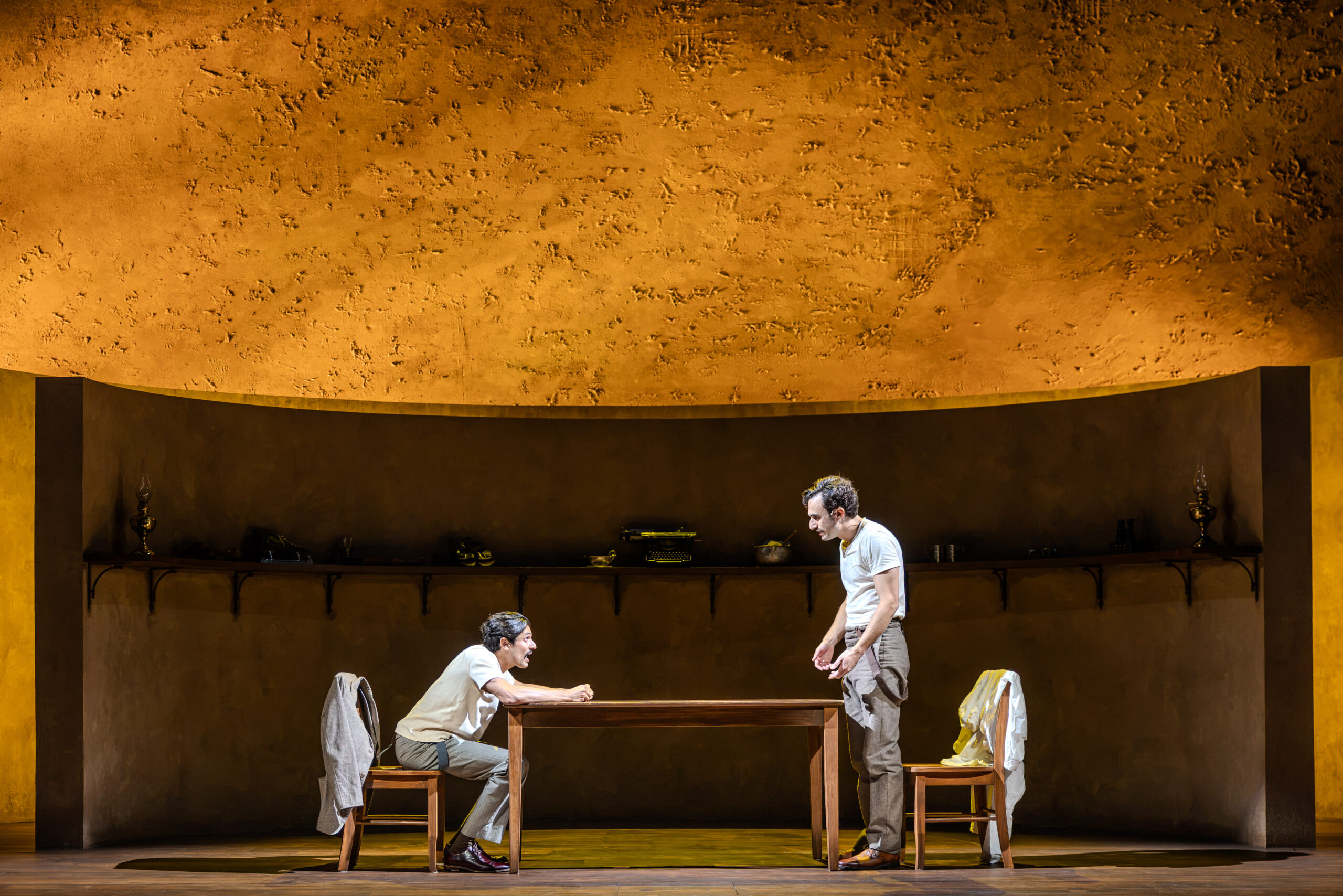
Photo by set co-designer Justin Swader








 A PaperStreet Web Design