






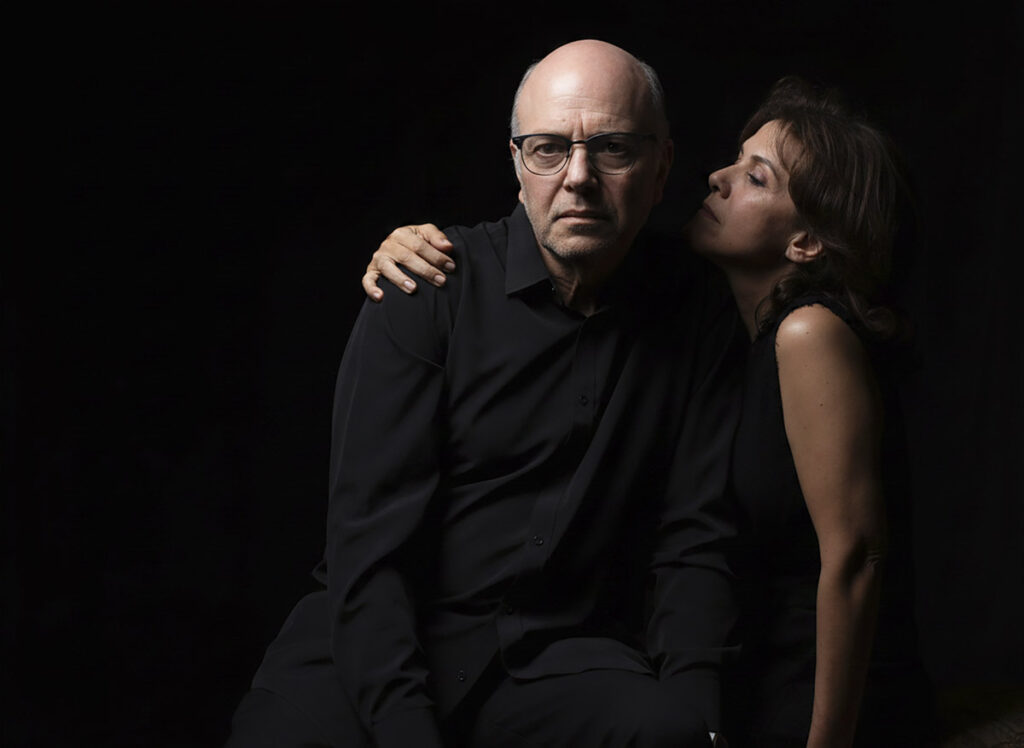
Carlos Acosta Milián as Willy Loman and Rosalinda Rodríguez as Linda Loman in Arca Images’ “Death of a Salesman.” (Photo courtesy of Arca Images)
By Michelle F. Solomon / ArtburstMiami.com
Pulitzer Prize-winning playwright Nilo Cruz had the idea of bringing Arthur Miller’s great American classic, Death of a Salesman, to a Hispanic audience. Alexa Kuve, founder and artistic director of Arca Images, had been looking for a way for her company to mark America’s 250th anniversary.
The play bridged the two ambitions.
Miller’s Willy Loman has spent more than 75 years chasing the American Dream.
For Kuve, presenting Death of a Salesman in Spanish in Miami doesn’t change that story. It may, in fact, bring it closer to an audience that knows something about starting over, striving to succeed and discovering that the promises attached to that dream don’t always come true.
Arca Images presents Death of a Salesman (La muerte de un viajante) through Sunday, Aug. 30, at the Westchester Cultural Arts Center with simultaneous audio English translation.
A Tony Award-winning Broadway revival of the 1949 Pulitzer Prize-winning drama just ended its run on Broadway. The enduring American play follows Willy Loman, an aging traveling salesman confronting the collapse of the life he believed he was building for himself and his family. Willy’s faith in success is distilled in one of the play’s best-known lines: “Be liked and you will never want.” For Kuve, that drive toward recognition is part of what makes the story feel so current.
“It’s a universal dream of hope, of being someone in life, getting somewhere in life, your children to succeed in life, to be important, to become someone,” she says.
For immigrants, Kuve says, that pursuit can carry even more weight.
“I think it even takes another dimension because it’s becoming someone in another country that is not yours,” she says. “Most of the time, starting from scratch.”
That idea is not theoretical for Carlos Acosta-Milian, the Cuban-born actor playing Willy.
Acosta-Milian left Cuba, lived and worked in Spain and eventually came to Miami in 2012, rebuilding both his life and his career along the way.
“I know what it means to start over — and not just once, but several times,” he says.
He landed in Spain as an established actor only to discover, he says, that much of what he had already accomplished didn’t carry the same weight in a new country. Then came another beginning in Miami.
“I arrived in Miami with almost nothing, without money, without guarantees, and already in my forties,” Acosta-Milian says. “At that age, you no longer have the body or the innocence of someone in their twenties. Every new beginning weighs more.”
It is one reason he understands Willy as more than one of American theater’s iconic roles.
“Willy Loman lives exactly in that territory: the territory of a man who feels he has arrived too late, that the world has changed and he no longer knows how to fit into it,” Acosta-Milian says.
The role was one he had dreamed about but never expected to play.
“Willy is one of the great summits of world drama, and certainly of American theater.”
Cruz and Acosta-Milian have a long artistic collaboration. The two have worked together on productions including “Lorca en un vestido verde,” “Baño de luna,” “Exquisita agonía,” “Dos hermanas y un piano,” “Sed en la calle del agua” and “Tres veces Cruz.”
Acosta-Milian recalls Cruz telling him after the pandemic: “I want to do ‘Death of a Salesman,’ and I want you to play Willy Loman.”
There wasn’t a hint of hesitation in accepting the role.
“I said yes right then and there. That was when the project was born. From that moment on, it began to take shape, to grow, to find its moment, until finally becoming a reality now, in 2026.”
Cruz is co-directing the Arca Images production with Samantha Pazos, a director he has previously mentored and worked with on productions of his work including “Two Sisters and a Piano” and “Anna in the Tropics.”
Kuve translated and adapted Miller’s play for the production, but it doesn’t attempt to transform the Lomans into a specifically Latino family.
“There is no reference to the characters being American or Hispanics,” Kuve says. “It can easily be (a) Hispanic family, but it can be an American family. It’s just that we’re doing it in Spanish.”
Acosta-Milian believes the language itself changes the audience’s entry point into Miller’s world.
“To translate a work like this is not simply to change words,” he says. “It is to open a door for the Latino spectator, so that they can enter the story through their own sensitivity, their own rhythm, their own way of hearing the world.”
For the actor, the story of Willy’s diminishing place in a changing world also feels increasingly contemporary.
“That feeling of invisibility, of not being recognized, of sensing that your life depends on someone giving you an opportunity — that I know,” Acosta-Milian says. “I know how it feels.”
Acosta-Milian first encountered American theater as a young actor in Havana, where, he says, it offered artists a way to speak indirectly about things they could not address openly.
“Not only because of the quality of the work, but because of what it allowed us to say. We had to approach it metaphorically in order to pass through the filter of censorship. It was theater that gave us a way to express things we could not say directly. For a young actor that was a mixture of risk, discovery and freedom.”
At 61, age has changed the way he approaches Willy, he says, adding that the play resonates differently now.
“I no longer read it as a theatrical exercise. I read it as a mirror of life. In Cuba, the trilogy was a metaphor for a country falling apart.”
Now, he says, the connection is more personal.
“Today, ‘Death of a Salesman’ is the story of a man fighting not to disappear. And I understand that fight. I know what it means to feel that the world is changing and that you must change with it in order not to be left behind. Before, I was a young actor encountering American theater. Today, I am a man who has lived enough to understand it from the inside.”
WHAT: Arthur Miller’s “Death of a Salesman” (in Spanish with simultaneous audio English translation)
WHEN: 8 p.m., Friday and Saturday, 5 p.m. Sunday. Through Sunday, Aug. 30.
WHERE: Westchester Cultural Arts Center, 7930 SW 40th St., Miami
COST: $25, $20 for seniors (ages 65 and older), students with a valid ID.
INFORMATION: (305) 934-5103 and www.arcaimages.org
ArtburstMiami.com is a nonprofit media source for the arts featuring fresh and original stories by writers dedicated to theater, dance, visual arts, film, music, and more. Don’t miss a story at www.artburstmiami.com









 A PaperStreet Web Design