





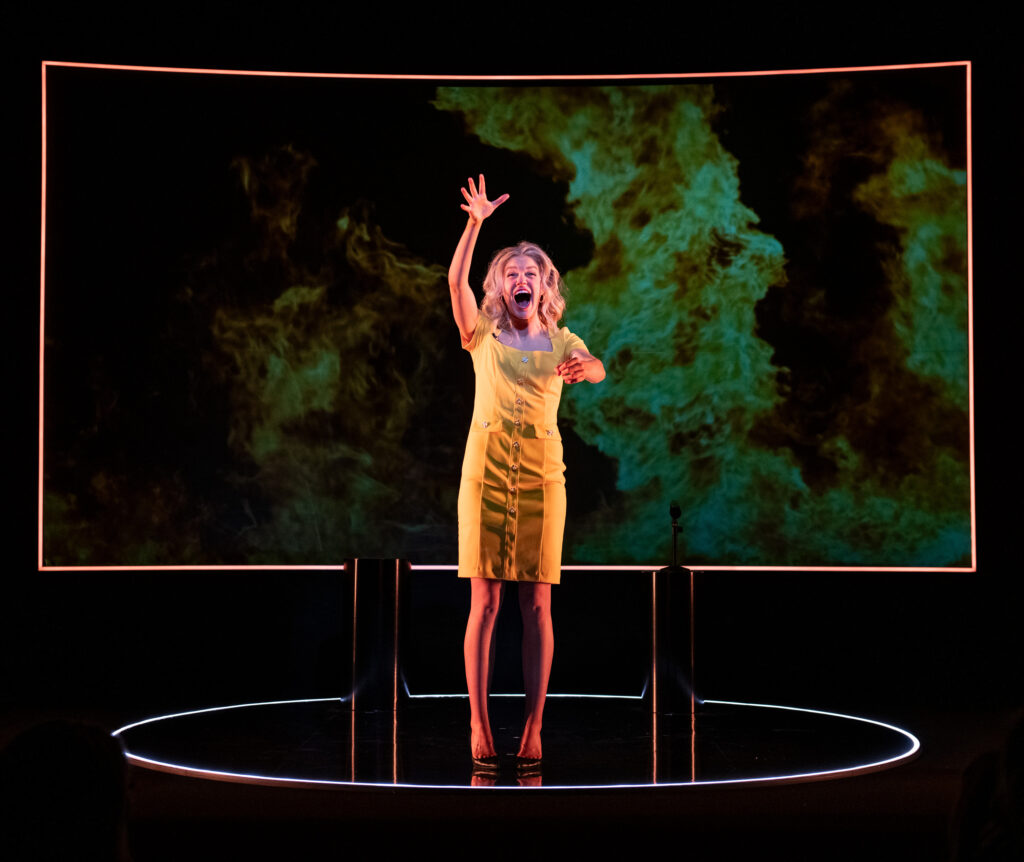
Ella Olesen as Stacey the Weather Girl educating the audience as California burns behind her. (Photos by Magnus Stark )
By Bill Hirschman
Any theater artist can tell you that crucial in connecting with an audience is to get them in sync with your vision early on, unless, of course, wandering in search of it is precisely the goal, as in, say, Waiting For Godot.
In the case of Nicole Stodard’s skillfully unsettling production of Brian Watkins’ Weather Girl from GableStage, it takes a while for many audience members to mesh; frankly some might not at all.
But for audiences willing to invest their concentration and introspection, they are richly rewarded with a unique piece of increasingly surreal theater delivered by a masterful actress and a visionary who outstrips the simple title of director.
This dark, dark critique is consistently leavened with satiric observation and brittle comedy. But it’s advertising precisely describes it as “a dizzying rampage into the warped soul of America.”
Not camouflaged by the cutting humor is a warning to recognize the omens of an imminent sociological and existential cataclysm. Also, but not quite as persuasively credible, is a solution being offered having to do with “listening to the earth” and to ourselves and the connection between them.
Our guide for the expedition is Stacey Gross, a California television weather forecaster required to perform bright cheery prattle. She is reporting live from a house fire in Fresno about dawn.
Later she appears in her styled canary outfit, manicured hair and 1,000-watt smile delivering a spritely forecast at her Fresno TV station. But actress Ella Oleson, Stodard and Watkins lift Stacey’s polystyrene exterior to reveal a bright, acerbic, sardonic Everywoman cynical of a world as plastic and shallow as the banter she is paid to deliver on screen. She is also deeply troubled without a clue what is infecting her equilibrium.
A natural storyteller, she shares her observations directly with us or we hear her interior thoughts. She shifts to a completely different voice: a slightly bewildered angst-ridden alcoholic who is confused and adrift in a world that becomes more and more Alice-Through-The-Looking-Glass. She begins a rambling journey looking for something. But she knows not what, except possibly a miracle, and again, but for what?
One of the weaknesses (or at least the danger) in Watkins’ script is that we don’t know either. So we travel along with our heroine on trust and as blind of her goal, or Watkins’ goal or the play’s goal. It is two-thirds of the pilgrimage before you have some idea of what is happening and why. Some audience members way wish for this to move along or be clearer. But Stodard and Oleson have courageously stayed loyal and hopeful. And most of us stay with them.
Throughout the play, that fire originating in that home roars on the projection screens behind her, building into a wildfire that grows and grows until the inferno engulfs the entire valley in a clear theatrical metaphor for a world-wide society-wide apocalypse.
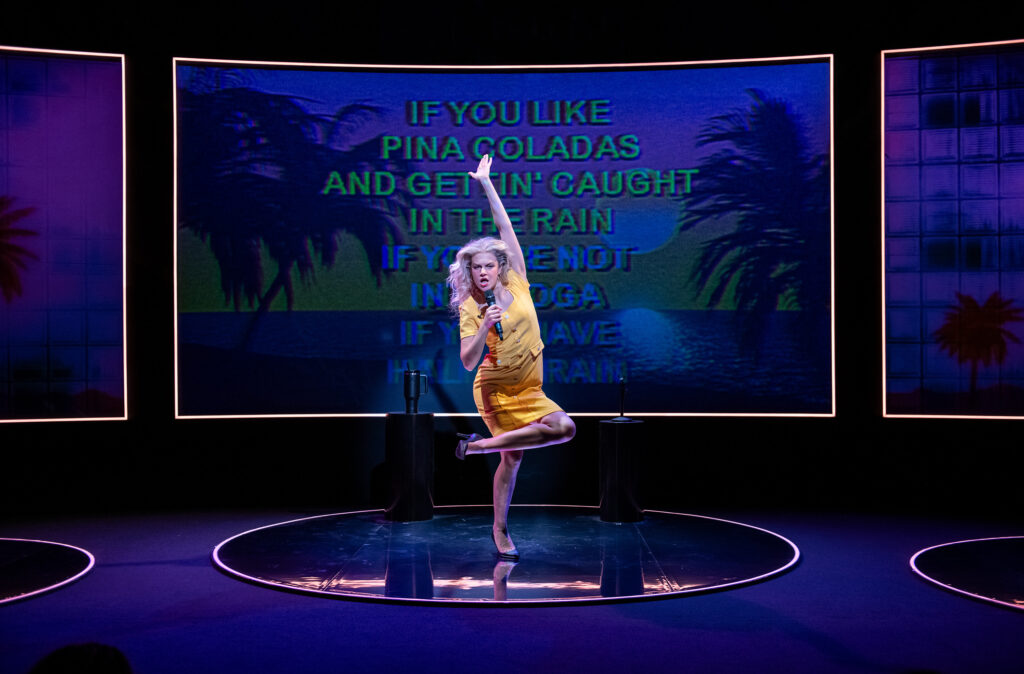
In an increasingly surreal odyssey, Stacey careens from a meaningless hookup to an intentional car wreck to singing “Pina Colada” in a karaoke bar to hanging out in a homeless camp to braving a purgatory of flames.
The entire arc seemingly takes a 45-degree turn when Stacey finds her estranged mother homeless, but convinced the self-professed witch says she can connect with the earth and create water. Is she nuts? No. For Watkins, this is central to one of his themes.
Overarching over it all is Watkins’ rebuke that we are not hearing the warnings or are blocking them.
At one point, Stacey’s boss warns her not to articulate her anxiety on air.
“Viewers want good news. They don’t want to hear that firefighters are out of water. The city’s doing the best they can to keep things under control and so the general consensus is that we should go ahead with the cooking segment and just wait and see.… All I’m asking you to do is smile and say the sun is gonna shine…. and then throw it to Kip for the dog show in Temecula. Got it?!’
But late in this voyage, an awakened Stacey switches gears during her forecast as the blazes surge, a solid example of Watkins’ craft depicting her emotional evolution.
“I hear that a lot of you don’t wanna evacuate or believe in climate change or whatever but all the farms and all your food is gonna shrivel up and soon there won’t be enough ground water to regrow anything and so you’re either gonna like burn really quick or starve really slow and your children… Cuz I know we all enjoy our TVs and our lush lawns and our four-car-garages but I’m telling you we live in a place where homes never should have been built and we’re gonna need a miracle to pay for what we’ve done….I want you to listen to your bodies, listen to the earth and see, just see if you can hear some I dunno something that we haven’t heard in a few centuries maybe?”
Watkins is gifted by the pure imagination of Stodard and Oleen’s bravura turn. They keep a majority of audience members enthralled no matter how weird and seemingly astray the story’s core veers.
You want to say that Oleson is simply marvelous, but there is nothing simple about the marvel-making being she has created here. Her face transmutes from beaming to anguish. Her physicality dictated by Stodard ricochets from nonchalantly erect to abject crawling.
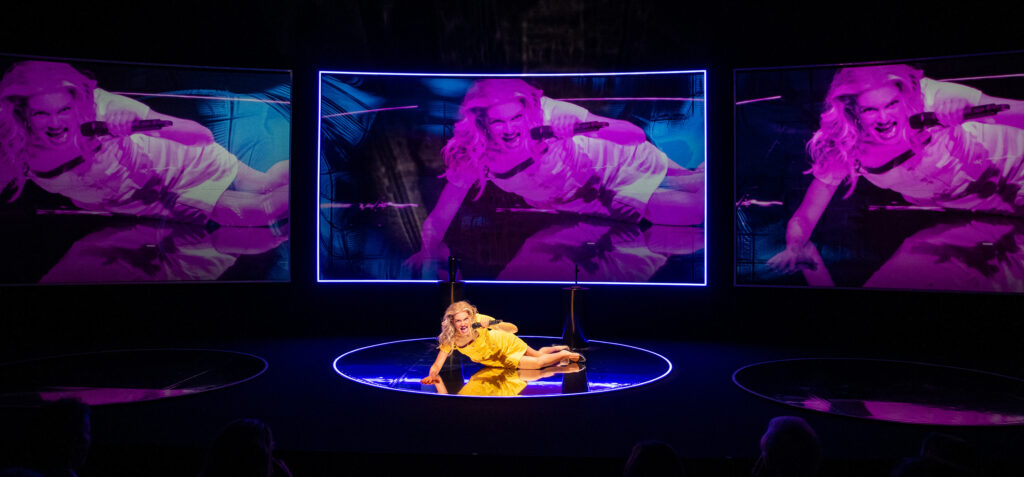
Oleson and Stodard imbue Stacey with her on-air voice, her quite different sardonic voice and the distinctive modulated intonations of a score of people she meets in her travels – an aural cornucopia lampooning each individual like cartoons.
In her GableStage debut, the Canadian Oleson is a member of New York City’s Ensemble Shakespeare Company who has appeared at Florida Repertory Theatre and Gulfshore Playhouse in Naples.
Watkins’ script is mostly the words of her monologue, so solidly credit the fullness of this vibrant production to Stodard’s artistic vision that she has used before – creating a three- and even four-dimensional aesthetic world.
Within Stodard’s vision, the visual and aural designs envelop you: three stage-size video screens hosting multiple live cameras on her and superb projections ranging from landscapes to control room camera views to interior mental images that skew slightly, then bend, then swirl into insane madness. When Stacey drunkenly goes into a karaoke bar and starts to sing, the lyrics on the screen behind her suffer a similar melting act.
Stodard, founding artistic director of Thinking Cap Theatre, has similarly directed and designed scores of works that aggressively push past predictability, sometimes visually, often thematically, reinterpreting titles you’ve seen, and championing the plays of Irene Maria Fornés.
This may be Stodard’s vision, but she has led a team of light and sound artists creating an almost hallucinatorily environment projected behind Olesen on three huge screens that deliver the steady reliability of the television studio to a karaoke bar to a neighborhood engulfed in an inferno.
Often, a half-dozen hidden cameras deliver live closeup coverage of Stacey’s increasing disintegration – again displaying both the “reality” of her on stage and the “other reality” of her videoed image of what we assume is her internal struggle.
Highest praise is due projection and video designer Jamie Godwin, scenic designer Frank J Oliva, sound designer Bree-Anna Obst and lighting designer Jessica Winward. A nod to the live cueing of stage manager Amanda Hernandez.
This is that wonderful kind of play that all the way home in the car you will debate its themes, its style, its worthiness, even whether it was worth your time and money. But even better, you’ll be kicking it around in your head the next morning, the next evening, maybe later in the week. You can’t ask theater for better than that.
Weather Girl from GableStage plays through Oct. 18 at the Biltmore Hotel, 1200 Anastasia Ave, Coral Gables. Performances 7:30 p.m. Wednesdays – Saturdays, 2 p.m. Wednesdays & Sundays and Oct. 17. Running time 80 minutes with no intermission. Pre-show talks with a member of the artistic team, 30 minutes before each performance. Post-show discussions with the cast and creative team following Wednesday matinees. Tickets $50 and higher. Students and teachers may attend any performance free of charge by arriving 45 minutes prior to curtain and filling any open, unsold seat. Valid ID required. Tickets available at www.gablestage.org and by contacting the box office. 305-445-1119 | BoxOffice@GableStage.org









 A PaperStreet Web Design