






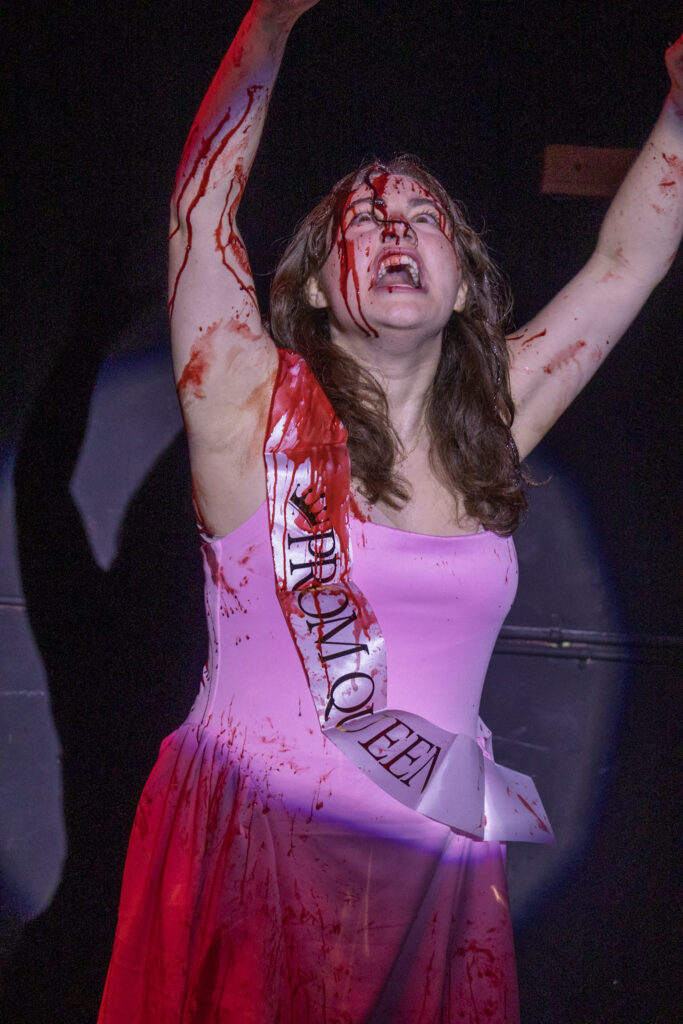
Emma Van Assche as the title character in True Mirage’s Carrie: The Musical (Photos by Emily Rodriguez)
By Aaron Krause
Promotional material for True Mirage Theater’s production of Carrie: The Musical tells potential audiences to “start Halloween season off right.”
The theater company literally may be saying the show will get patrons into the Halloween spirit. But audiences are also doing the right thing by attending this cautionary tale that asks us, “What does it cost to be kind?”
True Mirage’s riveting, realistic production of the show, based on Stephen King’s horror novel, runs for one more weekend in the company’s new intimate black-box theater in Kendall.
Carrie: The Musical is a stage adaptation of King’s 1974 novel about a bullied high school outcast who discovers she has telekinetic powers, enabling her to move objects with her mind. Carrie White is a shy, awkward teenager who is ruthlessly bullied and shunned by most of the students at her high school in Maine. At home, the titular character is trapped by her mother, Margaret, a fiercely religious fanatic who exerts tyrannical control over her daughter’s life.
After a remorseful classmate, Sue, asks her boyfriend, Tommy, to take Carrie to the prom, a malicious prank by the bully Chris ends in public humiliation. Pushed to the absolute brink, Carrie uses her powers to unleash total destruction, killing her schoolmates and others.
The history of Carrie: The Musical involves one of the most legendary journeys in theater history, moving from a historic financial disaster—the original Broadway production closed after 16 previews and five performances—to a successfully reinvented contemporary musical.
The original production tried to blend high-stakes operatic tragedy, particularly in the story of Carrie and her mother, with campy, 1980s bubble-gum pop choreography for the high schoolers, resulting in tonal whiplash. Famously, the opening of the second act featured a garish song-and-dance routine about slaughtering a pig. But you won’t find anything close to that in the revised version True Mirage is using. The 2012 revision stripped away many of the campy, dated elements and refocused the musical as a grounded psychological drama about bullying.
This is Miami’s first professional production of the show. Slow Burn Theatre produced it in Palm Beach County in 2014.
The revision also changes the framing device, structuring the story around authorities interrogating an adult Sue Snell about the disturbing events of her high school years. Snell’s retrospective perspective creates dramatic irony: we know the catastrophe is coming. That knowledge makes Carrie’s moments of happiness feel especially precious and heightens the tragedy of what follows.
Director Daniel Gil, who also portrays a teacher, creates memorable stage pictures, such as Carrie’s mother quietly soothing her crying daughter, who has buried her face in her mother’s chest. Also, Gil’s deft pacing makes the action consistently engaging. In addition, he helps the actors find their characters’ humanity and doesn’t over-emphasize the production’s minimal gore.
The decision to begin the show without warning, plunging us right into sounds of a catastrophe, reinforces the notion that life can take a drastic turn instantly, before we’re prepared. One of the production’s only shortcomings is that at one point, the devout Margaret slams her Bible on the floor and leaves it there. It’s hard to believe that such a religious person would do that and, regretting it instantly, not immediately pick it up.
The production’s intimate setting intensifies the impact of the performances. Because the audience is so close to the action—in the front row, you could practically trip a performer if you’re not careful with your feet—when the ensemble characters taunt Carrie, we viscerally feel their cruelty and nastiness. The effect is like a gut punch, or volts of electricity running through our bodies.
A fine cast of young triple threats believably brings their characters to vivid life.
In posture, movement and voice, Emma Van Assche naturalistically portrays the title character as a tense, wary teenage loner tormented by not only bullies but also her mother. Through Van Assche’s performance, we come to know Carrie as an insecure, shy girl who could use a friend rather than as a supernatural being. When she uses her telekinetic powers, we know we’re witnessing magical realism, but Carrie’s powers may also move us to think about people we know with special abilities, such as child prodigies blessed with at least one special talent and, hopefully, the capacity to use it for good. In the fictional world, characters such as Matilda spring to mind.
Van Assche makes Carrie a sympathetic character whose suffering is vivid. It’s hard to look into her watery eyes as she experiences torment. You also want to look away from the anguished expression on her face when pig’s blood suddenly drenches an unsuspecting, upbeat Carrie at prom. As a result, we feel happy for her when, before and during the prom, she smiles and seems to drink in the ambiance. While we don’t condone what Carrie eventually does with her powers, we understand her motivation and feel a sense of vindication for her.
Carrie doesn’t merely seek pity. She wants to overcome her circumstances, and that’s partly why she’s easy to root for. The show doesn’t give her many opportunities to express that desire, but when she sings, “I am the sound of distant thunder, the color of flame / I’m Carrie / I am a song of endless wonder that no one will claim / But someday, oh my, someday / Someone will know my name!” she expresses a longing for others to recognize and value her.
An actor portraying Carrie’s mother can fall into a trap of embodying an extremist monster rather than a caring but troubled human being with a twisted view. Fortunately, Margaret’s humanity shines through in Darcy Hernandez-Gil’s textured performance. We see her tightly hugging her daughter, pressing her daughter’s baby picture to her heart, and tenderly soothing Carrie as the crying girl, drenched in pig’s blood, buries her face in her mother’s chest. We also see the haunted, vulnerable expression on her face.
But Hernandez-Gil’s Margaret can turn from tender to frighteningly intense without warning. Her scary resoluteness and righteous indignation recall Kathy Bates’ chilling portrayal of Annie Wilkes in the film version of King’s novel, Misery. Of course, we don’t excuse Margaret’s decision to kill her daughter, but the performer convinces us that her character truly believes it’s the only way to save Carrie’s soul.
While the musical gives us glimpses into Margaret’s troubled past, more detail about how those experiences shaped her extreme religious beliefs might have injected the character with even more depth.
Nestor Santana embodies an upstanding Tommy Ross, the popular high school athlete, valedictorian, and kind-hearted boyfriend of Snell who takes Carrie to the prom. Indeed, he’s like Prince Charming, with teacher Ms. Gardner (Anna Russell, commanding in class yet kind and fiercely protective of Carrie) serving as the girl’s fairy godmother. But we also sense his initial reluctance to take Carrie to the prom, as though he belongs to a different class of people than she does. Santana makes that reluctance melt into sincere empathy toward Carrie.
Celia Voges gives Snell a haunted, nervous quality when authorities question her about the events of high school (she’s carrying these memories rather than just recounting them), and she conveys sincere sympathy toward Carrie. Early on, she seems to blend in with the other students but gradually becomes an openly emotional advocate for the title character.
Cast members portray Billy Nolan and Chris Hargensen with the right amount of arrogance and nastiness, but there’s no redeeming value in these two young people. Richard K. Webber’s unapologetic, gleefully evil portrayal of Nolan reminded me of Sean Kanan’s “bad boy” portrayal of Mike Barnes in The Karate Kid III. Meanwhile, Olivia Hudson-Fuentes embodies Hargensen, who is also always mean to Carrie, as an entitled, unfeeling emotional brat who probably never worked a day in her life. At one point, she leaves class in tears, but we hear a whiner, not someone we care about.
One of their teachers is Mr. Stevens, and Gil conveys a weariness that suggests this teacher has tried to get through to his students, particularly the uncaring ones, to little avail.
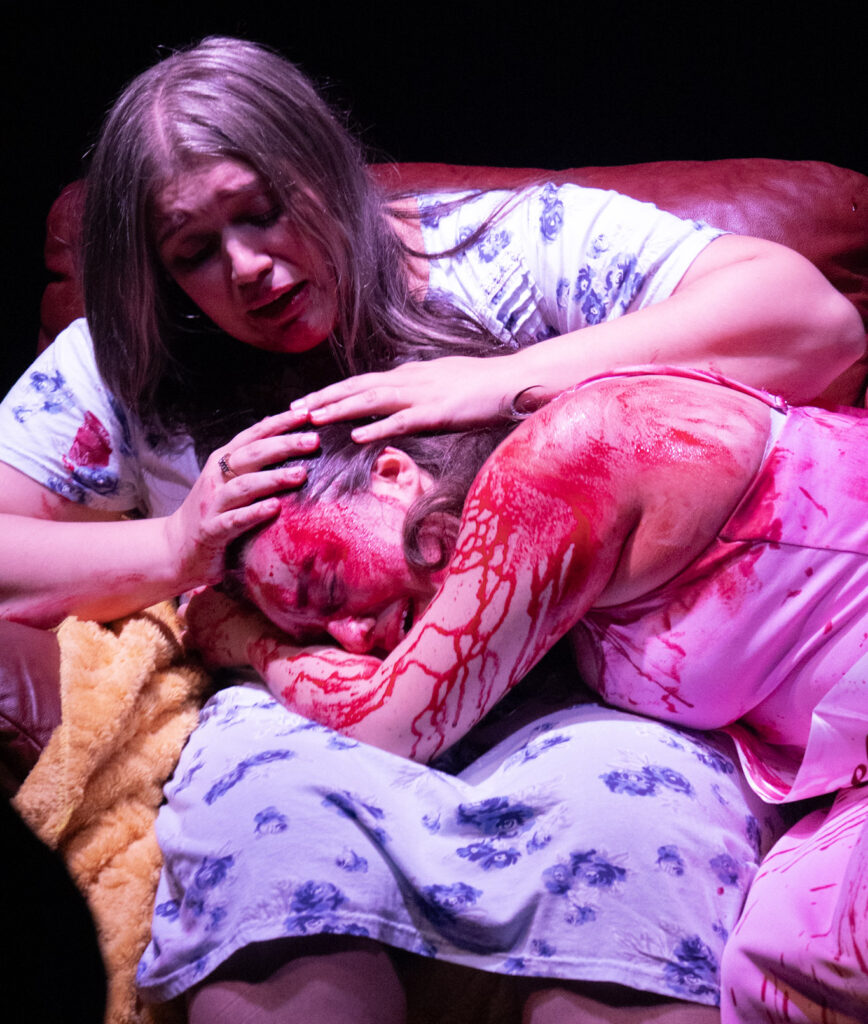
Darcy Hernandez-Gil’s mother comforts Emma Van Assche
Michael Gore’s score features a mix of hard-charging, intense songs that allow the actors to express their frustrations and vulnerabilities and softer, contemplative songs that take us into the characters’ minds and souls.
Dean Pitchford’s lyrics can be simple and clichéd, such as “Life is all about choices, about making the right ones” and “You ain’t seen nothing yet, this is gonna be a night we’ll never forget.” But there are also poetic gems, such as Carrie’s declaration: “I am the sound of distant thunder, the color of flame / I’m Carrie / I am a song of endless wonder that no one will claim / But someday, oh my, someday / Someone will know my name!”
Other lyrics are simple yet honest and relevant, such as the question, “What does it cost to be kind?” We leave the theater considering that cost. Popularity? Conformity?
During hard-charging songs, it can be difficult to make out every individual lyric over the recorded accompaniment. But these needy characters often prioritize raw expression over complete comprehension, choosing to be heard rather than strictly understood.
Under Hernandez-Gill’s choreography, physical and forceful dance moves help these characters express their frustrations. The vigorous choreography contrasts markedly with slower, swaying movements, giving the tender moments time and room to register emotionally. And, with foreknowledge of the tragic events to come, we wish the serene, happy moments could last forever for Carrie.
Raul Hernandez’s set design is minimal and functional rather than complex or gimmicky. Separate structures, onto which brick walls are painted, serve as the main set pieces, representing the titular character’s home and school. The structures move at times to suggest changing locales and allow for seamless transitions. Black chairs, doors, and other items round out Hernandez’s design. In addition to being economical, the set’s dark color reflect the grimness of the material, making the brighter moments involving the title character stand out more.
In addition to using realism, lighting designer Jordyn Cruz illuminates the set in red, suggesting passion and danger. The red lights blink repeatedly during upsetting incidents, such as when the bullies unsuspectingly drench Carrie in pig’s blood. The blinking red lights also contribute to the audience’s disorientation and create a sense of impending danger as the students surround and overwhelm Carrie. Significantly, Cruz uses red for a dramatic purpose rather than to impress or shock audiences.
In the end, Carrie: The Musical is a timely and timeless cautionary tale about unchecked bullying and religious fanaticism, as well as a story with Shakespearean qualities: flawed, complex people making choices that lead to tragedy. We leave the theater with this lyric in mind: “What does it cost to be kind?”
Credit True Mirage for dramatizing Carrie’s suffering without resorting to excess melodrama. Certainly, it’s difficult to watch bullies circle the title character while yelling at her and leaning into her. But sometimes, experiencing such a sight is what it takes to cement in our minds the kind of abuse that nobody should experience.
True Mirage’s production of Carrie: The Musical continues through Sunday at the company’s new black box space at 8780 S.W. 133rd St in Miami. Showtimes are 7:30 p.m. Friday and Saturday, as well as 2 p.m. Sunday. For tickets, visit https://www.onthestage.tickets/show/true-mirage-inc/6a579def7ee688422836ea8a/tickets#/productions-view.
.









 A PaperStreet Web Design