




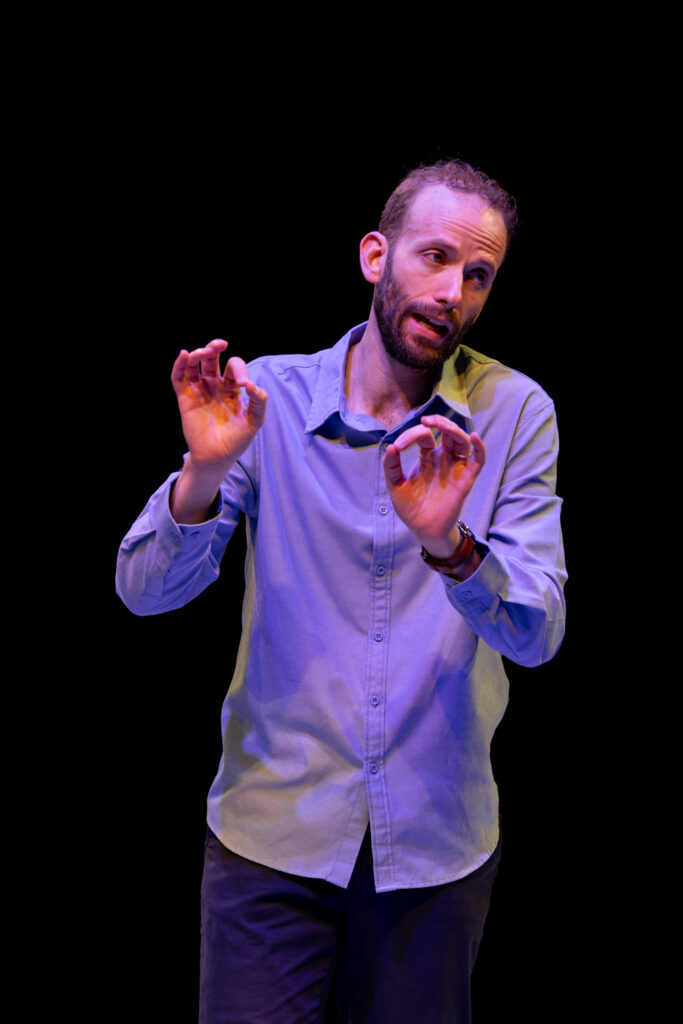
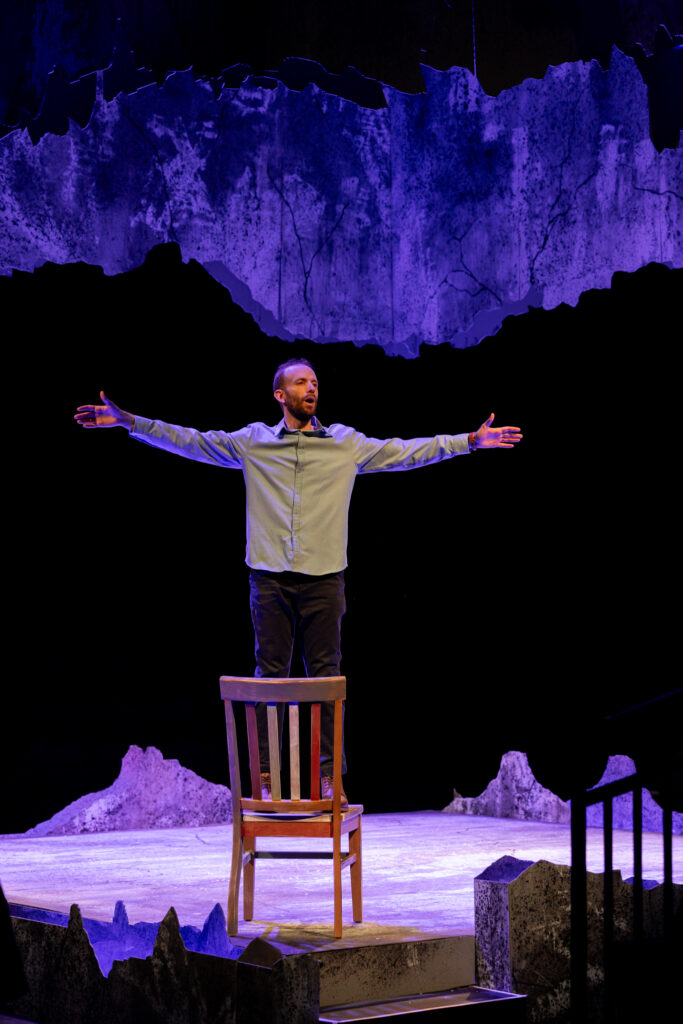
David Rosenberg in Zoetic Stages’ production of Michele Lowe’s Moses (Photos by Morgan Sophia Photography)
By Bill Hirschman
The unique magic of skilled storytelling – an often lazily-invoked cliché in reviews – is truly the compelling virtue of Zoetic Stage’s engaging drama Moses.
Yes, a memorable evening, for certain, but this observer wrestled in vain to find, let alone follow, the propelling essence. The damaged protagonist allegedly is searching for something, but only by reading the director’s playbill message and a Miami Art Zine miamiartzine.com interview with the playwright after the production did we learn what the intended throughline had been of the introspective episodic journey.
What carried us through this one-man marathon is that vital storytelling created by playwright Michele Lowe, director Stuart Meltzer and solo actor David Rosenberg who all provide absorbing companions capable of delivering drama and humor.
Rosenberg connects directly with the audience on all four sides of the platform stage relating the seven-year odyssey of the titular Moses, a 20-something contemporary Jew in the Bronx who initially wanted to be a rabbi but became an employee in the family hardware store.
His life vanishes in the aftermath of his wife and five children perishing in a blaze that levels their home. Blunted, unable to remember much including the fire and the death of his loved ones, he aimlessly wanders New York and New England. He settles down for short periods and intersects with a wide array of folks ranging from a cleaning lady to a tattoo artist to a brain surgeon to a cemetery office worker. Sometimes they are real and sometimes imagined in his dreams.
According to that Lowe interview, Moses learns something from each, but what that was or even if he did learn something it was not discernible the night we saw the show.
And yet, throughout, Lowe’s well-crafted insight-filled dialogue offers a dozen questions and the frustrating lack of answers we all wrestle with: Whether God exists, how can He/She ordain a world like this, how do we cope with it, etc. etc.
Finally, Moses reawakens when accidentally (or intentionally, I’m not sure) he faces his great tragedy and then begins (I think) to come to terms with it, restoring the human need to dream to fuel his future.
In real life, we are all searching for something – love, meaning, whatever — sometimes unclear ourselves what we seek. We never know what incident or acquaintance will arrive on our journey. We don’t know what the arc of our lives will be. And we don’t know where we are heading.
All of this is accurately captured by Lowe. But in traditional theater with its reliance on a dramatic arc, the audience has some idea what’s going on, even if the protagonist doesn’t. We have some idea of the possible ends of the arc. Here we are just riding along with someone who knows none of this. And neither do we the audience.
Wondering is tough on an audience when you have no idea what your paladin is seeking. So, this mode requires an investment of unwavering attention even from those more perceptive than I, which of course is a perfectly reasonable request from artists when we attend the brain-challenging works by Zoetic Stage. But it’s a courageous risk on the artists’ part.
Another problem is that this Moses, either as written and/or portrayed, is a listless, beaten, protectively reserved victim. If it wasn’t for Rosenberg’s lifeforce, you’d get weary of his pointed shut down affect of someone you are supposed to be rooting for.
But Lowe is a fine writer and she has created some undeniably special moments. For instance, the narrator inhabits an atypically impassioned and pain-filled Moses confronting God, sometimes orating God’s limited response:
“ ‘Where are you? You have wronged me.’ Even the birds stopped beating their wings and listened as he shouted at the Holy One. ‘Show your face, you coward! You cretin. You hack. No imagination. Just the same thing over and over again. Death. And more death! Show your face! I’m not afraid of you! …’ Moses looked up at the moon. The idea that God would show God’s face to Moses was ludicrous. To Moses? Why would God pay attention to him when there was all this humanity around? God wasn’t going to show God’s face that night or any other night. ‘Almighty God, teach me to give up on you, to erase you from my mind to obliterate you from every cell in my body. If you love me, teach me to forget you.’ ”
Lowe has the narrator go further:
“And as his words ricocheted around the buildings, the oldest cleaning woman on the Upper West Side was taking her break on the terrace of the New York State Theatre. She locked eyes with Moses, spread her arms, and said: ‘Everything is as it appears. There is nothing more, nothing less. The world is no longer poetry; it is a thesaurus. There is nothing to uncover or discover. It is the return of Genesis, nothing but names and names and more names. Objects identified, given a reason for being.’ ”
Besides the title and the questions about God, Judaism is threaded throughout the tale, although clearly this is meant to be relevant for anyone. Lowe obviously means there to be some connection to the Biblical icon but it’s never quite clear what that is other than they both drift through one form of a desert or another.
One inventive theatrical 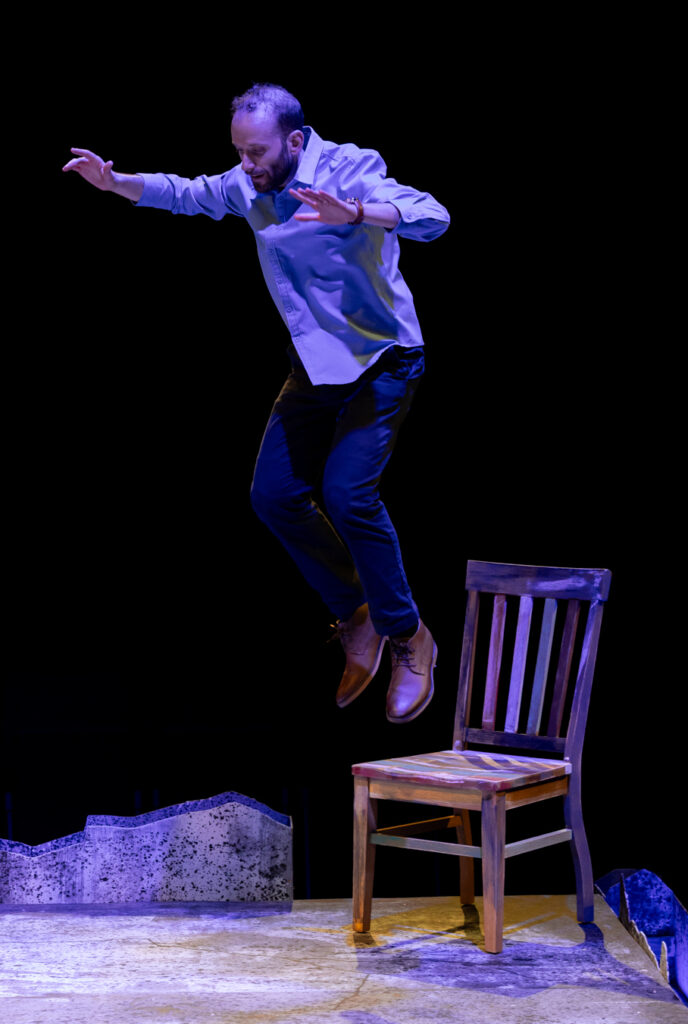 device is having a different real-life rabbi or rabbinical student drafted each night to answer a few questions such as how to create a burial for when your family is burned to ashes, or can Jews who wear tattoos are permitted to be buried in a Jewish cemetery.
The haunting echoes of Judaism are underscored intermittently by the velvety resonance of occasional musical overlays by clarinetist Orin Jacobs.
Another major asset is the creature that Rosenberg and Meltzer have physicalized in the flesh. The moment this tall, slender, charismatic personage enters, he beguiles the patrons. Throughout the 83 minutes, something is driving the narrator and he makes us yearn to know what it is. His words can flow quietly in measured phrases or spew in a torrent. He is in motion most of the time, ranging around, across and through the platform, arms and hands usually emphasizing phrases. He is always, always interacting with the audience.
Rosenberg, originally from Miami, received a Carbonell nomination for best new work for the play he wrote Wicked Child which Zoetic produced in January 2024.
The visual environment benefits from Becky Montero’s atmospheric lighting and Steve Covey’s projections. But memorably, Nikolas Serrano’ set surrounds the traditional in-the-round rectangle with ragged outlines of what can be mountains, glades or ice-capped peaks plus immense corresponding flats descending from the ceiling gridwork.
Others on the team include Vanessa Sanitago, resident stage manager and production manager; and Bailey Hacker, assistant director;
There may well be many patrons who captured all of Lowe and company’ visions. So here’s a secret most art critics don’t admit: Sometimes we don’t quite grasp all of what the artist is trying to say. We admire the work, even are absorbed by it, but either the script doesn’t land solidly, or the production doesn’t land fully, or, we admit it maybe we don’t follow it. But that may be the critics’ inability not the artists’.
A favorite legend: a New York City theater critic came to see the first English language production of Waiting for Godot in America when it premiered at the Coconut Grove Playhouse in 1956. Although droves walked out even before intermission, his review read something like: I really didn’t understand all of it. But something special was going on.
I feel similarly about Moses.
Moses plays through May 17 from Zoetic Stage at the Adrienne Arsht Center’s Carnival Studio Theater at the Ziff Ballet Opera House, 1300 Biscayne Blvd., Miami. Shows 7:30 p.m. Wednesday-Saturday; 2:30 p.m. Saturday-Sunday. Running time 83 minutes, no intermission, Tickets: $67-$73. Call (305) 949.6722 or visit| www.arshtcenter.org.
To read the aforementioned interview, go to https://www.miamiartzine.com/Features.php?op=Article_A+New+Promised+Land+The+Modern+Story+of+Moses






 A PaperStreet Web Design