






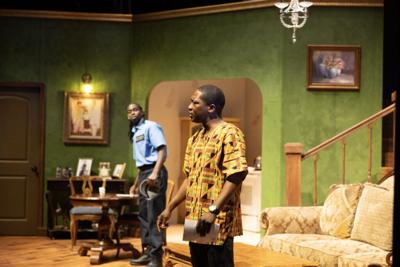
Jarryd Joseph as Peanut and Roderick Randle as Cricket in Layon Gray’s Searching for Willie Lynch at M Ensemble (Photo by Seven Fleurimond,)
By Aaron Krause
In M Ensemble Company, Inc.’s intense yet believable professional production of Searching for Willie Lynch, the Foster home looks comfortable and lived in. A couch includes pillows for extra comfort, a rocking chair sits nearby, and family photos adorn different parts of the set. An attractive chandelier hangs from the ceiling, and colors such as green and brown lend the spacious place a homey feeling.
The house may look familiar, but time does not operate as one might expect in this space. Three generations of the same family, from different periods, occupy the same space, sometimes at the same time, without the set ever changing.
The play compresses time, allowing the past to linger in daily life while confronting history.
Time, memory, and history overlap in this time-bending, semi-surrealist drama that blends three distinct eras—1930, 1965, and 2008—within a single Louisiana home. The play by acclaimed theater artist Layon Gray explores the legacy of the infamous Willie Lynch speech through overlapping timelines where characters from different periods coexist and interact within the same space across generations. While the play features a “mysterious door” that acts as a portal, it is firmly grounded in reality, exploring themes of inherited trauma, history, division, and resilience within Black communities.
Searching for Willie Lynch runs through Sunday at the Sandrell Rivers Theater at Audrey M. Edmonson Transit Village in Miami. The production by M Ensemble, Florida’s oldest running Black professional theater company, lasts about two hours, including an intermission.
The Willie Lynch letter, or “The Making of a Slave,” is a widely circulated, likely forged document purporting to be a 1712 speech by a British slave owner. Historians consider it a modern hoax. It outlines harsh psychological and divisive techniques intended to control enslaved African people and foster distrust among them for generations.
But in Searching for Willie Lynch, Gray does not revolve his play around the hunt for the titular character. In fact, the words “Willie Lynch” appear together just once.
Gray stars, wrote the play and directs M Ensemble’s production, bringing believable vigor to Basil. He creates a commanding yet approachable presence, evoking a man who enjoys life’s small pleasures, such as reading the newspaper and drinking coffee. He also clearly relishes spending time with his wife, Charlene (Sheena O. Murray). Murray and Gray share strong chemistry as a couple whose relationship brims with warmth and playfulness, though it is not without moments of irritation.

Layon Gray
Gray’s acting choices are consistently effective, such as sitting in a chair with his feet propped on a desk to emphasize Basil’s ease and comfort. He also shifts convincingly into a more volatile presence when provoked. He bellows and moves with sudden, almost predatory speed when something unsettles him. After someone steals his possessions outside the home, he re-enters like a violent storm, his voice reverberating throughout Mitchell Ost’s spacious and realistic set.
As Charlene, Murray embodies a character who enjoys life as much as her husband. She anticipates the future by touching and massaging her pregnant belly, but also celebrates the present by joyfully singing “Happy Birthday” to her husband while bringing him a cake. In a moment of playfulness, she touches his nose with her finger and remains spirited throughout. While lighthearted at times, she becomes firmer during serious moments without losing her warmth.
Thaddeus Daniels makes Mo believably stern, but also a dedicated father figure wishing to pass wisdom down to his son, Cricket (Roderick Randle), and that young man’s best friend, Peanut (Jarryd Joseph). A sense of urgency fills Mo’s booming voice, which commands the space with conviction. At one point, he repeatedly but lightly hits Peanut with his fist, as though trying to drive a lesson into him. When Cricket or Peanut disappoint him, Mo responds with authority and disapproval.
Joseph and Randle inject their characters with youthful eagerness and naiveté that contrast with the older and more worldly Mo and Basil. Randle’s Cricket balances humor with unease. He has an easy smile and laugh, but his voice turns serious as he anticipates something “wicked” approaching. He also looks believably weary at times.
During a lengthy monologue, Cricket dramatically narrates a true tale about a family ancestor. His expressive voice, gestures, and facial expressions bring the story to life while it unfolds above the main action. While he is the focus, Cricket also listens intently to Peanut as he recounts a painful moment from his past. Peanut’s voice breaks as he re-enacts abuse from his father, speaking with unsettling familiarity. Joseph makes Peanut’s pain palpable. Just as Cricket listens to Peanut, Peanut is equally attentive during Cricket’s turn.
Rahman and Phibe are Mo’s grandparents living in the house during the late 1920s. They rush back into the home seeking refuge following an incident with a gun that could bring the police to their doorstep. As Jean Hyppolite embodies Rahman, he is physically present but mentally elsewhere, massaging his temples and rocking slightly. His anguish builds as Phibe presses him, particularly when he recalls shooting someone while a white officer stood by and did nothing. His discomfort becomes ours as well, evoking broader historical patterns of racial violence and authority.
As is true with Basil and Charlene, Phibe seems to sincerely love Rahman. Hyppolite and Garcia are believable as a long-married couple. They touch each other warmly, but she grips his arm after Rahman, facing away and deep in thought, slowly approaches her. Garcia is intense during darker moments, shaking and shouting with anguish. With conviction, she speaks about lineage, pride, and protection, emphasizing her love for Rahman, and they embrace.
Davis Harlan (Melvin Huffnagle) represents the demolition of memory and history in the name of progress and ownership. He insists he bought the Foster residence after Mo failed to pay bills and plans to tear it down and redevelop the land. He enters with arrogance and authority, initially reading as a villain. The audience reacts with shock at his assertions. Mo meets him with equal intensity, and they confront each other directly. Over time, Harlan softens following a revelation about shared history, becoming vulnerable and ultimately embracing unity with the family. The characters move and sing together, suggesting reconciliation over division and undermining attempts to fracture Black identity across generations.
Gray, a highly decorated American playwright and director, is best known for creating historically grounded dramas that explore the African American experience with a distinct focus on conversational realism. M Ensemble has produced his Cowboy and The Dahomey Women and his 2017 Carbonell-winning Kings of Harlem.
Significantly, while Gray explores history in his plays, they never feel like a lecture. Rather, he grounds his works in compelling, relatable drama. His writing is also poetic, and parts of Searching for Willie Lynch evoke August Wilson’s The Piano Lesson.
In Searching for Willie Lynch, Gray, without lecturing or preaching, imparts a broader warning: trauma persists across generations, and history can repeat itself when apathy and inaction take hold. With its intense, vivid production, M Ensemble brings history into immediate, tangible focus, reminding us that its lessons remain present across time.
M Ensemble’s production of Searching for Willie Lynch continues through Sunday at the Sandrell Rivers Theater, 6103 N.W. 7th Ave. in Miami. RodRemaining performances are 8 p.m. Friday and Saturday and 3 p.m. Sunday. Tickets are $40.25, including a $4.25 fee. For more information, call (305) 705-3210 or visit www.themensemble.com.









 A PaperStreet Web Design