



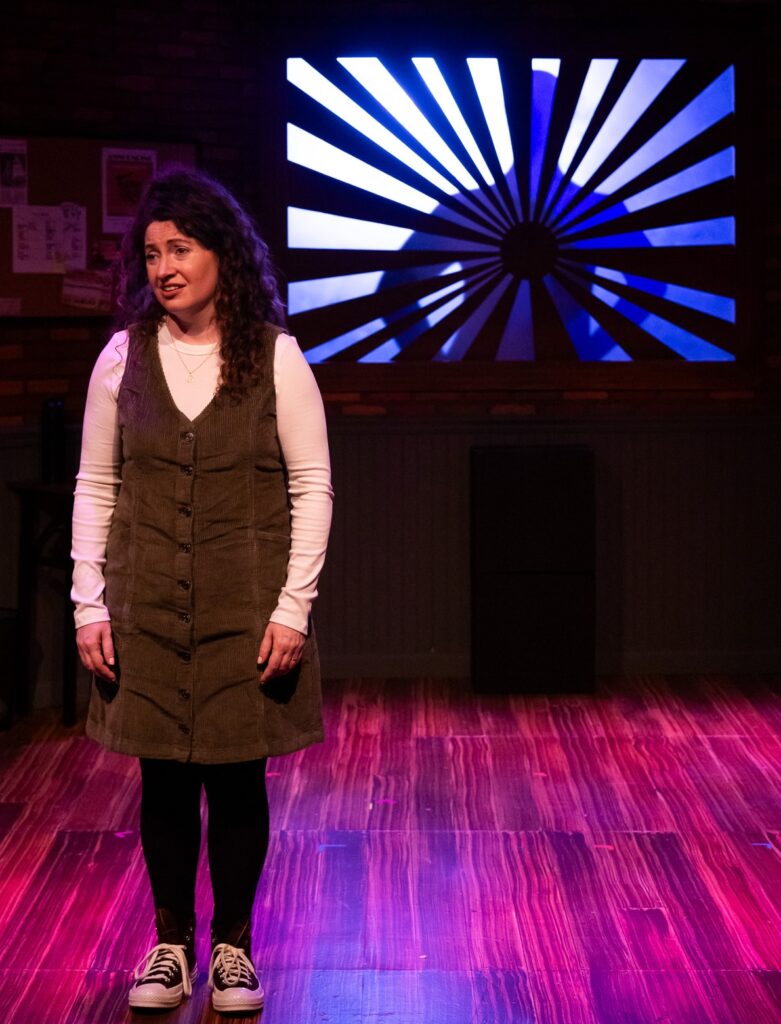
Joanna Castle Miller appears as herself in her own play INFERNA at Theatre Lab
By Bill Hirschman
We all have scripts.
Playwright Joanna Castle Miller says they are stories, values, ethos, norms and mores that we have been inculcated with since childhood by parents, schools, society and especially religion. But sometimes we have been indoctrinated in multiple scripts, some of which don’t sync, some of which counter each other, some which don’t even address issues.
Such are the dilemmas underlying Castle Miller’s play INFERNA having a world premiere at Theatre Lab as part of its OWL New Play Festival through April 26.
Specifically, with humor and satire as well as poignancy and pathos, she illustrates how her own her intense ingraining in an evangelical Baptist upbringing failed to prepare her for dealing with the issues of sexual coercion and sexual abuse, especially of youngsters and young women.
She is writing and starring in a chuckle-riven evening that only allows the subtext to peek out in the early scenes. Even when it faces it head on later, there is still a wryness to her skepticism.
Under deft director Margaret M. Ledford, Castle Miller’s heroine is her inescapably winning personality embodied by a grin – enthusiastic, effervescent, jovial, cheery – a entire dictionary entry of adjectives. But this is intentional. You can see early on that something darker driving is her.
As time goes on and the theme deepens, she can become somber and emotional for a scene that digs into the audience – and then caps it with a snappy one line rejoinder that seems to say don’t take that seriously – when you know both you and she do. There is no self-pity at any point, more like a friendly if serious wake-up call.
The title comes from the collision when she and her acting partner recreate a frighteningly fiery sermon in which a volunteer evangelist admonishes: “Do you know for a fact your friends and family will be with you in Heaven? Or will you be up there alone? How can you make sure they aren’t going to Hell… When they tell a child that anyone who hasn’t said a specific prayer is going to burn in a lake of fire, so you’d better tell them about Jesus before they die or their blood will be on your hands. It’s a lot of pressure.”
Later, when she is older, “I knew that when you get to Heaven, everyone gets a mansion. It’s like suburban Dallas there. And that always felt uncomfortable. All a bad person has to do is pray a prayer and they get to live next door to me in Heaven? Ding dong! It’s me! Adolf Hitler! I prayed the prayer! You have any extra eggs? To believe in that Heaven is to believe in a future where we all forget the past. But that’s not paradise. That’s a lobotomy.”
Part of the plot tracks her relationship with a drama teacher from childhood through her teens, in part because she is completely in love with seeing and participating in theater. Unlike the inevitable arc of How I Learned To Drive, they do not consummate even though he is later accused of sex with other students. But we see what she perceives as uncomfortable such as when he asks her to take off her pants for a high school moviemaking class remaking Halloween. Still, when one of her classmates makes an accusation that Castle Miller might be able to confirm, she instead leads an attack on her character– something she will regret her entire life.
“When someone gives you a script – a map if you will, you can follow it a long time before you realize you’re lost. And I knew the scripts inside and out,” she says.
One of Castle Miller’s ingenious tactics is presenting the evening as a kind of performance still being polished. For instance, she verbally calls for her scene partner to enter and exit. She forgets a piece of a speech and calls offstage “Line!” as is standard practice. She makes a slight reference to now being Jewish and then briefly notes that was the topic in her earlier play. And at one very telling point, she breaks from the script that she ostensibly wrote and takes the play down a different route.
This is beyond trying to be cute and entertaining. The whole evening is about people being so indoctrinated in the lifescripts they have been taught for decades that they cannot see beyond them to what may be the truth.
Her childhood indoctrination is on display in scenes depicting her limitless participation in church activities. Most notably is Bible Drill, a competition in which a student quotes the passage when given a specific chapter and verse. But even more spectacular is she can recite every book of the New Testament in 16 seconds – and Castle Miller proudly does it.
The entire flow is guided, paced and staged by the always deft Ledford who merged the pieces into a single comprehensible vision. She keeps the verbally intensive production moving with having Castle Miller roaming the stage much of the time and allowing her to physicalize extensively – skipping, twirling, hands akimbo and in constant gestures.
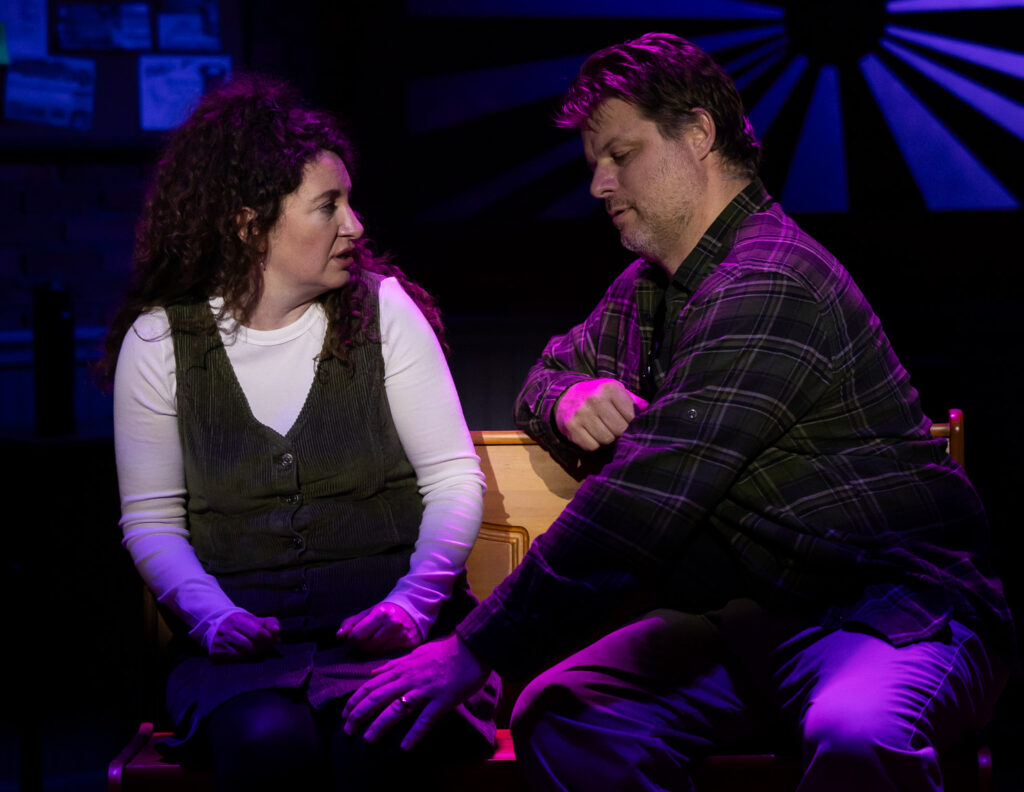
This is the second part of a trilogy that Castle Miller wrote and starred in. The first was CONVERSA which played at Theatre Lab in February. Unlike the monologue CONVERSA, she has a partner in this journey. Jeff Burleson seamlessly pops in and out as, among other things, a guitar accompanist, patron, pastors, Alan Jay Lerner, a director, Samuel Beckett, an angel, a man in hell, David Mamet, an actor playing Shakespeare’s Oberon – oh, and God.
Credit as well to the design efforts of K. April Soroko for scenery, Eric Nelson for innumerable mood changes and emphases by lighting, Matt Corey and Tyler Johnson Grimes for sound that underpins the evolving story, Carley Knotts’ stage management, among others.
As with her earlier work, the play eases further and further into seriously facing the issues. She asks the audience to close their eyes as she issues what she calls “a little private silent confession…This is a prayer I really wish some folks had prayed before I came into the world and got busy listening to the soundtrack of Camelot and making my Barbies kiss each other.”
She asks the audience to repeat her words privately to themselves as she pronounces: “ I am a human being steeped in a culture of abuse. I am not a passive participant. Every choice I make about the art I consume and the art I create happens only because thousands of generations of complicated people before me evolved their myths and tropes and legends, and those stories helped form the very core of my being.”
And then she asks the audience to speak the next sentences aloud at her prompting: “As both a consumer and creator, I will evolve myths and tropes and legends, too. And knowing the power that gives me over future generations, I will make sure that whatever I evolve is as beautiful as I can make it with the knowledge I have today.”
The production provides a print out the front door listing resources for sexual abuse victims.
This mainstage production is one of 30 readings, productions and events tied to Theatre Lab’s OWL New Play Festival through April 26. For more information, go to our story at https://www.floridatheateronstage.com/general/developing-new-works-in-two-festivals-theatre-labs-owl-new-city-players-lauder-made/
INFERNA plays through April 26 at the OWL New Play Festival at Theatre Lab, playing at Florida Atlantic University’s Boca Raton campus, 777 Glades Road., Parliament Hall. Performances 7:30 p.m. Thursday to Saturday, 3 p.m. Saturday and Sunday. Running time 80 minutes. Tickets $35-$45, FAU staff/faculty $25. Tickets at https://tinyurl.com/mresy42c or call (561) 297-6124 or email: fauboxoffice@fau.edu



 A PaperStreet Web Design