





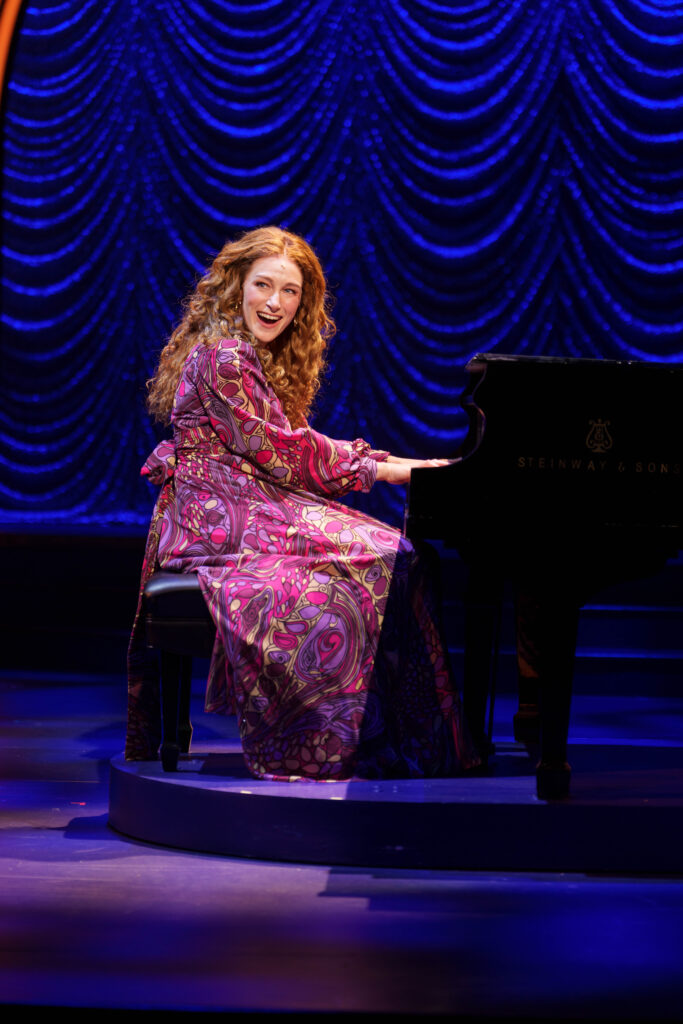
Julia Bain in Beautiful -The Carol King Musical at Gulfshore Playhouse
By Nancy Stetson
“What can you say in three minutes?” Gerry Goffin asks Carole King early in the jukebox musical, Beautiful: The Carol King Musical at Naples’s Gulfshore Playhouse through May 31.
They’re teenagers who’ve met at Queens College, and Goffin has plans to be a playwright.
It turns out you can say quite a lot in three minutes, the typical maximum length of a pop song in the 60s and 70s.
Goffin (Zachary Freier-Harrison) teams up with King (Julia Bain) to write lyrics for her compositions, and the two go on to write a string of iconic hits for Don Kirchner’s production company.
Their songs are performed by others: “Will You Love Me Tomorrow” (The Shirelles), “Up on the Roof” (The Drifters), “The Loco-Motion” (Little Eva), “Pleasant Valley Sunday” (The Monkees), “(You Make Me Feel Like) A Natural Woman” (Aretha Franklin).
If you’ve never seen “Beautiful” before, you should know that the show doesn’t focus only on the songs King wrote as a solo artist, but also on the tunes she and Goffin co-wrote for others, as well as those written by Cynthia Weil and Barry Mann.
Weil and Mann, played by Madison Claire Parks and Oliver Prose, respectively, also wrote for Kirshner, and were in friendly competition with Goffin and King. They’re known for hits such as “On Broadway” (The Drifters), “You’ve Lost That Lovin’ Feelin'” (The Righteous Brothers), “We Gotta Get Out of This Place” (The Animals).
The musical also sneaks in snippets from other popular songs of the time, including a couple by Neil Sedaka (“Oh! Carol!” and “Stupid Cupid”) and Jerry Leiber and Mike Stoller (“Poison Ivy,” “There Goes My Baby,” “Yakkety Yak.”) The ensemble performs a mash-up of some of these songs and others in “1650 Broadway” — named after the New York City building where these songs were written and pitched.
If you’re of a certain age, Beautiful is a goldmine of musical memories, stuffed with hit after hit after hit, with lyrics known by heart. (In fact, in its opening curtain speech, the theater reminds patrons that this show is not a singalong — a wise move.)
Freier-Harrison plays Goffin as the moody, troubled artist who marries but can’t settle down. There are red flags even before he proposes to King. They make beautiful music together, but Goffin is unfaithful.
Parks’s Weil is sophisticated and witty, the complement to Proses’ neurotic, hypochondriac Mann. The two provide some comic relief to King and Goffin’s marital drama, as well as songs that are classics. Parks is vibrant as Weil.
But it is Bain who is deservedly the star of the show. Not only does she look like a 60s/70s Carole King but also sounds like her when she sings. Bain’s vulnerable and authentic; she has the audience rooting for her from the beginning, even though they already know how the story ends.
In fact, the show (book by Douglas McGrath) opens and closes with King performing solo at Carnegie Hall, seated behind a Steinway grand piano, singing her own songs.
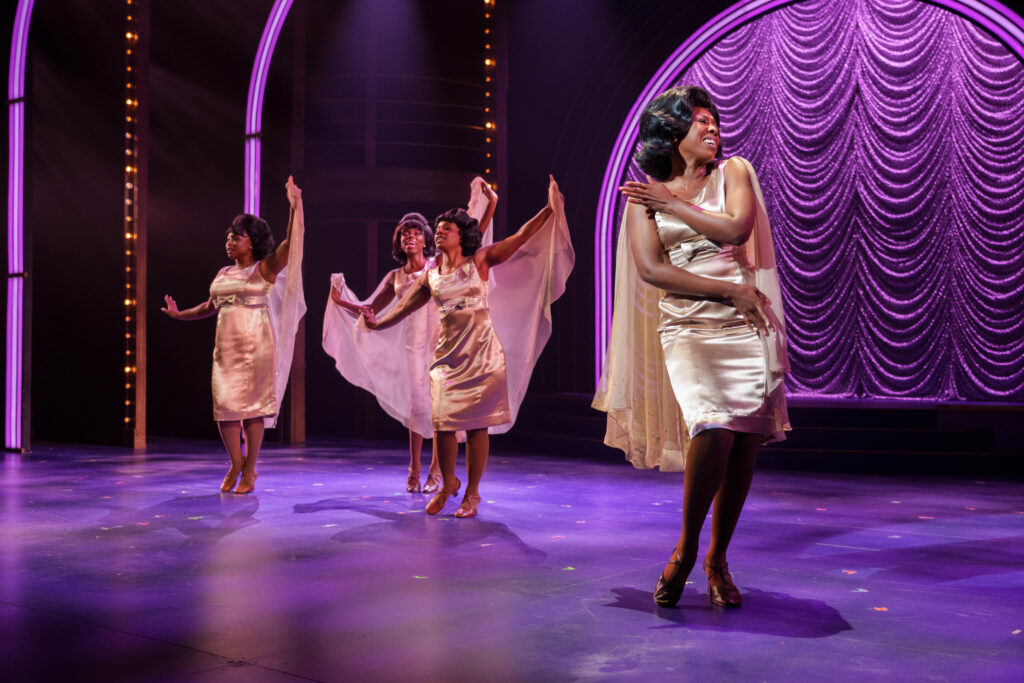
Though these four songwriters are the heart of the musical, the hard-working ensemble plays multiple roles. Jamonte, Reggie Bromell, Jacquez Linder-Long and Torrey Linder play The Drifters, as well as other roles, and Tiffany Frances, Candace, Tiana Marie Williams and Sydney Archibald are the Shirelles, with Archibald also playing Little Eva and Frances doubling as Kirschner’s personal secretary.
Director Matt Lenz keeps the action moving, so there’s never a lull; Dann Dunn’s choreography is equally fast-paced.
The orchestra (directed by Lon Hoyt, also on keyboards) is top notch, with its guitars and horn section, but some of the more moving moments of the show occur when it’s just the singer/songwriters and a piano. The songs often morph into something grander, performed by the group that popularized that number, but it’s fascinating to see their simple beginnings. That demonstrates the true strength of a song, when it can stand on its own with just a voice and a single instrument.
The costumes (by Johanna Pan) are a missed opportunity, though. The 60s and 70s were such a time of self-expression in fashion as well as in music, but for the most part, these characters’ outfits miss that vibe. Even the sophisticated Cynthia Weil isn’t as chic as she could be. And the back-up dancers for Little Eva are puzzling; they look as though they’re wearing retro Burger King uniforms.
The wigs (Bobbie Zlotnik), on the other hand, are authentic and reflect the times well.
Ann Beyersdorfer’s sets portray multiple locales: King’s childhood living room, Queens College, Kirshner’s office, a ski resort, a suburban home, a TV studio, rehearsal rooms, a hospital room, various performance stages. It’s a lot, but the mini-sets zip in and out. (The white picket fence is a nice touch for the suburban home scene.)
Abe Goldfarb gives a solid portrayal as a droll and professional Kirshner, and though others’ accents land authentically, for some reason Goldfarb doesn’t speak in Kirshner’s well-known nasally voice. Rachel Coloff, as King’s mother, doesn’t have a lot of stage time, but makes the most of what she does have; she’s comedic gold.
Beautiful showcases King’s music, especially, at the end, many of her songs from “Tapestry,” her solo album that exceeded all expectations. With hits such as “It’s Too Late,” “You’ve Got a Friend,” “I Feel the Earth Move” and “Beautiful,” it sold over 14 million copies in the US alone; it seemed as if everyone owned a copy. “Tapestry” also won four Grammys: Album of the Year, Best Female Pop Vocal Performance, Record of the Year (“it’s Too Late”) and Song of the Year (“You’ve Got a Friend.”)
Beautiful isn’t only a celebration of King’s music but of much of the pop music of that era. It’s also the story of finding your own voice and having the courage to follow your own creative path.
Beautiful“reminds you of the first time you heard these songs playing from your transistor radio or over your car speakers; they’re still just as magical.
Beautiful: The Carole King Musical plays at Gulfshore Playhouse (100 Goodlette-Frank Road South, Naples) through May 31. The show runs 2 hours and 30 minutes with a 15-minute intermission. Tickets are $154, $134, $124 and $44. For more information call (239) 261-7529 or go to gulfshoreplayhouse.org.
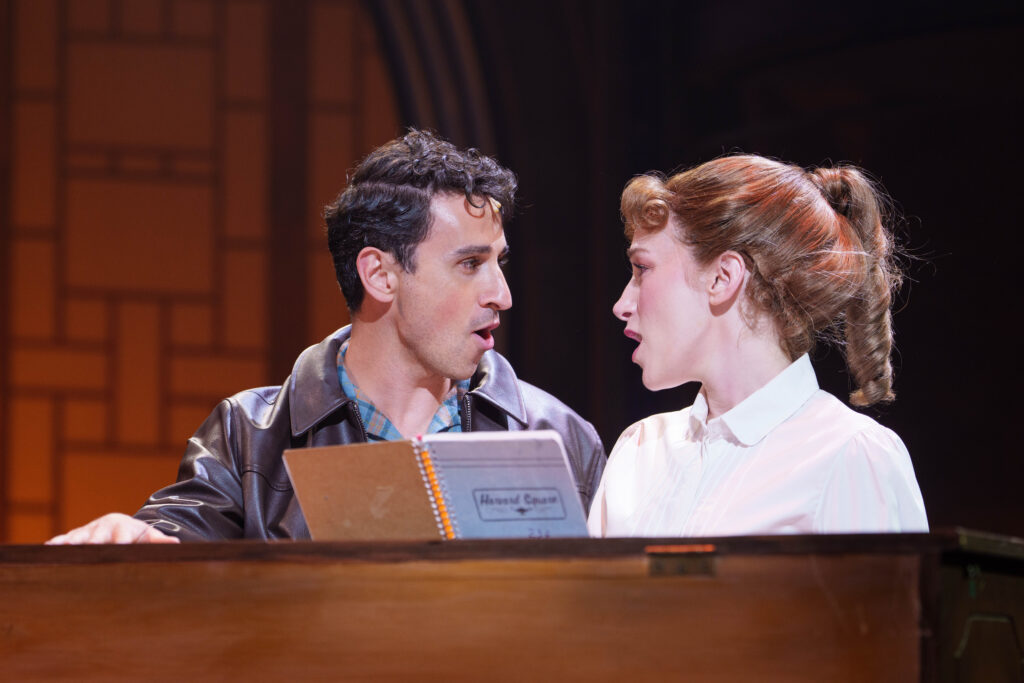
Zachary Freier-Harrison teams up with Julia Bain







 A PaperStreet Web Design