







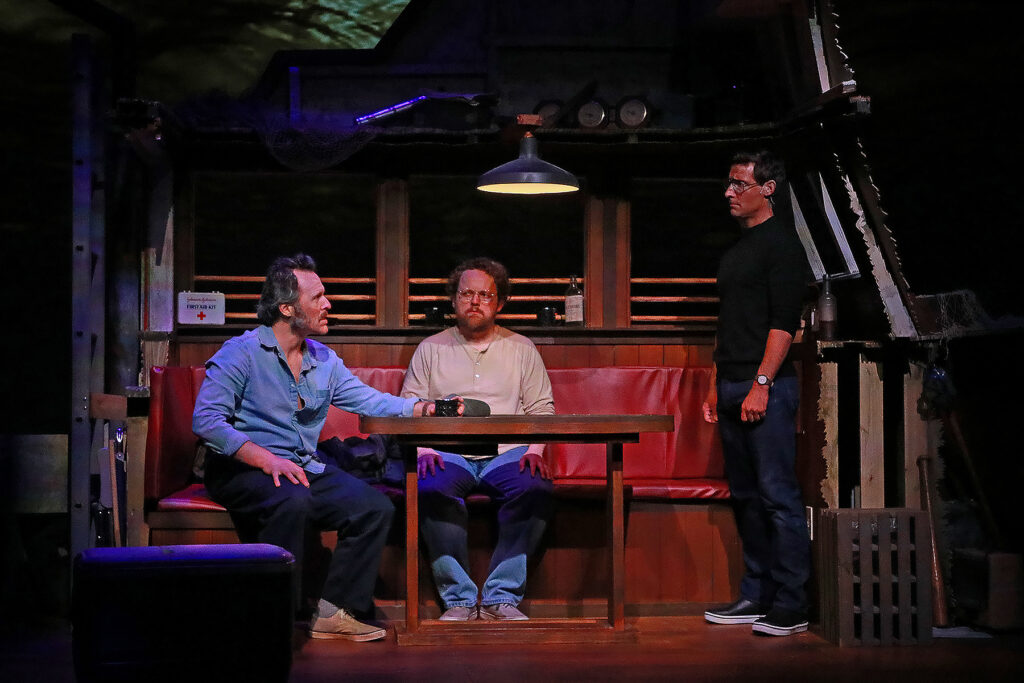
Iain Batchelor (Robert Shaw), Wesley Slade (Richard Dreyfuss) and Adam Poole (Roy Scheider) in The Shark Is Broken at Actors’ Playhouse at the Miracle Theatre. (Photo by Alberto Romeu)
By Bill Hirschman
Erudite film scholars recognize the film Jaws for two milestones in the history of cinema. First, it is considered the first commercially successful summer blockbuster. Second, no other film double-busted its budget and overran its schedule because of a shark.
Well, not just one shark. OK, there were other mechanical sharks. But primarily one.
Thus comes the title of Actors Playhouse’s The Shark Is Broken, a sometimes broadly comic, sometimes dryly witty and sometimes rue-tinged exploration of fame, fathers and film in the 1975 classic thriller.
The 2019 script feels like three different plays straining to merge into a whole. But the energy and commitment of the acting, directing and visual designs succeed in delivering a reasonably entertaining evening.
Robert Shaw, Roy Scheider and Richard Dreyfuss are virtually trapped on the set of a decrepit shark hunting boat as they wait day after day, week after week for shooting to resume despite inclement weather and Bruce, a 25-foot mechanical shark that breaks down over and over.
Many details are factual given that the script was co-written by Ian Shaw, the son of Shaw. But a great deal is gleefully invented as the very different film thespians clash and grate and jape and gel fueled by a bottomless supply of alcohol.
So, this must focus on relationships in this triangle, since like Waiting For Godot you have people trapped in a play in which nothing actually happens plot-wise. That Sisyphus of theater is a very dangerous and daring set-up for a theatrical effort when fighting boredom is the heroes’ primary goal.
But director David Arisco usually keeps things alternately pulsing and contemplative with his capable cast: Iain Batchelor as the tempestuous Shaw, Adam Poole as the peacemaker Scheider and Wesley Slade as the volatile Dreyfuss.
The script co-written by Joseph Nixon enjoys numerous references to the iconic film in a kind of breaking-the-fourth-wall joking. When Shaw says he spent $50 feeding his kids at McDonalds, Scheider asks how many kids he has. Nine, Shaw says. Roy snaps back “You’re gonna need a bigger boat!” Rimshot.
Some comedy is almost vaudevillian. When Dreyfuss complains that they should be shooting in the studio instead of on water, he quips, “Jews should stay away from water. Nothing good ever happened to any Jew on the water.” Scheider rejoins, “Didn’t Jesus walk on water?” And Dreyfuss snaps back, “Yeah! … And look what happened to him!” Double rimshot, but it gets the laugh.
Somehow, they even get a genuine guffaw from the audience when seasick Dreyfuss vomits overboard and Shaw razzes “Thar she blows!” Neil Simon this ain’t.
Similarly, Arisco injects plenty of physical comedy such as Dreyfuss wrestling to get a jacket on and Scheider anally folding his clothes prior to taking a sun tan.
The writers regularly tease the audience directly. At one point, Shaw predicts, “I still think this film is destined for the dustbin of history—like the other big beasts of this decade: The Towering Inferno, The Exorcist, Love Story,”
Or later: “It’s really about a shark!! Don’t read any more into it. It’s a thriller, a machine for making money. Do you really think people are going to be talking about this in fifty years?”
And finally, “Mark my words boys, one day there will only be sequels. Sequels and remakes, and sequels to remakes and remakes of sequels.”
The cast may look and sound a little like the real people, but they have wisely not attempted to be impressionists.
Batchelor, a Carbonell winner for Theatre Lab’s The Impossible Task of Today, makes the most of the juiciest part, the cantankerous multi-leveled Shaw. He is especially effective in one the toughest jobs in acting: creating a credible drunken tirade. And savor Batchelor’s musically deft delivery of Shakespeare’s Sonnet 29 as Shaw proving his true talent to Dreyfuss.
Further, anyone truly conversant with the film knows how this play must end (we still won’t spoil it) but credit Batchelor for nailing the epilogue to the bulkhead.
Slade, remembered locally for an array of Hand to God, Frozen and Shrek, trots out his encyclopedia of comedy tropes for the neurotic, paranoid and endlessly fidgety youngster with ambition. Especially impressive is the sequence, once again an acting challenge, in which he melts down.
Poole has the toughest job since Scheider is accurately and intentionally more even-handed than his counterparts. He’s the straight man in most of the comic bits, but also the compassionate semi-observer the audience can connect with.
All three and Arisco deliver when each character enters a period of shared revelations of their troubled pasts and their questioning the lasting worth of what they do. Musings revive alcoholic fathers, bigoted fathers, departing fathers. These sharp downshiftings ought to make you hear the gears grinding, but these folks sell it.
What does grate for those knowledgeable about the film’s making and the personal backgrounds of the actors is the playwrights’ continual insertion of factoids. If you didn’t know them, they arguably provide interesting background. But for others, it is as a subtle as a rusty fishhook. For instance, Shaw was both a novelist and a playwright. Dreyfuss says, “that play of yours—The Man in the Glass Booth, that’s anti-Semitic, man!” (By the way, it wasn’t). You can almost hear the writers saying, “I’ll bet they did not know that.” Or Scheider remarks that he was nominated for The French Connection. We know, Roy.
Brandon M. Newton creates the iconic two-level Orca boat sliced in half from stem to stem, crammed with appropriate sailing detritus from Sam Sigler and backed by a wall-sized projection of rolling ocean waves and storm. Best of all, he has a lamp hanging from the roof of the main cabin which rocks appropriately when someone boards the boat.
Add credit for Eric Nelson’s lighting, Reidar Sorensen’s array of environmental sounds plus the offstage voice of Spielberg, Ellis Tillman’s costumes mirroring those in the film and the overall eye of production stage manager Naomi Zapata.
Unconsciously for Boomers and maybe their immediate offspring, works like this and those greatest hits musicals provide an affirmation that these avatars in our cultural DNA have enough worth to merit reprising in a nostalgic reminiscence.
.The Shark is Broken plays through Aug. 9 at Actors’ Playhouse at the Miracle Theatre, 280 Miracle Mile, Coral Gables. Running time 95 minutes with no intermission. Shows 8 p.m. Wednesday-Saturday, 3 p.m. Sunday. Tickets $40 to $80. Call (305) 444-9293 or visit www.ActorsPlayhouse.org. 10 percent off all weekday performances for seniors and $15 student rush tickets to any performance 15 minutes prior to curtain with identification.










 A PaperStreet Web Design