







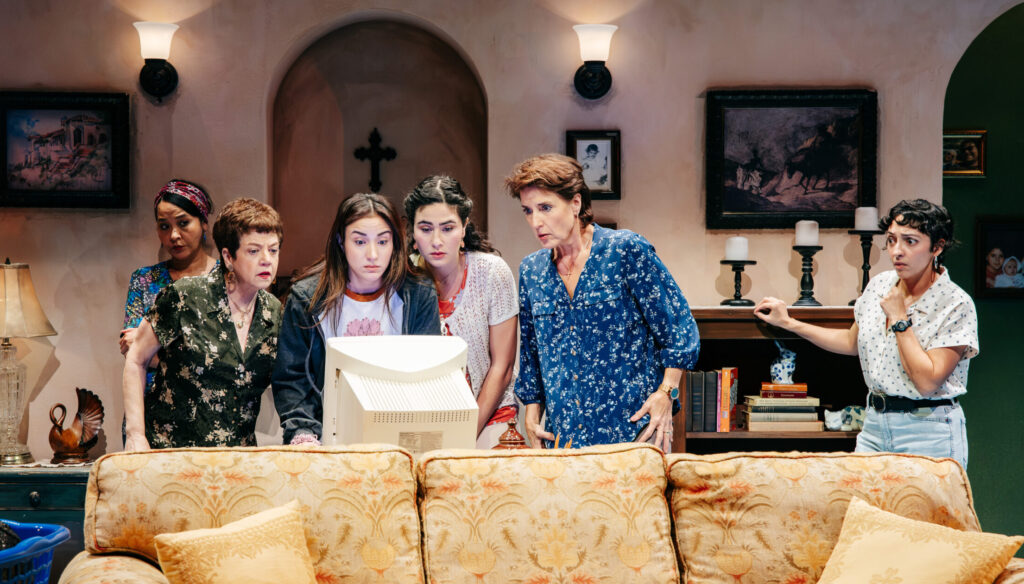
The family gathers around the computer to discover evidence of a destructive secret in Palm Beach Dramaworks’ Alba (Photos by Coastal Click Photography)
By Bill Hirschman
Modern rewritings of classic works to make them more accessible or stressing their themes’ universality are increasingly common these days.
But Alejandro Rodriguez’s world premiere Alba developed at Palm Beach Dramaworks respects Frederico Garcia Lorca’s The House of Bernarda Alba, yet transmutes it into something worthy on its own terms.
Lorca’s bleak tragedy, written in 1936 two months before his assassination, has become a mainstay in the repertoire of classics centered on family dysfunction.
Unlike Lorca’s play, Rodriguez and director KJ Sanchez’s vision threads joy, considerable humor and affection though much of the evening. But from the first scenes, omens lay the groundwork for a sinking spiral of evolving tragedy.
Rodriguez reinvents the setting, time period, environment and injects the effect of changing culture. Specifically, a present-day young poet recreates for our eyes his Cuban-American family in August 2001 Miami that he had been estranged from until recently.
A key in the themes and motivations is detailing the heroines’ loss of cherished solidity in pre-Castro Cuba, clashing with the social, economic and emotional challenges refugees faced building a life in America.
Rodriguez adopts Lorca’s themes of repression, passion, conformity, and inspects the effects of men upon women, adding a significant emphasis on sexual pressures on young people.
Yet, he has created a classically constructed Arthur Miller-like family kitchen sink drama with secrets, conflicts and personalities colliding in a closed tight environment.
Again, unlike the classic, Sanchez and the skilled cast gift us with a powerhouse lifeforce flowing almost from the opening scene that drives through the evening. Some kind of reverse magnetism draws us inside.
The plot opens as a young poet retells reflective memories of his family a generation before. The poet is talking to someone, although we never know who until the final minutes. Rodriguez intentionally keeps the audience a bit off-balance as his characters are.
Alba (the poet’s now-deceased grandmother) and her extended family are preparing their modest but well-maintained working-class home for a gathering after the funeral of Alba’s husband. As one person quips about the close quarters – eight people living in three bedrooms — “That’s Cuban mathematics.” There are a score of such quips.
Besides Alba (an astounding Maggie Bofill), there are daughters Angie (Dayana Morales), the stalwart trying to keep the family bonded; Amelia (Gianna DiGregorio Rivera), an emotionally troubled teen and computer whiz aiming for college; and Adela (Diana Garle), a rebel straining to escape the suffocating stricture of this home.
Then there is Josephina (Mary Lou Simo), their grandmother with severe dementia; her Honduran nurse Gladys (Mónica Quintero), and Yolanda (Barbara Bonilla), Alba’s verve-brimming friend since before they left Cuba. The unnamed poet (Matthew Ferro) narrates from the sidelines but occasionally wanders through the past.
Over the next few weeks, we watch the family struggle, often with communal humor and affection, sometimes roiling in two ferocious melt downs.
Alba is desperately wrestling with debt and the ever-encroaching outside world that she fears will destroy her family. She wants to model their lives on that reliable world she lost when she escaped Castro.
Like Lorca’s title monster, this Alba is a towering tyrannical figure. She is curt, commanding, seemingly cold and callous to the point that one daughter terms her Wicked Warden of the West.
ALBA: This is not a conversation. From now on, you are there, or you are here. That is it. No more parties, no more “gettys.”
ADELA For how long?
ALBA: Hasta que la rana críe pelo (Until the frog grows hair) Or until you move out, whichever comes first. Do not ask me if you can go to a sleepover. Do not ask me if you can go to the dance. Do not ask me if you can go watch a movie at Sunset. The answer is no, no, y no. If it costs time or money, and everything costs time or money, the answer is NO.
But an even more searing scene portrays Alba scorching the walls: “Silence! All of you! THIS IS MY HOUSE! DO YOU UNDERSTAND? YOU ALL ARE IN MY HOUSE! That roof?! I put it there! These walls?! I hold them in place! Even the air you breathe, IS ON LOAN! FROM ME! DO YOU UNDERSTAND? If I wanted to I could reach into your little throats and snatch it back, SO HELP ME GOD!!! SO WHEN I SAY WE WILL BE RESPECTABLE, GOD-FEARING WOMEN IN THIS HOUSE.”
But here’s the underlying difference and a crucial theme of Rodriguez’s play based on his own grandmother: Alba is a complex multi-faceted creature who secrets a genuine protective love for her family. Much of her exterior is not just trying to reestablish and reaffirm the universe she knew, but now striving to find dry land while adrift in a world of uncertainty. Rodriguez has said he wanted to “dimensionalize” her.
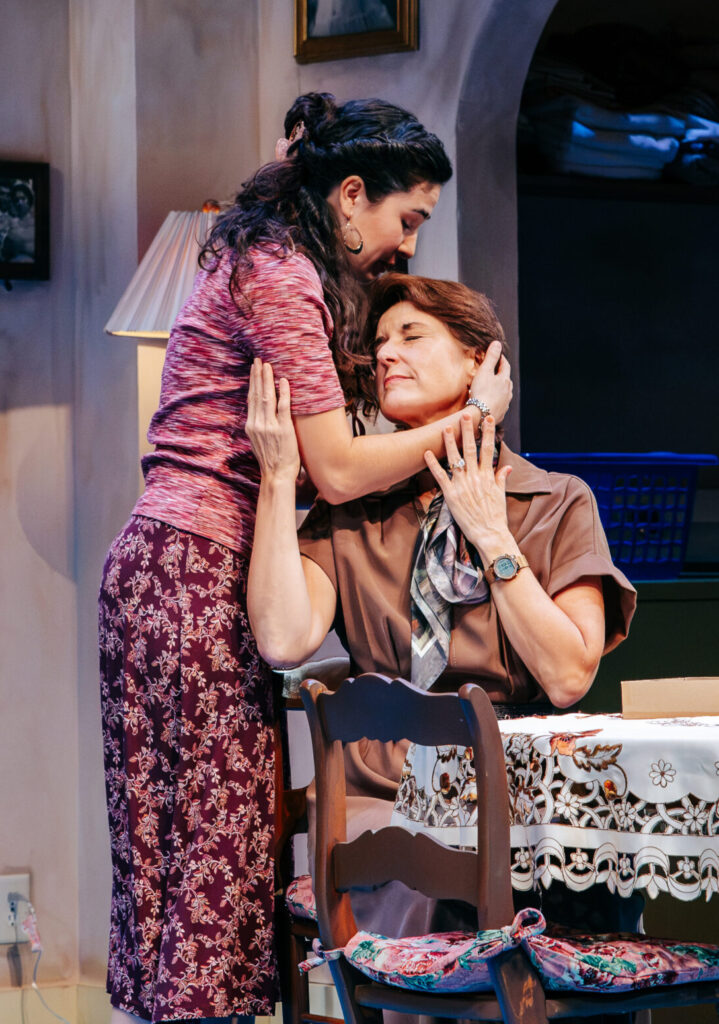
Dayana Morales and Maggie Bofill
Amelia chides Adela: “You think mom chose to be here? You don’t think she’d prefer to be back in Cuba? With her cousins and her aunts?,,, Put yourself in her shoes. One minute, you’re in school, chilling with your friends, telling jokes; the next minute, you’re thrust into this portal with one suitcase, and on the other side … gibberish. Everywhere around you. You can’t understand … anything. The career you had … gone. The friends you grew up with … Then when you get here, you don’t even have time to say, fuck…. No. You have to get papers. You have to find housing. You have to figure out what the hell everyone is saying. You really think anyone would choose that? Voluntarily?”
Everyone connected to the production, again especially Bofill, credibly delivers guarded moments and memories and reflections that expose Alba’s genuine love for these people, such as a small grin when Alba views Adela’s wild dancing.
Some scenes are borrowed from Lorca including a sudden bolt of shock when Alba stops Angie from going outside to meet her boyfriend — wearing what Alba considers too much makeup. She angrily grabs the girl and forcefully wipes it off her face.
While the dialogue is naturalistic, Rodriguez gifts his poet narrator with an artist’s bent for metaphors such as when he recalls his reaction at Alba’s death whom he had not contacted for years in his self-imposed estrangement.
“I thought I would feel grief, but … I felt nothing. Which in turn, made me feel guilt. So I started playing her voicemails over and over. The ones I had saved on my phone, that she left when she couldn’t reach me. Which was …. all the time. And it was, like, listening to a photo fade. Or a ghost being born. I wanted to reach through the phone and pull her out.”
Deepening the flavor of place and time, the evening is peppered with Spanish phrases, interjections, exclamations and homilies. The script states “The play is unabashedly multilingual, and purposefully designed to elicit those alternating moments of comfort and disorientation that such experiences inspire.”
Fortunately for those of us who don’t speak the language, the actresses’ expert delivery delivers their emotional meaning. But there were scores of times that the specific verbiages were a source of humor judging by the laughter of many in the audience.
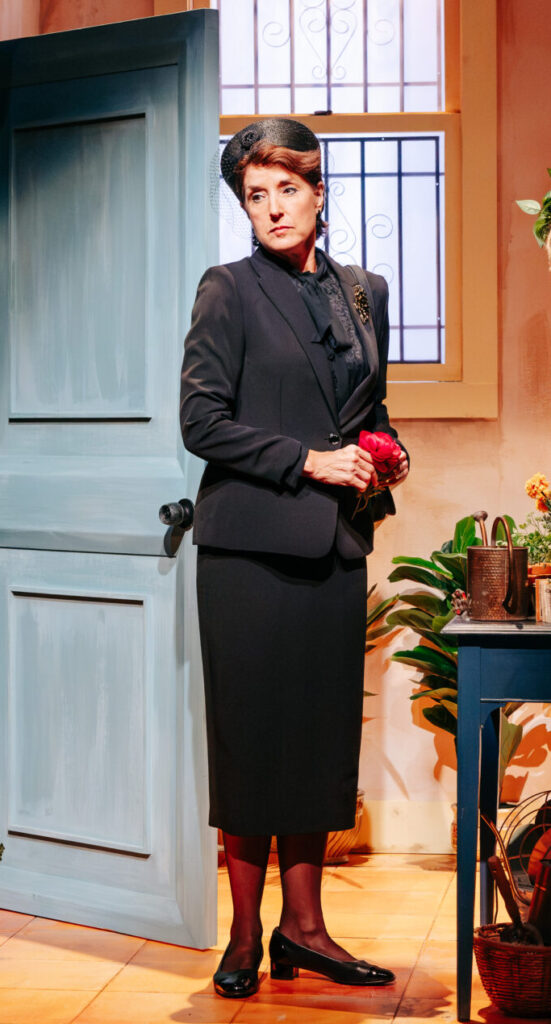
Maggie Bofill
Every member of this cast is marvel-inducing. But rightly, your memory will be Maggie Bofill’s stunning inhabitation of Alba. She creates a proud unlikeable force of nature with a buried fear of the possibility of destructive forces like those that destroyed her past. She strides, she gesticulates, she commands. Sometimes she is harsh and autocratic, occasionally you can see Alba’s submerged stress and pain.
Sanchez deftly leads the effort with invisible but subtly effective staging and ensuring that the family banter propels the flow. She is an associate professor in the Department of Theatre and Dance and the head of the MFA Playwriting/Directing programs at the University of Texas at Austin.
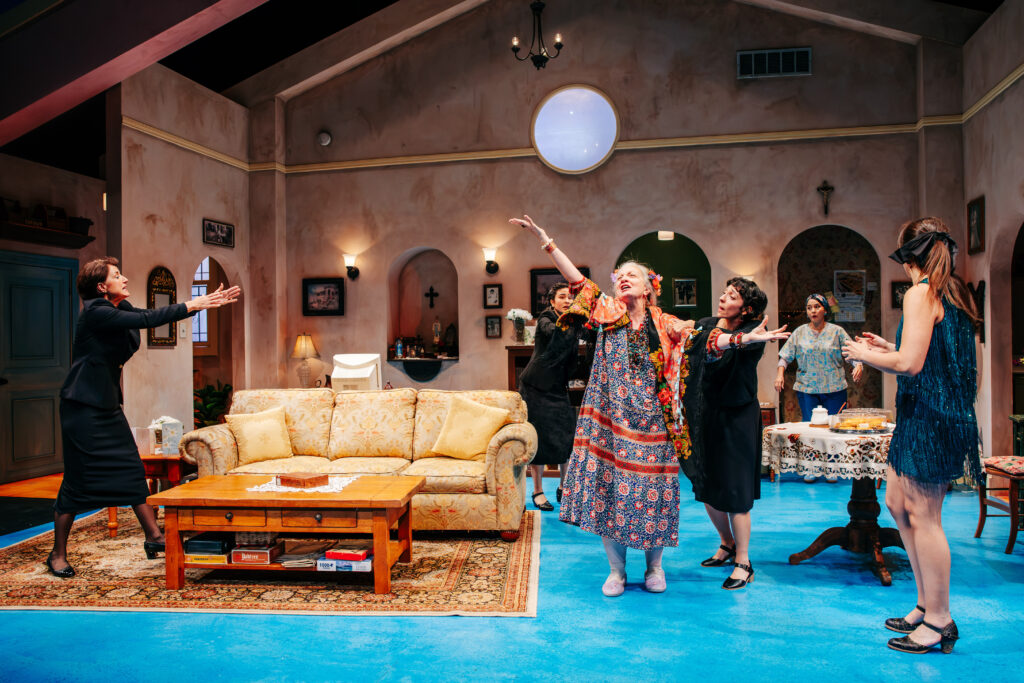
Brian O’Keefe’s costumes range from the ebony mourning dresses (slightly different for each person) to the everyday wear in the house to a plot-key green dress that Tina Turner might envy.
Tanya Orellana and Danielle DeLaFuente further the sense of time and place with their creation of the home including a laundry room plus walls with crosses and family photos from the past (many of the actresses’ own families). Attention to detail includes putting an air-conditioning vent near the top of one stage-high wall. Adding to it are the numerous sounds coming from outside the home, plus inside computer startups and cellphones via Roger Arnold. Robert J. Aguilar’s lighting further directs the audience’s attention.
Rodriguez is a Miami-based Cuban-American theater artist and Juilliard graduate who unveiled a draft during Dramaworks’ 2025 Perlberg Festival of New Plays.
It’s a work that deserves to travels far beyond this region which is celebrating Hispanic Heritage Month.
Alba plays through Oct. 7-25 at Palm Beach Dramaworks, 201 Clematis St. in West Palm Beach. 2 pm. Wednesday, Thursday, Saturday, Sunday; 7:30 p.m. Wednesday-Saturday. Running time is 2 hours including one intermission. Tickets $101 plus service charge. For more information, visit https://www.palmbeachdramaworks.org.
Our preview feature about the production can be read at https://shorturl.at/a6wlY
Numerous videos are on Palm Beach Dramaworks’ Facebook page\









 A PaperStreet Web Design