




 By Britin Haller
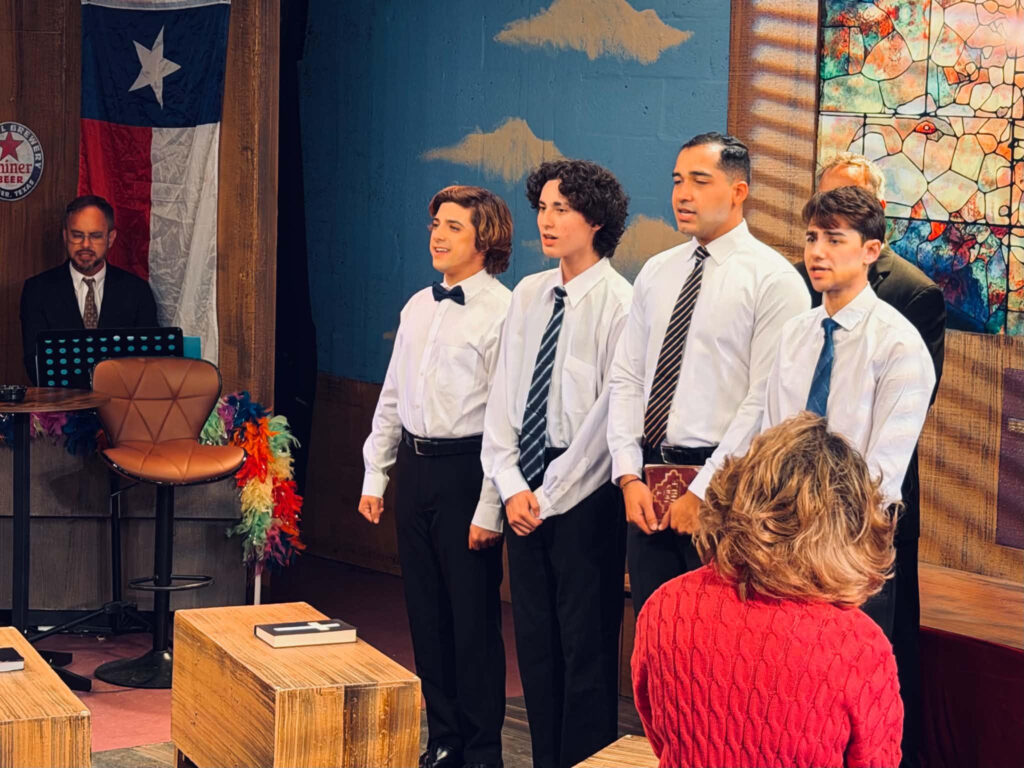
Southern Baptist Sissies, now running at Empire Stage from ArtBuzz Theatrics, begins innocently enough with four young men in white shirts singing in lovely four-part harmony. There are church pews, a stained-glass window, familiar Christian hymns, and an atmosphere so convincing you half expect someone to pass the collection plate. Then playwright Del Shores and Director Larry Buzzeo get to work, and before it’s over, we realize we’ve been taken to church in more ways than one.
The story is largely seen through the eyes of Mark Lee Fuller (Kole Rosin), who serves as narrator as he looks back at his childhood growing up in the Calvary Baptist Church in Dallas, Texas, alongside his three friends T.J. (Matthew Almeida), Andrew (Graysen Master), and Benny (Brian Piedra). They’re all gay, but each responds differently to the religious teachings that tell them there is something fundamentally wrong with them, and that they are incompatible with the God they have been taught to worship.
Mark is the deep thinker of the group, questioning everything and pointing out the hypocrisies he finds in the Bible. T.J., Mark’s first crush, chooses another path trying to suppress his sexuality by liking girls and wanting to build the life his pastor says he is supposed to. Andrew desperately wants to believe enough, pray enough, and behave well enough to make himself acceptable to God.
And Benny, bless him, decides if the church insists he is going to hell anyway, he might as well arrive looking fabulous.
Rosin carries much of the play as Mark, moving between questioning child, angry young man, and eventually survivor of everything these boys experience. He is forever trying to reconcile what he sees and feels with what he has been told is true, even admitting as a kid he had the hots for Jesus and didn’t know what to do with that. As Mark’s friends move further and further away from him, Rosin’s portrayal never loses sight of the wounded boy whose vulnerability remains, even as the world as he knows it is crumbling apart around him.
Almeida gives T.J. an entirely different kind of struggle. T.J. works on his walk, his voice, and everything else that might betray the part of himself he is determined to bury. Almeida’s scenes with Rosin are tender enough that we understand exactly what is being lost, particularly when the two boys move beyond friendship. Their chemistry makes the relationship matter, which makes T.J.’s determination to deny it all the more painful because it’s obvious to anyone but T.J. that he’s protesting too much.
Master has perhaps the most emotionally punishing assignment as the boy who keeps his Bible close and believes if he prays hard enough, God will take his homosexuality away. His monologues become progressively more difficult to watch as Andrew describes wanting the safety of a man’s arms while simultaneously believing that desire condemns him.
Master does not overplay it, instead letting Andrew’s desperation accumulate, a restraint that makes the character’s journey even more devastating. Andrew has the most painful arc of the four, and Master handles it with a sensitivity and understanding wise beyond his years.
And then there’s Benny, who rather than fight his urges gives into them blissfully, becoming female illusionist Iona Traylor (think about it), and others like Tina Turner. Piedra has a wonderful time with the transformations, but his performance is more than an excuse for wigs and drag routines, because compared to his friends, there is something lovely about seeing Benny not treating himself as a problem needing to be solved. Piedra gives Benny deep warmth, as well as flamboyance, and his appearances provide some of the evening’s best moments.
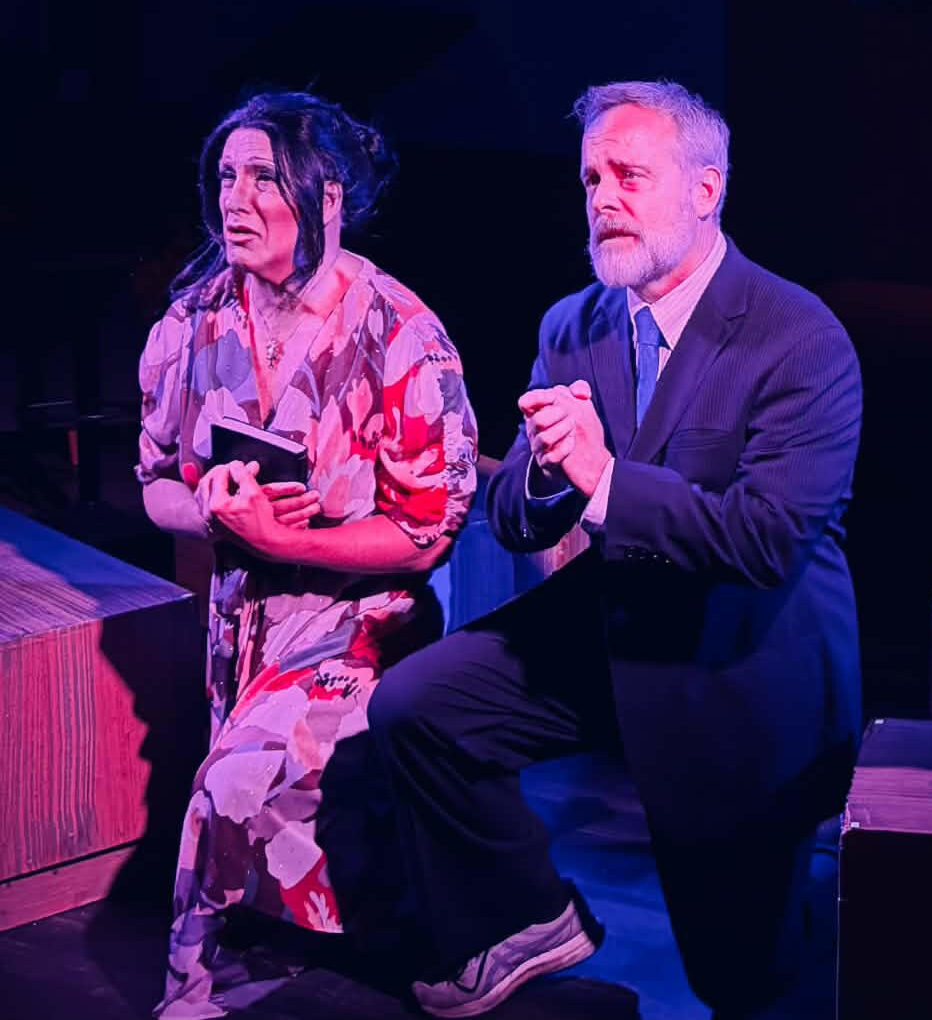
Standing at the pulpit is David R. Gordon as the Preacher, and Gordon delivers his sermons with enough conviction that for a moment you may find yourself checking the program to make sure you haven’t accidentally walked into a revival meeting. That conviction is exactly what the role requires. The Preacher cannot become a cartoon villain, because it is precisely his absolute certainty about sin, salvation, and “deviant” behavior that shows us how deeply such words, delivered as unquestionable religious truth, can burrow into a child and remain there forever.
Fortunately for us, Del Shores apparently realized that an audience can absorb only so much damnation before demanding a cocktail, so enter Odette Annette Barnet (Lisa Kerr) and Preston “Peanut” LeRoy (John F. Hernandez) from stage right. And thank Heaven for them because just when all that Baptist guilt threatens to send us scrambling for an antidepressant, in stroll the twosome as former church-goers and barflies with enough alcohol, one-liners and unsolicited opinions to qualify as the unsanctioned descendants of Muppets Statler and Waldorf. All they’re missing is the balcony.
Every time these two wander back into the action, you know relief is coming. Peanut’s complaints about such pressing matters as excessive back hair are met by Odette with exactly the amount of sympathy they deserve, and Odette, who describes everything in her life as an “unfortunate incident,” receives much the same compassion back from Peanut.
Kerr and Hernandez are terrific together with comedic duo timing that can’t get any sharper, a seemingly effortless rapport, and dialogue that never disappoints. But Shores has a trick waiting for us because just when we decide their sole purpose is to keep us laughing, their stories deepen, and the jokes begin revealing loneliness and old wounds underneath, particularly as Odette talks about the gay brother she once tried to pray straight. Suddenly, Statler and Waldorf have wandered out of the balcony and broken your heart.
Director Buzzeo also appears onstage playing the Mothers, plural, because Shores wrote Mark’s, Benny’s, and Andrew’s mothers to be played by one performer. Buzzeo had some initial doubts about whether he should have cast a woman, but we are confident he made the best choice because his Mothers add exactly the right layer of camp this production needs. One minute Buzzeo is turning around on the church pew and giving the audience a little wave; another incarnation arrives in leopard print, platinum hair, and enough personality to announce herself before she even opens that mouth that never stops chomping on a big wad of gum. Buzzeo even gets his signature laugh in there.
There’s something so poetic about a man in drag playing the Christian mother of gay boys, yet Buzzeo never allows the Mothers to become mere caricatures. Instead, when their stories become serious, he goes with them. The humor comes from character, costume, attitude, and Buzzeo’s wonderful willingness to go just far enough without bulldozing the emotional material. Once again, Buzzeo proves why he is one of our South Florida theater community’s most precious gifts.
Christopher Hamblin appears as both Brother Chaffey and the gay-bar’s piano-playing “straight man” to Odette and Peanut. Hamblin also does excellent work as the musical director, with familiar church songs like “When the Roll is Called Up Yonder” immediately placing us inside the boys’ religious upbringing. The four-part harmonies are sweet, creating an interesting tension because what sounds so comforting to our ears is coming from the same world teaching these boys to fear and loathe themselves.
Larry Buzzeo and David R. Gordon
Visually, the production does not need to get fancy. Buzzeo’s scenic design gives us the suggestion of a sanctuary without crowding Empire Stage’s intimate space, then lets the actors and Shores’ writing do the heavy lifting. Preston Bircher’s lighting takes us between the church, the gay-bar, and the more intimate scenes, while David Hart’s sound design keeps the music integral. The incomparable in-house Patrick Vida serves as stage manager and works the board. Vida’s transitions are smooth, a talent particularly important in a play that moves through memory and time.
Playwright Del Shores knows this territory intimately having grown up gay as the son of a Southern Baptist preacher in Texas. Shores is also responsible for Sordid Lives, another work exploring the collision between religion and sexuality. Southern Baptist Sissies premiered at Los Angeles’ Zephyr Theatre in 2000 and became one of his most acclaimed works, winning the GLAAD Media Award for Outstanding Los Angeles Theater Production, among other honors.
In 2006, Delta Burke (Designing Women’s iconic Suzanne Sugarbaker) played the three Mothers in the revival and subsequent national tour with Leslie Jordan that came to Fort Lauderdale’s Parker Playhouse in November of that year. Surprisingly, Southern Baptist Sissies has never played Broadway or Off-Broadway. Burke certainly did, but not in this show.
More than a quarter-century after its premiere, Southern Baptist Sissies has unfortunately not become a period piece. The questions Mark asks about what is true, what is taught, and what happens when religious certainty collides with human reality remain painfully recognizable. Shores, however, does not surrender us to despair and disillusionment, because Mark’s recurring dream of a perfect world, one that is built on acceptance and understanding, eventually becomes the play’s answer to the condemnation surrounding these boys.
And even though the church pews that began the evening as familiar pieces of Sunday-morning furniture have accumulated a lot of baggage by the final scenes, Mark arrives at something closer to hope, a belief that love in all forms may be considerably less complicated than the people who keep writing the rules for it.
Southern Baptist Sissies earns its laughs, its tears, and the strong audience response that followed both. Thankfully, an initial decision not to make it Carbonell Award-eligible was rescinded by the powers that be. Perhaps they realized the careers of this quartet of incredible young men could literally be made by this remarkable show.
Or perhaps they realized what they have created here is so special it deserves every opportunity to be recognized by its peers; a show where everyone does their job beautifully, from the four who carry the central story, to Gordon’s frighteningly convincing Preacher, to Buzzeo’s parade of Mothers, to Lisa Kerr and John F. Hernandez swooping in periodically to save us from emotional collapse.
Southern Baptist Sissies understands it needs both halves of that equation. Play the whole thing for laughs, and it loses its soul. Play it as two plus hours of suffering, and everyone watching will need to stop for anxiety meds on the way home. Shores’ marvelous script, and Buzzeo’s stunning direction, find the middle ground, and the result is a stellar production from beginning to end.
Go for the performances of the immensely talented young men. Go for Shores’ writing. Go for the four-part harmony. Go for Larry Buzzeo chewing gum in a platinum wig. And when things get too heavy, do not worry because Odette and Peanut will be along shortly, probably with a drink, an inappropriate observation, and absolutely no intention of minding their own business.
Simply put, Buzzeo’s Southern Baptist Sissies is one hell of a revival.
Southern Baptist Sissies plays through Sunday, October 4 at Empire Stage, 1140 N. Flagler Drive, Ft. Lauderdale (two blocks north of Sunrise, east of the railroad tracks); Fridays and Saturdays at 8 pm; Sundays at 5pm. Many performances are already sold out. Running time approx. 150 minutes includes an intermission. General admission tickets are $40. Call 954-678-1496, or visit empirestage.com.
Britin Haller is a journalist, editor, and author who serves on the board of directors for the Mystery Writers of America Florida Chapter. As a celebrity wrangler, Brit regularly rubbed elbows with movie, sports, and rock stars, and as a media escort, she toured with NY Times bestselling authors. After appearing in local musicals and all-state choir, Britin studied theater at Indiana University (a Big 10 college) and the University of Evansville (Rami Malek’s alma mater).







 A PaperStreet Web Design