





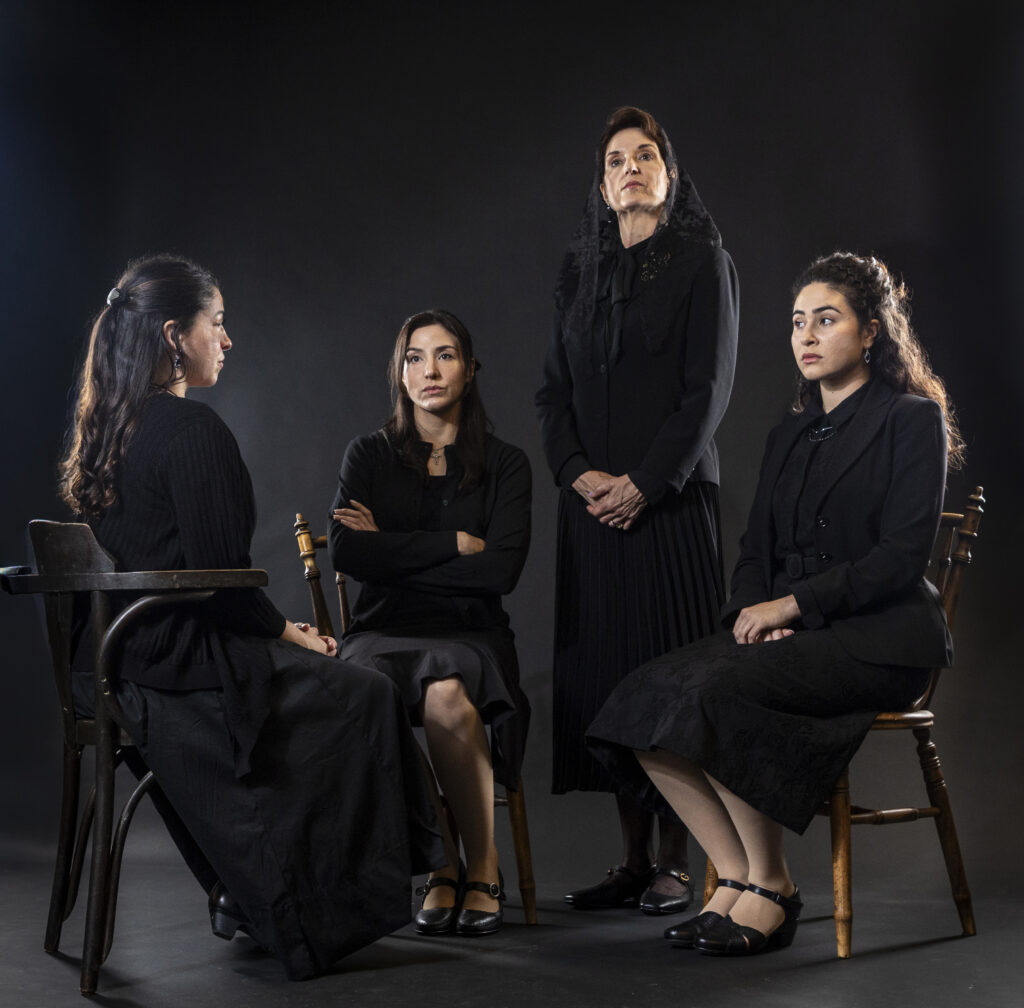
The women of Alba: (from left) Erica Negron, Diana Garle, Maggie Bofill and Dayana Morales (Photo by Jason Nuttle Photography)
By Aaron Krause
How many times have you inspired someone to contact their long-estranged grandparent?
Alejandro Rodriguez can claim that feat multiple times.
In particular, audience members at a reading of Rodriguez’s new play, Alba, told the playwright that his piece moved them to call a long-estranged grandparent.
Rodriguez hopes his new play prompts you to talk about your own family members on the ride home from the theater.
Alba, inspired by Rodriguez’s late grandmother and the classic Federico García Lorca play, La Casa de Bernarda Alba, is set to receive its world premiere production from Oct. 7-25 at Palm Beach Dramaworks in West Palm Beach. Preview performances take place on Oct. 7 and 8, and opening night will be Oct. 9 in the professional, nonprofit theater company’s space on Clematis Street.
PBD introduced audiences to Alba during its 2025 Perlberg Festival of New Plays.
“The reading was such a success that it led to this world premiere production,” reads a PBD press release.
The play, which will launch PBD’s 2026-27 season, follows a strong-willed Cuban matriarch trying to maintain control of her house in the face of myriad encroaching forces, including newfangled technology, impatient debtors, and a young suitor with suspicious motives. The piece, set in working-class Miami in 2001, “seeks to make sense of the unspoken secrets that led to a tragic family event,” the press release reads. “That may sound dark, but Alba is also very funny.”
According to PBD, you do not need to be familiar with La Casa de Bernarda Alba in order to appreciate the world Rodriguez has created.
Rodriguez, a Miami-based Cuban-American theater artist and Juilliard graduate, said he has long admired Lorca’s writing. And yet, “I’ve never seen a single Lorca production that I’ve liked. When I saw his work done in the U.S., it was all mood, very heavy, and dense. And I often found the characters mean-spirited. I just thought, ‘How can I like this playwright but not the productions of his plays?’ That’s when I began thinking about a modern adaptation.”
Rodriguez’s memories of his grandmother also inspired him to pen Alba. She died in the summer of 2020, and as he thought about her, he began writing down stories from his past.
“It occurred to me that she was kind of a Bernarda Alba type,” Rodriguez said. “Let me be clear: By that I mean she was a strong-willed woman who ran her house in a very specific way that others would probably evaluate and describe as tyrannical. But I loved my grandmother and she was very sweet with me. And that’s where the adaptation was born. I thought I might be able to complicate the Lorca story in a way that’s resonant with contemporary audiences.”
While the story is similar to Lorca’s play, the details, tone, and the singularity of each of the characters are quite different from the source material. Rodriguez said his play is “way funnier than Lorca’s play. I’m confident you’ll be laughing for more than half of the night. As KJ (Sanchez, the director) keeps telling our actors in rehearsal: It’s a comedy…until it’s not.”
Rodriguez became acquainted with Sanchez at PBD’s 2025 Perlberg Festival. Sanchez, “a true force in the American theater,” according to the playwright, directed the festival reading and helped shepherd the play to its upcoming world premiere production. Rodriguez spent time working on the play with Sanchez at her home in Austin, Texas, where she’s an Associate Professor in the Department of Theatre and Dance and the head of the MFA Playwriting/Directing programs at the University of Texas at Austin.
They streamlined the play’s action, focusing it on the heightening stakes within the family. Rodriguez and Sanchez also expanded the role of the caretaker, Gladys, “from a character on the margins of the story to a woman with her own center of gravity,” Rodriguez said. “Finally, KJ helped me understand and integrate the narrator character, mysteriously called ‘The Poet,’ into a role I feel elevates our adaptation and makes it truly unique and personal.”
The narrator is “the one character I didn’t transpose, or repurpose, or reimagine from Lorca’s play,” Rodriguez said. “I invented him completely out of whole cloth, and to be honest, I wrestled with that decision for quite some time. In the end, I surrendered to the truth that it sometimes takes the distance of a generation or two to see a family member in a new light. My primary purpose in writing Alba was to dimensionalize this misunderstood woman, and putting her grandson on stage really helped to add a layer of understanding that would have otherwise been absent without him. Plus, it’s called ‘intergenerational trauma’ for a reason – it pays off, I think, to see how these behaviors trickle down through subsequent generations.”
Rodriguez said he set the play in Miami due to his familiarity with the city, and its 2001 setting is not random.
“I needed (the title character) to be afraid of the ‘world outside her door’ as she is in Lorca’s play, and the year 2001 provided the perfect fulcrum moment in our society to make that possible. It’s when the iPod was first released, Wikipedia was born, the 24-hour news cycle came online, and so on. Personal computers and digital cameras were entering people’s homes, and the fear of this encroaching (and still wholly unfamiliar) technology was the perfect threat for Alba to respond to in the play. I’d also point out the story is set in August of that year. Consider what happened in September of 2001, and you’ll have a sense of just how much of a precipice society was on.”
Expect the characters to speak English and Spanish.
“I believe theater – among other things – is a place where we go to get some necessary practice with pluralism,” Rodriguez said. “Literally, we practice sharing space with difference – different worldviews, different political opinions, and yes, different languages. It’s like a gym for democracy — between you and me, we can use the reps! I believe in inviting audiences to navigate the healthy discomfort of not understanding every single word at every single moment, but to welcome the mystery and suspense of piecing the story together through body language, tone, and context. It’s an experience most newcomers to this country know too well.”
While you may not understand every word, “we’ve made sure all the important plot points you need to enjoy the story are repeated, clearly, in English, for patrons we cherish and do not want to alienate,” the playwright said. “I think it not only makes us better neighbors, but it makes for a richer, more meaningful night of theater.”
Alba will have its world premiere production from Oct. 7-25 at Palm Beach Dramaworks, 201 Clematis St. in West Palm Beach. Previews are set for Oct. 7 and 8, while opening night is on Oct. 9. For more information, visit https://www.palmbeachdramaworks.org.









 A PaperStreet Web Design