





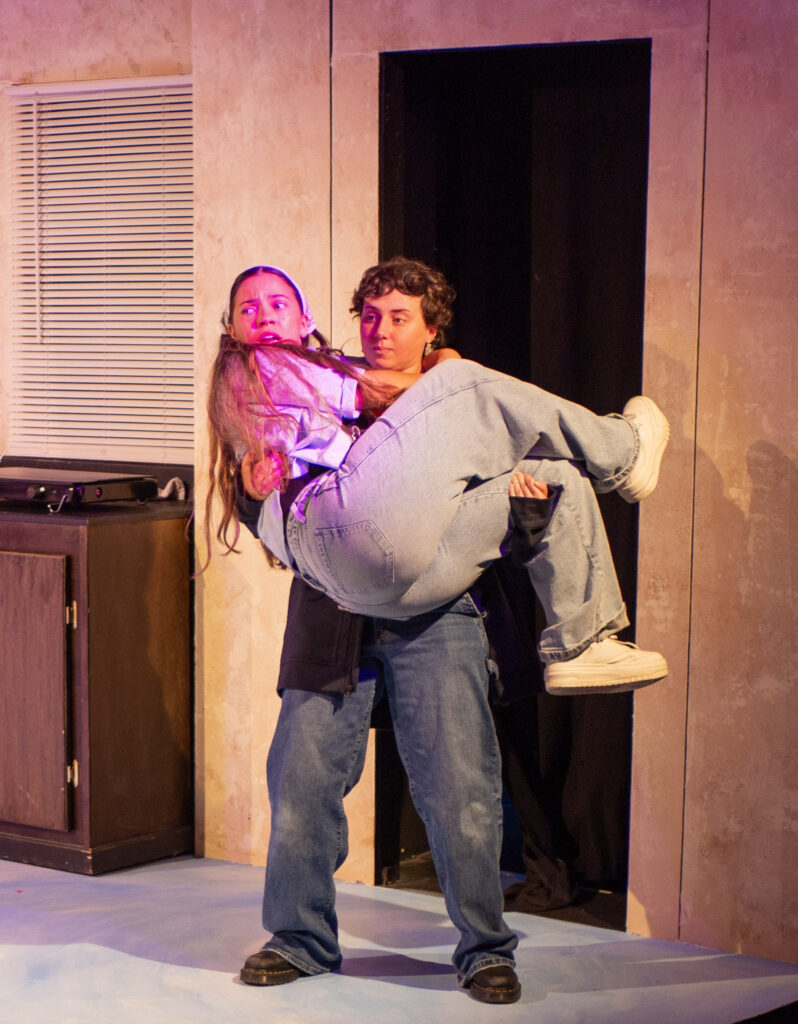
Jessica Calle as Gwen and Nico Graves as Kevin. in Brandon Urrutia’s , Kevin and the River Flan from Main Street Players
By Aaron Krause
We’ve all been there: You swat or stomp on an insect and experience perhaps a pang of regret. But then there’s the title character in Brandon Urrutia’s intriguing play, Kevin and the River Flan. After he accidentally strikes and kills a butterfly with his car, he spirals into a state that makes him question his worth and whether to carry on.
Thankfully, Kevin and the River Flan, while dark, isn’t a play that depresses us into despair. Rather, Urrutia’s piece uses hope and humor to engage with a subject many artists might avoid: suicide. Main Street Players’ solid professional world premiere production runs for one more weekend at the company’s intimate space in Miami Lakes. The production lasts about 80 minutes without an intermission.
Under Ina Ruiz’s smart direction, the play stars talented performers Nico Grimes, Jessica Calle, Chiara Jacobus, Giuseppe Fusca, and Rubi Del Rio-Herrera.
Kevin and the River Flan is a surreal, bilingual coming-of-age drama that blends realism and fantasy to explore themes of suicide, guilt, existential despair, personal loss, and cultural identity. The play, which takes place in present-day Miami, follows Kevin, a young man whose actions send him into a downward mental spiral and a supernatural journey as he seeks to right his wrongs.
Urrutia’s piece joins a sizable list of plays and musicals that deal with suicide. Certainly, titles such as Dear Evan Hansen, Next to Normal, Spring Awakening, Rent, and Every Brilliant Thing spring to mind. These works deal with this difficult subject with honesty but without depressing audiences. Similarly, Urrutia sprinkles his play with dark humor to make it palatable while treating the topic with the seriousness it deserves. The playwright doesn’t pretend to have easy answers, but Kevin and the River Flan is a piece that seeks to keep suicide in the public consciousness so that society can confront the problem rather than keep treating it as a stigma.
When you enter the theater, the first thing that grabs your attention is a seemingly legless individual sitting upstage on a stool. He remains so still that he resembles a statue.
Other than the fact that he remains motionless and does not appear to have legs, this mysterious observer resembles an ordinary person. Dark, longish hair covers his head, and he wears dark, everyday clothing (costume designer Hunter Castlemann). He remains stationary even after the production officially begins, appearing to silently observe the action while blending in with the other scenic elements.
Set designer Amanda Sparhawk has created a spare, spacious, realistic environment featuring light-colored walls and household items such as an air conditioning vent, a cupboard-like structure, and flowers. Except for a few small windows, there is no view outside the space. The set remains largely unchanged even though the play unfolds in more than one location. This simplicity proves effective in a play in which realism gives way to dreamlike supernaturalism.
Lighting designer Danny Nieves’ mostly naturalistic lighting shifts into purple and yellow hues during scenes featuring the supernatural characters Ochún and Babalú-Ayé, helping establish an otherworldly atmosphere. At one point, a lighting effect casts a character’s shadow against the wall, further reinforcing the play’s aura of nonrealism.
While much of Kevin and the River Flan is accessible, certain cultural references and untranslated Spanish may at times make the play difficult to follow. Urrutia, who is Cuban American, has written portions of the play in Spanish without translations. In the script, the playwright warns, “Please be aware that none of the Spanish in this script is translated. I grew up unable to fully understand the language and that aspect of my life is represented in my work. I did not get subtitles, neither do you.”
In performance, however, the actors often convey meaning through telling facial expressions, gestures, and tone of voice, as well as spoken words.
While Urrutia could further develop Kevin as a character, he often comes across as sympathetic partly because he does not merely pity himself. True, he sometimes despairs, but Kevin also demonstrates a resilience that makes him easy to root for. “I’m choosing to stay alive and work through my issues instead of just escaping them,” Kevin tells Gwen.
Kevin also earns the admiration of Babalú-Ayé, a timeless Orisha character described as part San Lázaro and part Monarch Butterfly. Babalú-Ayé exists in a purgatory-like state where he encounters Kevin after the title character dies by suicide. He is also the same figure who appeared legless at the beginning of the play, sitting so still he seemed not even to breathe.
While the performances are not flawless, the actors deliver portrayals that are often believable and dynamic. As Kevin, Nico Grimes convincingly sulks, evoking a bored, eye-rolling teenager who does not want to perform chores before escaping into video games. But Grimes’ performance is not one-note. The actor sensitively conveys Kevin’s vulnerability, speaking in a voice tinged with pain and revealing a sense of helplessness through wide, frightened eyes. At other moments, Grimes captures Kevin’s determination when he expresses a willingness to confront rather than escape his problems. The performer is equally effective in moments of sympathy, particularly when Kevin learns that Ofelia’s son has died by suicide. By the end of the play, Kevin is a changed person. “He learned from his mistake. He helped Ofelia heal. Goodness came from this,” Babalú-Ayé notes about the titular character.
Jessica Calle captures Kevin’s best friend Gwen’s intense frustration with Kevin through a loud vocal delivery and forceful physicality. At times, however, the performance is overdone, falling short of the naturalism one would expect in a professional production. Still, Calle’s work is not one-dimensional. As loud and hyperbolic as Gwen can be in earlier scenes, the actor effectively shifts into moments of genuine empathy, convincingly portraying the concern of a best friend confronted with crisis.
As the “timeless” figures Ochún and Babalú-Ayé, Chiara Jacobus and Giuseppe Fusca command the stage, lending their characters an air of mystery that suggests they are not ordinary mortals. Fusca, who sits as still as a statue for much of the play, later suddenly springs to life in a striking shift in presence.
Rubi Del Rio-Herrera delivers the production’s strongest performance as Ofelia Marin. In a portrayal marked by unforced intensity, palpable anguish and annoyance pour from her as Ofelia laments the loss of her son and conveys her irritation at Kevin’s intrusions into her life. Multiple times, she slaps her thighs in frustration to emphasize her character’s exasperation. Rio-Herrera is a Miami native, but she fully inhabits a convincing accent for the role.
As the director, Ruiz makes smart, thoughtful choices. At the start of the play, Kevin lies on the floor, literally and figuratively at one of his lowest points. He refuses to eat and cannot shake the memory of accidentally killing a butterfly while driving. Gwen is clearly angry with him, yet she sits on the floor next to him, suggesting a desire to maintain connection despite conflict. The characters also share moments of physical affection at appropriate times. In contrast, Ruiz positions them almost nose to nose during moments of confrontation, heightening tension through proximity. Overall, she handles both intimate and intense moments with care and paces the production effectively.
Beyond the play’s supernatural elements lies a work that gently reminds us that while we cannot solve the ever-present problem of suicide, sometimes all it takes is a caring voice or supportive touch to remind us that, in the late, great Stephen Sondheim’s words, “no one is alone.”
Main Street Players’ professional production of Kevin and the River Flan continues through May 17 at the company’s intimate space, 6812 Main St. in Miami Lakes. Performances are at 8 p.m. Friday through Saturday, and 2 p.m. Sunday. General admission tickets are $30, while senior, student, and military tickets are $25. Visit www.mainstreetplayers.com.









 A PaperStreet Web Design