





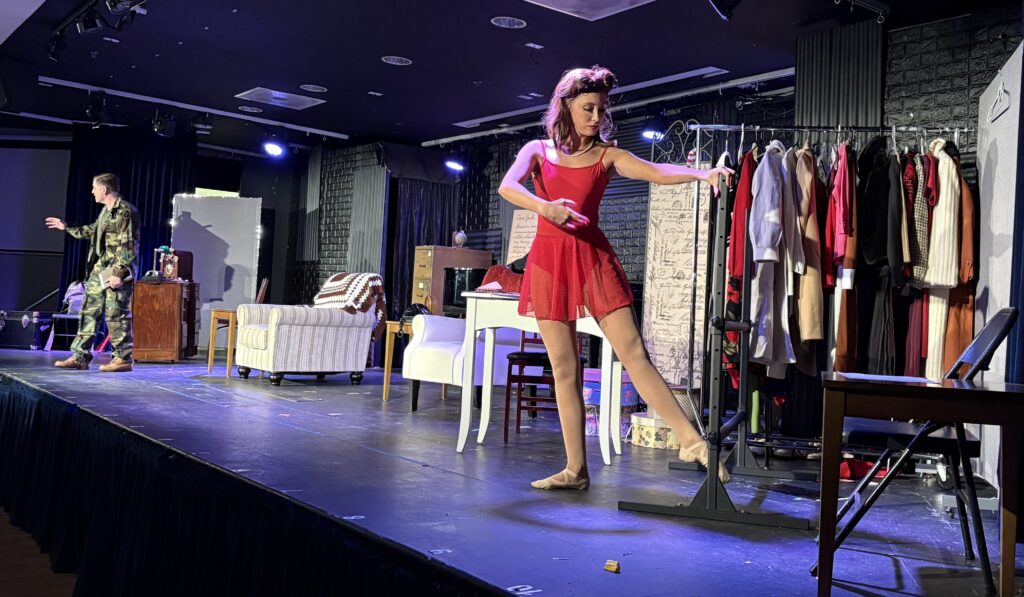
Alexandra Van Hasselt corresponds with Alex Bakalarz in West Boca Theatre Company’s Dear Jack, Dear Louise (Photos by Holly Budney)
By Britin Haller
Attention, Attention, Incoming Dispatch: Audience members and South Florida awards judges are strongly advised to report to the West Boca Theatre ASAP.
Dear Jack, Dear Louise, a dramatic comedy now playing at the West Boca Theatre Company, is the kind of show that makes you wish your Greatest Generation relatives were still alive because you know how much they’d love it. We declare a victory, because this two-person play by Tony Award-winning playwright Ken Ludwig is definitely worth writing home about.
The premise, based on a true story, is deceptively simple. Jack is a military doctor stationed in Oregon during World War II while Louise is an aspiring actress living in New York City. Through a set-up by family, the two begin writing letters to each other despite never having met, and what starts as polite correspondence becomes deeper as they navigate career ambitions and wartime anxieties.
Like two submarines passing in the night, Jack and Louise never share the stage in the traditional sense, instead occupying separate spaces, reading and responding to letters that travel across the country while the world outside their windows is changing rapidly. The result is a theatrical device that may sound easy, but requires considerable skill to pull off.
From a production standpoint, Dear Jack, Dear Louise is appealing to producers for purely practical reasons because it requires only two actors and a relatively basic set, although Director and Set Designer Holly Budney may rightfully argue that last point. At a time when many local theaters are balancing artistic ambition with financial reality, a play that delivers emotional impact without requiring an army of performers is understandably attractive.
Of course, this simplicity also places a great deal of responsibility on the actors. Without elaborate staging, or large ensemble scenes, the entire engine rests on their ability to make the relationship believable. If the audience does not care about Jack and Louise, this play has very little else to fall back on.
A two-person play can be like walking a tightrope, or performing on a flying trapeze, because everything depends on the chemistry and trust you have with your partner. A duo reading mail onstage for ninety minutes could easily become monotonous if they aren’t lively enough to sustain it. Thankfully, due to some brilliant casting, and dialogue that keeps the story moving, Dear Jack, Dear Louise soars.
 As Jack, the more grounded of the two because obviously, the war, Alex Bakalarz gives a performance that feels both deeply personal and historically accurate, capturing the quiet bravery and vulnerability of a young military doctor during World War II. He balances Jack’s intelligence with a gentle humor, allowing us to see how a man trained in science falls headlong into something far less predictable.
Through subtle shifts in tone and posture, Bakalarz conveys Jack’s growth from polite curiosity to genuine investment, particularly in the moments when the letters become more intimate, and the distance between him and Louise feels unbearable. The result is a portrayal that never feels overly sentimental, yet still carries the weight of longing and duty that defined so many real wartime romances.
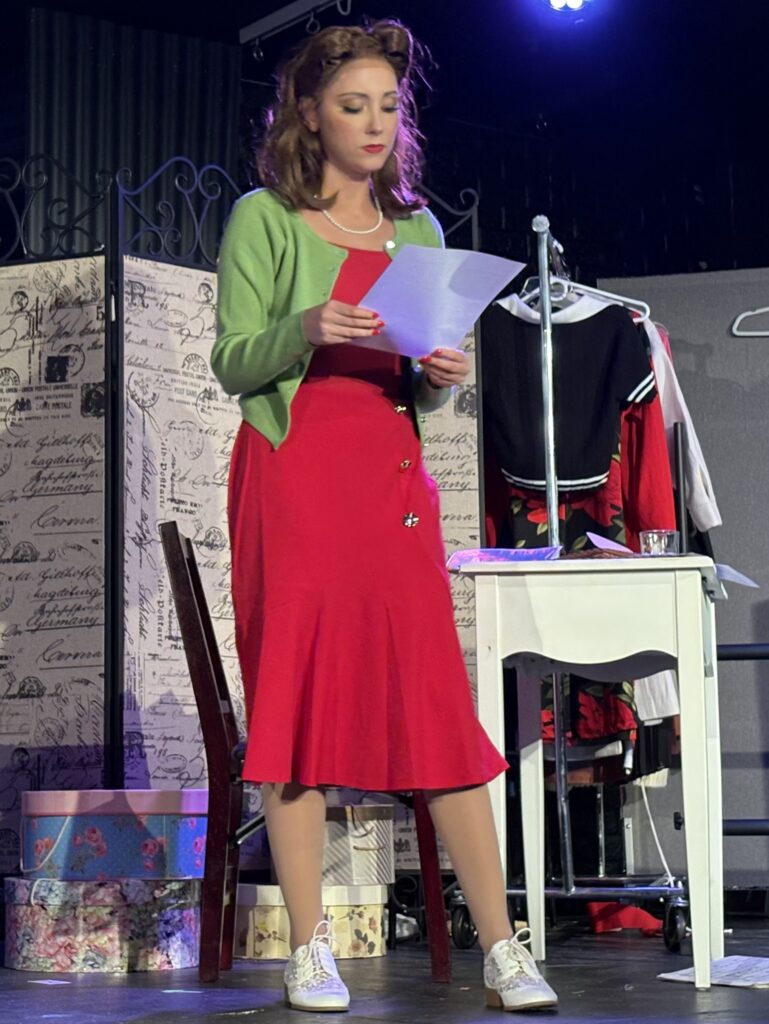 As Louise, Alexandra Van Hasselt brings a luminous vitality to the role, capturing the believable annoyance of a young woman whose life in the NYC theater world is suddenly interrupted by war. During one bit, she seems a little shallow as she goes on and on about her audition experience while Jack is literally telling her about the atrocities of war, but he doesn’t seem to mind, so why should we?
Van Hasselt skillfully navigates Louise’s playful charm giving each letter a sense of spontaneity, as though the thoughts are arriving on the page at the very moment she speaks them. At the same time, she allows glimpses of the uncertainty that is growing as the distance between her and Jack stretches across continents, and years. As an added bonus, Van Hasselt gets to show us her singing and dancing skills.
On two separate occasions on opening night, audience members interrupted the show showing no consideration for the attendees, or the actors. To their extreme credit, Bakalarz and the Carbonell Award-nominee Van Hasselt never missed a beat, especially commendable for Van Hasselt as one of the instances occurred during her big scene near the end. “Keep Calm and Carry On” was one of WWII’s most famous catch phrases, and they did just that.
Part of what makes Dear Jack, Dear Louise work so well is the way Ludwig balances romance with reality, each letter revealing a little more about who they are as individuals. She loves to dance, he has two left feet and claims the last woman he danced with is still on crutches.
The humor arrives naturally. Jack is earnest and awkward in the way many people become when speaking to someone they are trying to impress. He doesn’t want her to meet his family because he’s worried they will run her off like they did the last girl. Louise, meanwhile, is not particularly interested in pretending to be anything other than herself.
On paper, these two characters’ personalities should never mesh. But they do, even when conflict abounds like Jack’s sister Betty trying to undermine the couple. She told Louise on a visit: “My brother Jack is so intelligent,” then going in for the kill. “You’re not his type.”
Because this is essentially romantic suspense powered by the postal service, we wondered how realistic the presented time frames between letters were. What we found was that by using the train system, the mail service was surprisingly quick back then, probably faster than it is today. It took approximately three to five days to get a letter from Oregon to NYC, even less for first-class, but even so, delays were inevitable, delays that Ludwig wisely uses to his advantage because that means misunderstandings have plenty of time to flourish.
The costume design by Holly Budney is particularly striking helping to establish both the period and the characters’ personalities. Each change feels purposeful, visually charting the passage of time and subtly reminding the audience that the world outside is changing quickly too. A special thank you goes out from WBTC to Alexandra Van Hasselt’s mother, Melanie, and the FAU Department of Theatre for the use of their incredible costumes.
Jack isn’t sporting dog tags, and we can’t help but think that would have been a nice touch. Identification tags, or dog tags as they’re called, were a required part of a soldier’s attire during WWII, even when dressed in civilian clothes. And yes, while we know that history tells us they were supposed to be worn underneath the shirt, television and films often feature them on top of the clothing for dramatic effect.
In a lovely touch, Louise’s hair is styled in what was called “Victory Rolls,” so named after the barrel rolls fighter pilots perform while celebrating a win. This glamourous hairdo was both practical for women working in the factories, and patriotic, as it symbolized a “V” shape for victory. While Jack’s nicely trimmed hair would have met Army regulations at the time, we can’t help but wish Bakalarz had gone full buzz cut, or at least a high and tight. But no matter.
Dramaturg Ana Marie Calise prepared an info packet for the actors giving them a much-appreciated historical perspective, while the nostalgic music selected by Budney does not disappoint. Songs like “Don’t Sit Under the Apple Tree,” “Boogie Woogie Bugle Boy,” “It Had To Be You,” and “Bei Mir Bist Du Schoen” (To Me, You Are Beautiful) reflect the era. Alan Nash co-directed and designed and runs tech, while Mark Hernandez, who just wowed us as Stanley in WBTC’s Broadway Bound, oversaw the play as production manager.
Director Budney’s set and props are remarkable, working in total harmony with the story’s simplicity, while at the same time dropping us into a world we can only imagine. The old-timey radio last seen in Broadway Bound makes an appearance here. Jack’s Emeralite, or green banker’s lamp as it’s more commonly called, has been around since 1909. Newspaper front pages from the time period, and copies of their letters to each other, adorn the walls. And who doesn’t love a good hat box, or three?
A dressing partition and rack of clothes allows Louise to do quick and clever changes while never leaving the stage, sometimes continuing her dialogue from behind it. A grand piano center stage adds class while never being played while on top of it a table display features the Curtain Call Boarding House where Louise lives with other aspiring showgirls.
Dear Jack, Dear Louise held its first performance in 2019 at the Arena Stage in Washington D.C., and while it has had success regionally has not yet appeared on Broadway. The original correspondence the show is based on was burned by the real Louise before her death, so Ken Ludwig had to reconstruct the romance when writing the play.
Dear Jack, Dear Louise is a reminder of a slower, and perhaps more romantic, way of falling in love, capturing the simple magic of two people discovering one another word-by-word. For audiences lucky enough to share the evening with loved ones who remember those years, this play may spark conversations long after the curtain falls.
For those who lived through the war itself, the world of handwritten letters, rationing, and long separations will feel deeply familiar. For younger theatergoers, it offers a glimpse into an era when relationships unfolded slowly, and every envelope carried the thrill of possibility.
Today, the Greatest Generation is almost gone, and with it the firsthand memories of the world that shaped us. In that sense, Dear Jack, Dear Louise feels like a time capsule, preserving the resilience and hope of a decade that is rapidly slipping from living memory. The irony of waiting for that knock on the door while at home ordinary life continued, the personal sacrifices people made both personally and professionally, and the intense longing for our servicemen to just come home are all reflected here.
This March, let yourself surrender to a world when time moved slower, and Americans were united for a common cause.
And because your grandparents would want you to.
Warning: This presentation of Dear Jack, Dear Louise includes combat sounds like air sirens, strobe lights, and intense war themes. Veterans, and others, are advised to take care.
Dear Jack, Dear Louise from the West Boca Theatre Company runs through March 22 at the Levis JCC Sandler Center, 1050 95th Avenue S., Boca Raton (south of Glades Rd, west of Lyons, be prepared to present your driver’s license at the guard gate); 7:30 p.m. on Saturdays; 2 p.m. on Thursdays and Sundays. Running time is approximately 105 minutes with a 15-minute intermission. General admission tickets starting at $40 for non-JCC members. Call 561-558-2520, or visit levisjcc.org.
Britin Haller is a journalist, editor-for-hire, and an author who serves on the board of directors for the Mystery Writers of America Florida Chapter. As a celebrity wrangler, Brit regularly rubbed elbows with movie, sports, and rock stars, and as a media escort, she toured with NY Times bestselling authors. After appearing in local musicals and all-state choir, Britin studied theater at Indiana University (a Big 10 college) and the University of Evansville (Rami Malek’s alma mater).







 A PaperStreet Web Design