




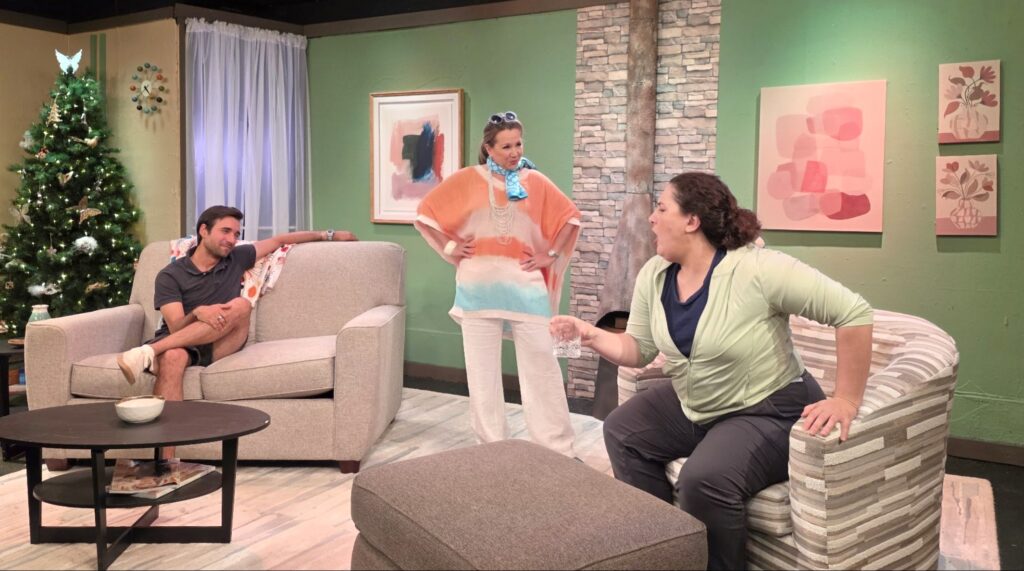
The family wrestles over suppressed issues in Bridge Across The Pond’s Other Desert Cti (Photos by Manny Zalidvar)
By Britin Haller
There is good theater, and then there is good theater. In short, Other Desert Cities, produced by a relatively new local production company and now playing at Empire Stage, is so much so in the latter category we would be hard-pressed to find anything wrong with it.
When Bridge Across the Pond’s Co-Founder Gary Solomons first saw the Pulitzer and Tony Award-nominated play on Broadway, he recognized immediately his desire to be part of it. How lovely for him to see that dream realized with Co-Founder Dan Levine.
Playwright Jon Robin Baitz’s family drama is so tightly constructed it feels almost effortless, and is, in our humble opinion, one of the best American plays of the past several decades. And Broadway obviously agrees because its upcoming revival opens in September and is due to feature Julia Louis-Dreyfus, Ed Harris, Allison Janney, Joe Keery and Lily Rabe.
Other Desert Cities is not a play to play around with. In the wrong hands, or with the wrong cast, or even with one wrong actor, it would go downhill fast. But that is not the case here because Gary Solomons has directed a highly accomplished group of actors with a tender touch, creating a masterpiece that deserves to be seen.
This is intimate theater at its best.
It’s 2004 in Palm Springs, California, where the Wyeth family has gathered for Christmas. Parents Lyman and Polly are wealthy, conservative Republicans with deep connections to the Hollywood and political establishments. Their adult daughter Brooke has returned home after several years away, joining her younger brother Trip, and their aunt Silda, for what initially appears to be an ordinary holiday reunion.
Except ordinary is not what’s about to go down, because Brooke has brought everyone a Christmas present they most definitely did not ask for.
Brooke has written a book, more specifically a tell-all memoir about the most painful chapter in their family’s history. She was just a child when her older brother Henry’s life unraveled after he became involved with a radical antiwar group during the Vietnam era. Brooke believes the book tells the truth about Henry and about what happened to her family in the aftermath.
Her parents believe its publication will destroy them. “Wait. Publish it in a few years. Just wait ‘till we’re gone,” her father tells her. “Which should only be a matter of hours the way things are going,” Polly says, earning a big laugh, of course.
Every member of this family has spent decades living with the absence of Henry, but each has found a different way to survive it. Brooke writes. Polly socializes. Lyman protects. Silda drinks. Trip smokes marijuana and tries to negotiate the minefield left behind by everyone else.
Eventually all these survival mechanisms collide, and because theater thrives on collision, the result is a fascinating study into a family where there are no easy villains. Everyone believes they are right, and more importantly, they have reasons for believing it.
And when the turn comes midway through the second act, be ready, because everything you thought you knew goes up in a puff of pot smoke when we are forced to mentally replay everything we just watched, from a cast of actors where there is literally no weak link.
As the moral center of the story, Ana Marie Calise is mesmerizing as Brooke. We loved Calise in Pigs Do Fly’s 2025 production of Painting Churches, as again the daughter of difficult parents, and here she perfects the bit. Calise’s transformation, as Brooke goes from certainty to what the hell is happening here, is a wonder to witness.
Brooke believes this is her story to tell. She has lived with the consequences of her brother’s death for years, and writing about it has become part of her attempt to understand both him and herself. Meanwhile Brooke’s parents, Polly (Michele Verdi) and Lyman (Dan Levine), see their daughter’s memoir not as an act of healing, but as a betrayal.
Levine as Lyman has the easier go of it because he’s seen as Brooke’s hero, the good guy, the former beloved actor who always nailed his death scenes, the dad who was always there with an offer of friendship, or even money. Lyman is the glue holding them all together. But even he can’t remain impartial to this new development and reacts accordingly with moments of believable anger and frustration.
Verdi, on the other hand, must be spot-on because the caricature of the woman we meet in the beginning is surface-level only, even changing her accessories in the middle of the day, and what’s underneath surprises even her. This is a woman who has buried so much so far deep inside her even she doesn’t know who she is anymore; a woman who seems to resent the year of her life she devoted to nursing Brooke through a dangerous depression. If the role of Polly isn’t cast carefully, the whole cookie could crumble.
We saw Verdi last year in another role for which she seemed hesitant, but all of that is gone. This is a Verdi who runs the show, commanding the stage with a confidence and authority necessary for the part. Well-done.
Brooke’s younger brother Trip is interesting. He might be a sex addict, although he claims to have dated a Russian woman twice his age whom he loved deeply. He produces a tacky television show called Jury of Your Peers. He knows for a fact he doesn’t want kids, and who can blame him considering the family he grew up in?
Trip is played admirably by Mark Hernandez, who’s a staple both on-stage and off at the West Boca Theatre Company. As older brother Stanley in their last season’s Broadway Bound, Hernandez showed a ruthless pragmatic side. Here he must be pragmatic as well, but with a wide range of emotions running the gamut from compassion to utter exasperation.
Lory Reyes, in the role Judith Light won the Tony for, portrays Polly’s sister Silda. She’s recently sober and trying to get healthy, but hating every second of it. “I’ve been on a diet for two weeks, and all I’ve lost is two weeks.” As the character with the best one-liners, Reyes knows how to wait for the laughs.
The relationship between the two sisters, who take turns sharpening their claws on each other, is a highlight. The siblings have refined the art of knowing each other’s vulnerable spots and poking them with astonishing accuracy. “I’m going to have to learn how to deal with you now that I’m sober,” Silda tells Polly.
Watch what the characters are doing when they’re not speaking, because blocking is critically important for this play and this small stage. There’s a moment deep in the second act when, at the exact same moment, multiple characters turn their heads ever so slightly. That’s precision, and that’s one of the details that should make Other Desert Cities stand out at awards nomination time.
Or when there’s so much to watch stage left at one point that we didn’t even catch Silda napping on the couch until she finally moved. Shout-out to Habitat for Humanity Fort Lauderdale for the loaner use of the cool furnishings, and to the scenic design team of Eric Fields, Anne Solomons and Edgar Maldonado, and the lighting design of Preston Bircher.
Fields will also do double duty for some productions when he steps in as Lyman, filling in for Levine to attend a family celebration.
Specially selected 60s and 70s songs, like “California Dreaming,” “A Horse with No Name,” and “Hotel California” add a groovy ambience.
There are moments late in the play when the emotional weight is almost unbearable, because by that point, these characters have stopped feeling like figures in a carefully constructed drama and begun feeling like individuals whose private pain we have been allowed to witness. This is not a Hallmark greeting-card family wearing matching flannel pajamas, these are flawed and damaged people finally forced to confront what actually happened on the night their world changed forever. People who love profoundly, but still want to strangle each other with a Christmas wreath.
The specific circumstances surrounding the Wyeth family may be unusual, but the emotional landmine should feel familiar to all of us because every family has stories it tells, stories it doesn’t, and stories different members remember differently. Most simply don’t have a novelist in the family threatening to publish theirs.
Funny, intelligent, heartbreaking, and beautifully constructed and directed, Other Desert Cities is the kind of play that reminds you what great theatre can do with nothing more exotic than a room, five people and a secret. Welcome to South Florida, Bridge Across the Pond. We hope you stick around for a long, long time.
Don’t miss this one.
Warning: Please be advised this production briefly includes the use of an herbal cigarette.
Other Desert Cities plays through Sunday, August 30 at Empire Stage, 1140 N. Flagler Drive, Ft. Lauderdale (two blocks north of Sunrise, east of the railroad tracks); Fridays and Saturdays at 8 p.m.; Sundays at 5 p.m. Some performances are already sold out. Running time approx. 140 minutes includes an intermission. Tickets start at $33.85. Call 954-678-1496, or visit empirestage.com.
Britin Haller is a journalist, editor, and author who serves on the board of directors for the Mystery Writers of America Florida Chapter. As a celebrity wrangler, Brit regularly rubbed elbows with movie, sports, and rock stars, and as a media escort, she toured with NY Times bestselling authors. After appearing in local musicals and all-state choir, Britin studied theater at Indiana University (a Big 10 college) and the University of Evansville (Rami Malek’s alma mater).









 A PaperStreet Web Design