





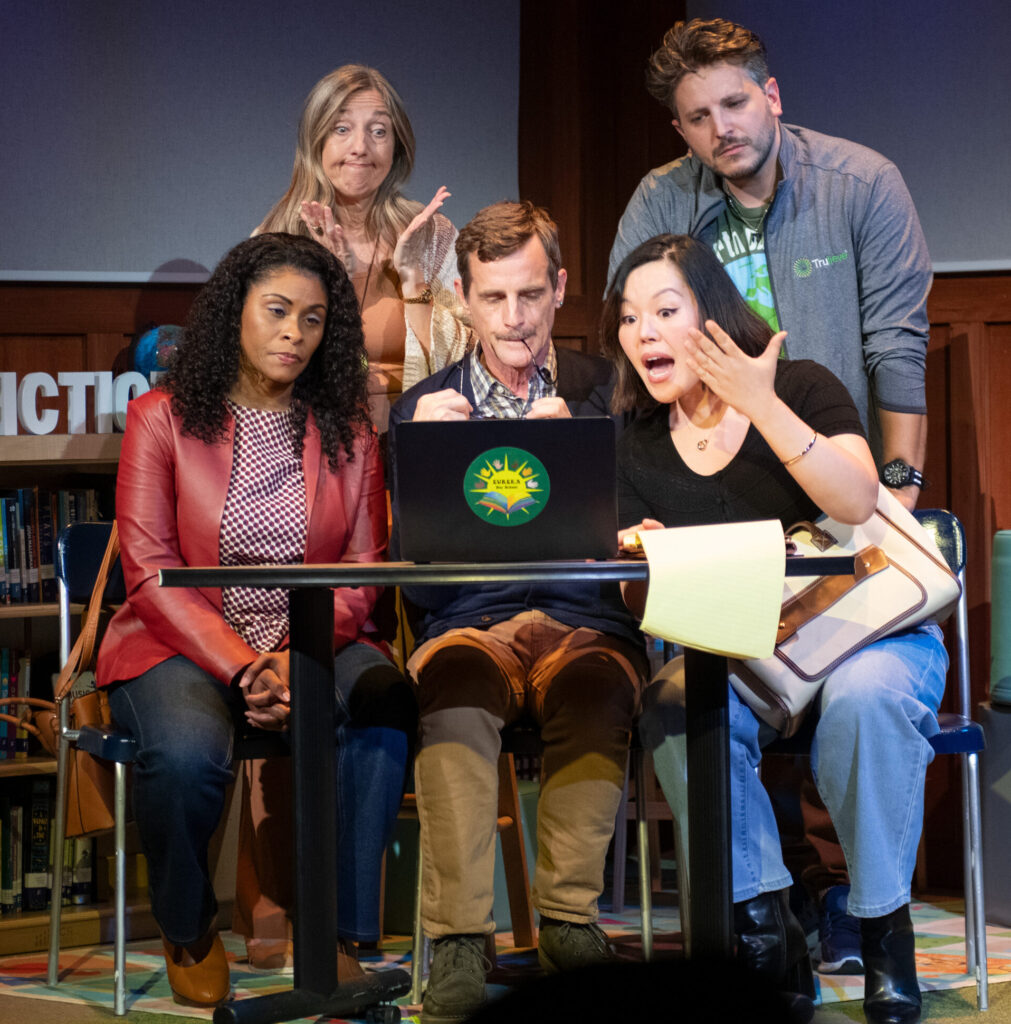
Eureka Day’s school board, from left, Rita Cole, Jeni Hacker, Mark H. Dold, Jordyn Moone and Ryan Didato (Photos by Magnus Stark)
By Bill Hirschman
This has been a hallmark season in quality for South Florida theater, but few if any productions have elicited as much laughter, rendered occasional pathos and drowned you in mind-spinning ideas at war as in GableStage’s stunning Eureka Day through June 14.
No more timely investigation can be found on local or national stages as this incisive depiction of how difficult – perhaps insoluble it might be — to develop consensus among our deeply divided fragments of society, to move us forward together when faced with calcifying crises.
Eureka Day is such a 21st Century-grounded work that it ought to be put in a time capsule for future generations to study. It is set in the 2018-2019 school year but, trust us, the real date is May 15, 2026.
Playwright Jonathan Spector’s premise is that the ultra-well-intentioned board of a private liberal-leaning elementary school Eureka Day is meeting to figure out how to deal with a county edict only allowing inoculated children to attend during a mumps epidemic. Their standing policy is not to vote on anything, but only to act if there is consensus – an amorphous goal.
In the early scenes, the initial altruistic over-eagerness on everyone’s part is gently funny. They step gingerly with political correctness and ethnic sensitivity guiding and blocking every step as if they are navigating a minefield. (The phrase “I’m sorry” is the most repeated phrase of the entire play.) Simply trying to fine-tune the social-ethnic self-descriptions of students in their admissions form, they debate the term “Transracial Adoptee.”
But then their intricate corkscrewing ideologies intertwine, get tangled – while they all strain in good faith to respect each other, but realizing that their individual dogmas clash.
In later scenes, chaos is unleashed testing tempers and receptivity, especially at the proposal of requiring vaccinations. No timeliness there, right? And they throw similar examples at each other such as what to do if different parents teach different views of evolution at home.
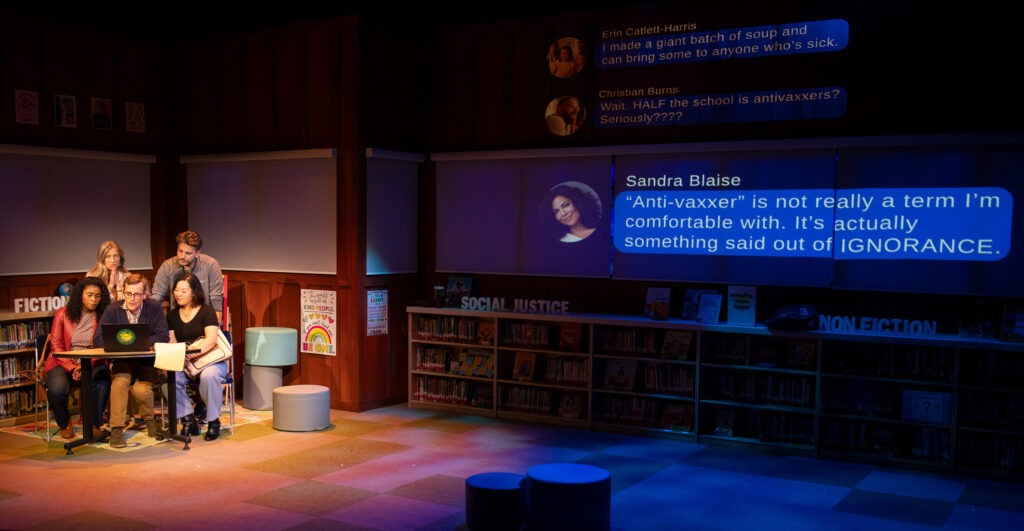
But the supremely inventive theatricality comes in the mid-point scene: “the livestream.” The board crowds around a laptop computer on one side of the room. The room’s shades serve as a screen for projections of a procession of a score of impossibly varied parents rapid firing impossibly varied opinions, with silly avatars alongside their comments. Their fractious interplay is the definition of hilarious. Joke after joke includes one woman whose only comment is a meaningless thumbs up emoji becoming a running punch line. That the online chaos nearly obliterates the specifics of the chaos of the board’s trying to manage the meeting is intentional.
 The over-caution of correctness gets a jocular jab when they recall producing Peter Pan as the school play. By this time, the audience anticipates that this somehow has been a disastrous enterprise. The principal then sincerely regrets “Aside from the extremely problematic portrayal of Native Peoples, there’s actually a whole host of Colonialist issues in terms of the content that I for one had been completely blind to.” He solved it… by setting Peter Pan in outer space.
Spector says in the script that it is possible to play the whole evening for the humor, which he advises against and this company wisely agrees. Spector even opposes seeing this as satire. They are all correct because we have to like these folks first, laugh with them second, but be able to feel for them personally for a drama-infused third act as the structure disintegrates.
Don’t mistake this for a single-minded focus on the vaccine issue; it’s only the gridiron for the play’s broader concerns about social concerns.
Brilliantly enriched by an A-list cast and equally masterfully directed by Zoetic Stage founding director Stuart Meltzer, Eureka Day slices under your skin and leaves you quietly mulling on the drive home about its troubling themes.
Because Spector is only illustrating the depth and breadth of a problem. His ringing alarm doesn’t offer any possible solution and, again, implies that there might not be one.
Can someone can be part of a social whole while being faithful to their individual ethos – and then can we agree on the required remedial action. One character intones, as socially expected, “Diversity is the source of our strength,” but, indeed, that virtue is what is preventing alliance.
Huge credit to Meltzer and the cast for the precisely paced sections, whether chaotic or introspective.
That cast is composed of some of the region’s finest talent. Rita Cole, recently in Palm Beach Dramaworks’ The Mountaintop, creates the newest member, an African-American who her colleagues miscategorize as a welfare mom. Ryan Didato is the apparently wealthy patron stay-at-home dad. Mark H. Dold, who filled this stage in the one-performer Harry Clarke, is delightful as the principal who starts off somewhat controlled, but who comes unglued verbally, vocally and physically. Jordyn Moone is a seasoned newcomer locally who plays the single mother who knits to keep her cool. A brief but crucial walk-on is given to Maleeha Naseer some shows and Alaysia Penso others,
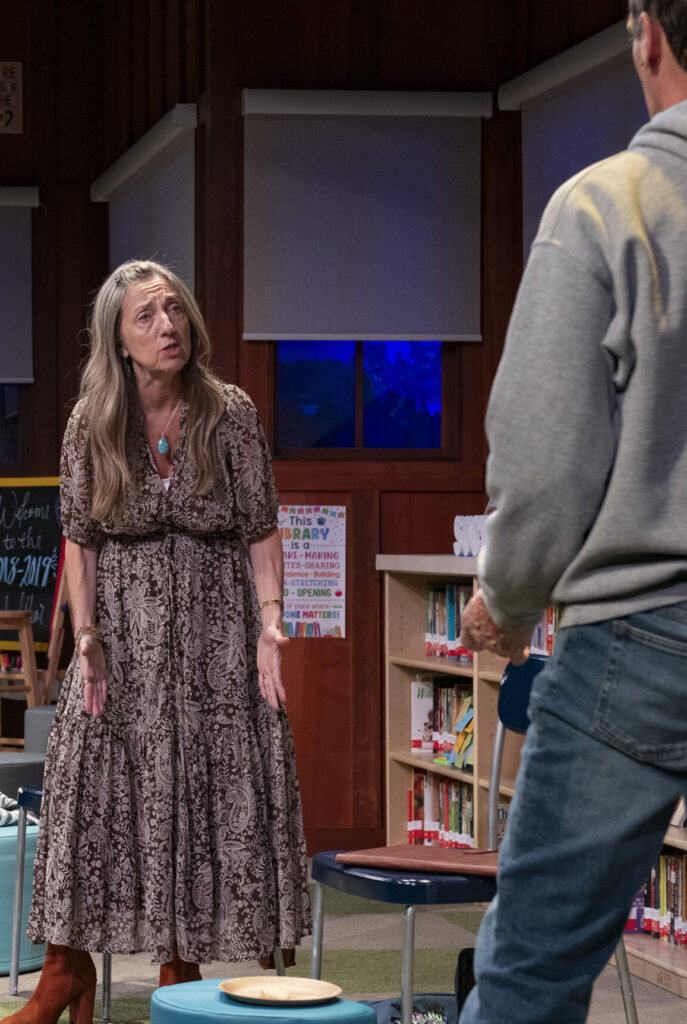
Jeni Hacker and Ryan Didato
But the critical spotlight in this well-meshed ensemble justifiably shines on Jeni Hacker as Suzanne, the superwoke mother who nurtures at the school. Over the journey, we are supposed to lose a touch of patience with some of her personality quirks. But then we are drawn into Hacker’s gut-wrenching monologue about one of Suzanne’s five children. Spector uses the reveal to chasten us for shallow judgments. Hacker has soared in Next To Normal, Fun Home and the moving Grindr Mom, but credit her here with one of the most moving moments in a local theater’s season that has been filled with them.
Stage managers rarely get the recognition they earn every night, but the company’s new hand Sam Powers deserves a special Carbonelll nomination for the mouth-dropping skill at cuing live, that’s live, folks, the scores upon scores upon scores of livestream lines with a comedian’s timing, building in tempo and often reacting to the actors’ lines on the side of the stage.
As Spector requested, the dialogue, if that’s the right word, is suffused with overlapping lines, cut off sentences, incomplete thoughts. Of course, the implication is that people are not always listening to each other, more driven by the urge to verbalize their thoughts. The cast and Meltzer nail this theatrical challenge.
This 2018 play, that won the 2025 Tony for best revival, is far defter than Spector’s still evolving Birthright which received its world premiere at Miami New Drama in April and is headed to Broadway next month.
As usual, the visible and audible aspects expertly create the environment of a well-funded elementary school library down to the Dewey Decimal labels on the bottom of the books lining the walls, the spirit-building posters and the lovely set-wide view of the Berkley bay area from the upper class banks.
Ccredit is richly deserved by scenic designer Frank J Oliva, lighting designer Tony Galaska, projection designer Steven Covey, sound designer Sean McGinley, costume designer Laura Turnbull and properties designer Jennifer Wake who has the principal carry an NPR gift bag.
This has been one of the strongest seasons in South Florida theater in some time and we can drown you in a list of superb dramatic and musical productions that we would put up against any regional theater in the country. This is in the highest tier.
Note: Hacker’s role of Suzanne will be played May 20-24 b y Sarah Rome Guerra.
Eureka Day plays through June 14 at GableStage, Biltmore Hotel, 1200 Anastasia Ave, Coral Gables. Performances are 7”30 p.m. Wednesday to Saturday, 2 p.m. Wednesdays and Sundays, plus three Saturday matinees at 2:00pm on May 30, June 6, and June 13. Running time 1 hour 40 minutes with no intermission. Tickets $50-$95. Box office (305) 445-1119, BoxOffice@GableStage.org or www.gablestage.org. Students and teachers may attend any performance free of charge by arriving 45 minutes prior to curtain and filling any open, unsold seat. Valid ID required.








 A PaperStreet Web Design