



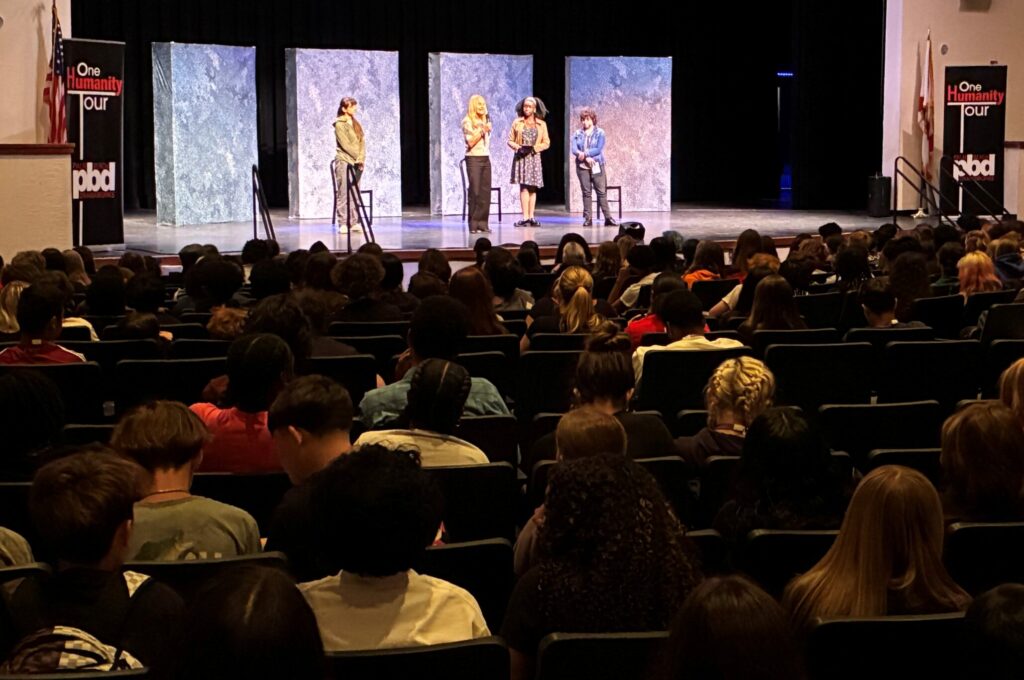
Seminole Ridge Middle School students are engaged by Live To Tell, a play about sex trafficking of teenagers created by Palm Beach Dramaworks’ One Humanity Tour (Photo by Jason Nuttle
By Bill Hirschman
In one of three plays in a professionally produced tour, a trio of disparate 15-year-olds are lured into prostitution via human trafficking. In the second, a high school athlete taking pills for a track injury sinks deeper into opioid addiction. And in the last, a troubled teen lured by shoplifting is grievously injured by a well-meaning cop.
The Florida audience seeing the first two are middle to high schoolers. The patrons for the third are sixth graders.
Certainly, many theater companies tour in-school shows to children and teens, usually centered on light-hearted romps, inspirational appeals to mainstream virtues, a bit of Bard, and, in some cases, watered down warnings.
Instead, Palm Beach Dramaworks’ One Humanity Tour is unapologetically frank for rapt youngsters still learning algebra.
These are not lectures; these are three-dimensional respirating illustrations. In no-holds-barred depictions, students face characters that look and sound like them, their sibling or their best friend. They see all-too-recognizable situations, which can be the first step down an abyss, such as receiving lures on their cellphones.
“It’s the impact (of seeing) the younger sibling when the older sibling dies of an overdose. It’s the fact that one character goes to prison for stealing his grandmother’s assets and then her checkbook. So they see the cause and effect,” said program leader Gary Cadwallader, director of Education and Community Engagement.
“We are not only telling a compelling story of three young people ensnared in trafficking, but hopefully saving young people from falling into the trap of coercion and exploitation… planting red flags in their brains.”
Hungry Ghosts about drugs, Live To Tell about trafficking and Swagger about the pressure to steal all were commissioned from experienced playwright Eric Coble and developed by Dramaworks as a donated program to the community. Since 2017, the program has mesmerized more than 40,000 students with another 6,000 or more expected through two-dozen visits this season.
The response from students, several educators and some parents has been fervent -– and in some cases concrete.
“So at one of the middle schools close to where some of the Epstein survivors came from, the principal says, ‘I need you in my school.’ Not only was there a young girl whose grandmother realized that her granddaughter was being trafficked and they were not kidnapped, (we learned students are) living at home and going to school. You know, this whole misconception of they’re being kidnapped is mostly not true unless they’re immigrants,” Cadwallader said.
“And then the principal said, ‘I had an 8th grade student who was recruiting for her trafficker.’ All going on at the same time at this one school. The school was in Palm Beach Gardens, a middle school. When I told him I was setting this up, the principal said, ‘This keeps me up at night.’ ”
Last fall, a high school student came to the behavioral health professional and said, “This is happening to me.” The theater connected the school with a Human Trafficking Coalition and they in turn alerted law enforcement.
Indeed, part of the goal is simply to make students and their parents accept that such scourges do exist in their county which is a mix of wealthy and impoverished families. The reality: The county health department estimated an average of 49 emergency overdose calls per day for children ages from infancy to 19 years old during the summer of 2023.
The education system and law enforcement element support, even vet the details of the material.
Dr. Kim Joseph, Behavioral Health Professional at Seminole Ridge High School, touted, “Rather than relying on statistics alone, the performance places real stories at the center, creating an immersive experience that encourages empathy, awareness, and action. By blending artistic expression with public health education, the project reaches audiences in a way that traditional messaging often cannot.”
Unlike some other programs, Dramaworks tracks the results with pre- and post-surveys “so we know what they’re learning and how they’re learning,” Cadwallader said. “It’s evidence-based and there’s a measurable knowledge growth.”
Students’ post-performance surveys contain a message at the bottom of the page: “If there is a situation in your life where you feel uncomfortable and would like to speak with a trusted adult, please say so below. Turn in this paper directly to your teacher.”
The effort continues after the curtain drops with talk backs and in class with suggestions from a teacher’s guide produced by the program’s supporters.
And even further: “It takes all of us – educators, parents, and community leaders – to protect our children. Because parents must give permission before their children can see the play, they enable Live to Tell and the entire One Humanity Tour. One of our goals is to spark important conversations between students, parents and educators,” said Dramaworks Executive Director Rudina Toro.
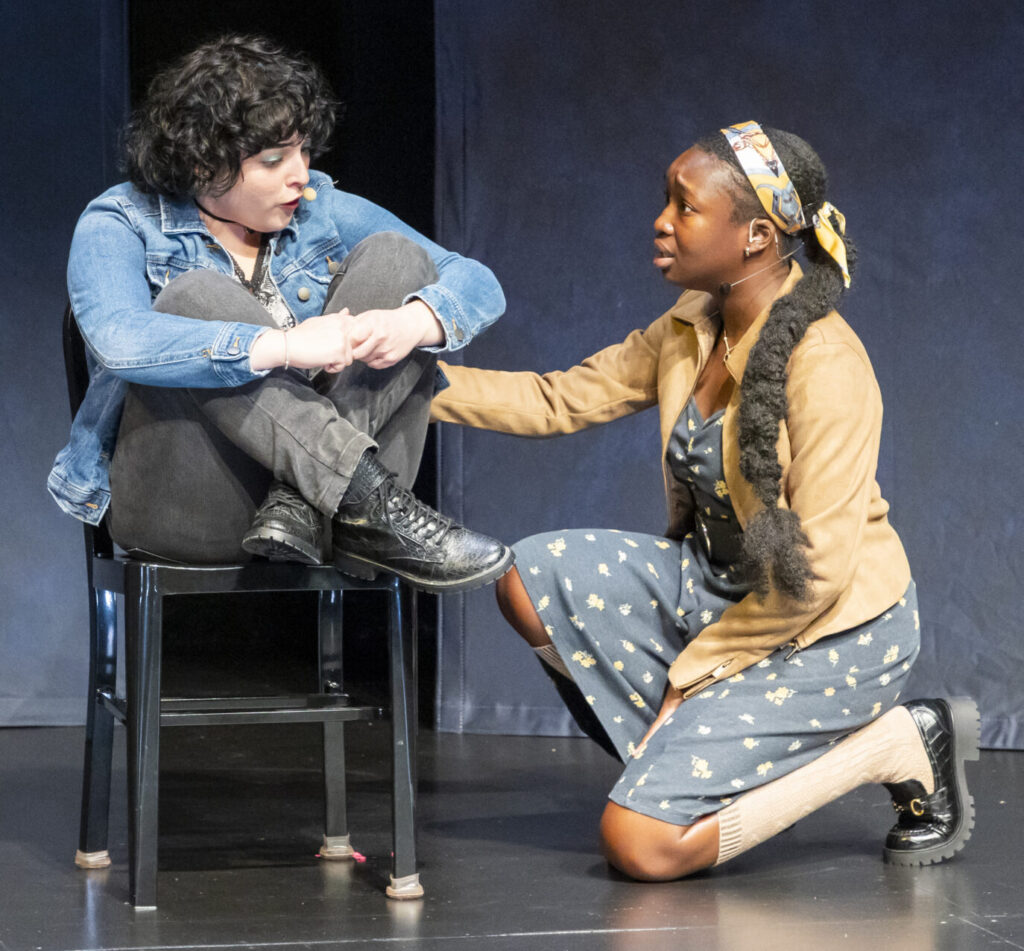
Jordan Monteagudo and Cassidy Joseph in Live To Tell
Although the productions are stripped down to chairs, flats, costumes and no more than four professional actors, still the expense is significant mounting shows, development of vetted researched scripts and the educational support materials. Besides volunteer help, the fiscal contributors have included the Hearst Foundations and the original $100,000 sponsor Impact 100.
Swagger, the first play, was sparked by a high-profile police shooting of a man waiting for a tow truck by his disabled car on I-95 A school administrator said to Cadwallader, “Nobody is talking about it with the kids.”
Cadwallader reached out to Coble, a playwright with 30 published plays whom he knew connected with the Cleveland Playhouse.
His scripts are straight-forward but not artistically drab. In one passage about addiction, one girl says of her friend, “What they call hungry ghosts. These spirits that are doomed to want food all the time, and never be full, they like walk the earth forever starving. It feels like Valora’s turning into one of those.”
As the brainstorming and script evolved, the creators formed with an educating and vetting team including the representatives of the Palm Beach County Sheriff’s Office Human Trafficking Unit, the West Palm Beach Police Department Trafficking Unit, and the Center for Missing and Exploited Children.
When they started work on the human trafficking play, they interviewed survivors who were trafficked as young children in Palm Beach County. They interviewed stakeholders. “We interviewed a mother of a child who still ongoing active addiction. We interviewed a younger sister, which still breaks my heart thinking about her interview with Eric, crying over it, and so Eric wrote a younger sister role into the play,” Cadwallader said.
Various experts read the scripts to make “sure that it was all airtight,” he said.
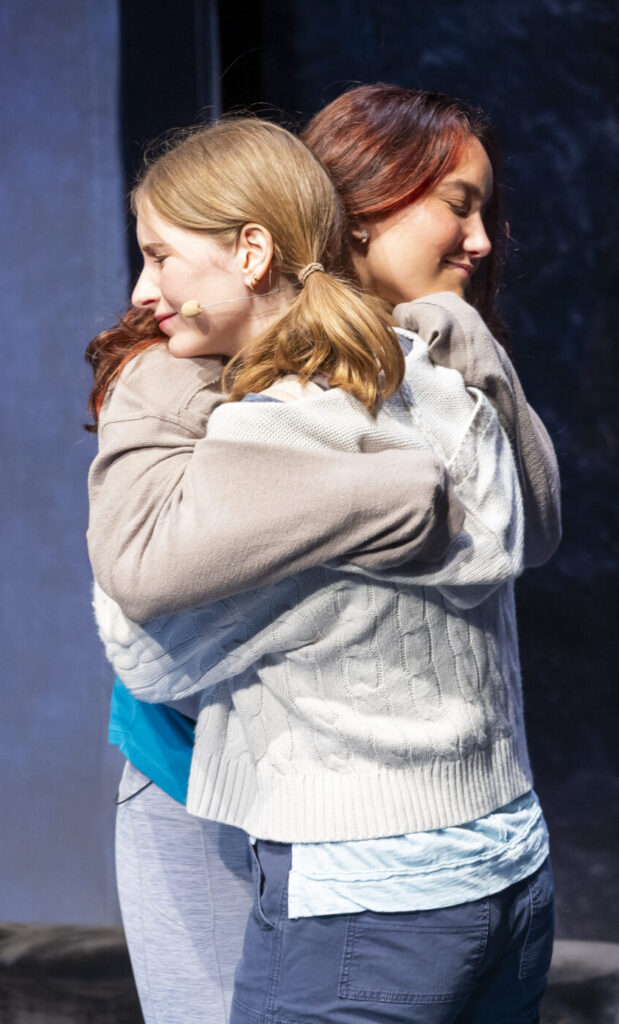
Hannah Martin and Sarah Stepanek in Hungry Ghost
Producing Artistic Director William Hayes, who has championed an even broader education component into the company agenda, said, “We’re covering our bases, make sure we’re politically correct, all the right language, no trigger words.”
Dramaworks is a 26-year-old non-profit based in West Palm Beach whose history is marked by everything from classics to contemporary dramas to developing world premieres. But over the past decade it has expanded its student-based programs to encompass student playwriting in addition to the traditional trope of bringing students to see their regular productions for free.
While several principals and teachers welcome the initial offer to showcase the shows, some were spooked by exposing children to the subject matter – and their parents’ reaction when a child comes home and says they saw a play about human trafficking even though the language and approach are honest, but not obscene or excessive.
“It’s reasonable that there is some fear. When we’re afraid of something, we keep it at arm’s length,” Toro said.” I mean I’m a parent and it’s like your worst nightmare for these things to happen to your child. We just want them to understand that this is education, and it’s prevention, and it’s evidence-based.”
Cadwallader added, “Well, the world is a lot less safe than when we went to school. A lot less safe.”
For detailed information including specifics about each play, go to https://www.palmbeachdramaworks.org/education/one-humanity-tour.





 A PaperStreet Web Design