







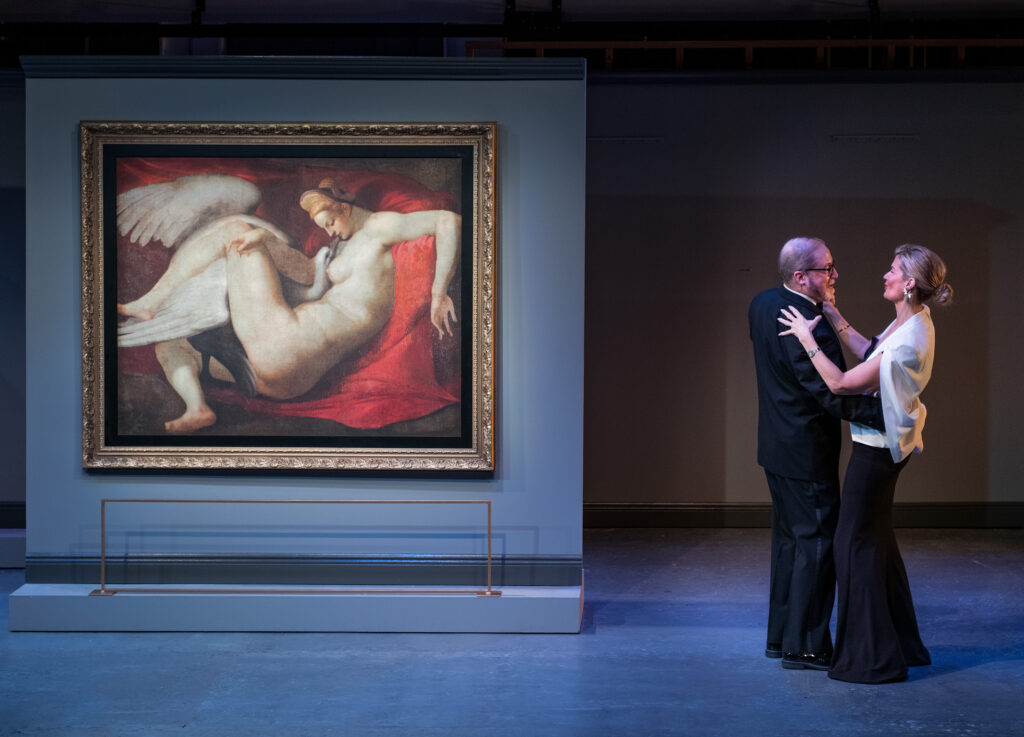
Art dealer Buddy (Stephen Trovillion) and museum curator Jodi (Mia Matthews) waltz by the acquired Leda and the Swan in GableStage’s True Art (Photos by © Magnus Stark, 2026.)
By Bill Hirschman
Truth – seen by some as unassailably sacred and by some as too damaging to acquiesce – lies at the heart of True Art, GableStage’s mrthful comedy pleasantly clothing profound messages worth debating on the ride home.
All of it is set in the environment of an ardent Love of Art (capitalization intended) with its simultaneous aesthetic, cultural, societal and monetary facets. How much is Art valuable for the image itself or the artist’s reputation?
Passionately acted, superbly directed and given award-worthy production values, True Art is (I avoid gifting advertising quotes, but …) one of those shows you don’t want to miss.
The premise of the first act is that a museum has acquired what has been exhaustively authenticated as “Leda and the Swan,” a long-missing masterpiece by Michelangelo donated by a billionaire who paid nine digits for it.
Jodi Dean, the curator of the museum’s Renaissance department, is preparing for its arrival a few days hence. Jodi (the amazing Mia Matthews) is a stylish steely doyenne determined to rise at any costs, nicknamed outside her hearing as Demon Lady. She does revere art but she’s an ambitious up and comer. Her motto is “First lesson: All’s fair in love and art.”
Lauren Sanders (equally memorable Casey Sacco) is a wide-eyed 22-year-old college graduate just assigned to Dean as her fourth temp in a row. Lauren spent years building an encyclopedic knowledge and an unquenchable devotion for the essence of art itself.
Lauren is being pursued by the personable if offbeat young sort-of employee J.J. (a fine Samuel Krogh). Finally, there’s Buddy Silver the Manhattan-style mensch art dealer who found and is selling the painting (Stephen Trovillion who will accrue more adjectives later).
They all have their own style of adoration for Art. Jodi admonishes Lauren:
“Lesson Nine: get life experience… My dissertation was on Michelangelo. I’ve analyzed every credited piece – in person. I know exactly what a Michelangelo canvas looked like – front and back – before he applied a single drop of paint. I know where he worked, what he ate, what he wore, who he fucked, I could summon a walking/ talking AI hologram of Michelangelo – right here, right now – and his own mother would never know the goddamn difference. You have to live with the material – in your bones – only then do you get to ask “does it feel like a Michelangelo?”
The preparations for the delivery and the depiction of the interacting personalities proceed with the most sharp satirical timing. And we finally get to see the painting when it arrives at the end of Act One.
Now comes the problem writing this review: Trying to provide a more specific sense of the themes without giving away the first act closing revelation – and I even hate revealing that there will be one, although some of you may catch it earlier.
So, you’ll have to trust me that in Act Two playwright Jessica Provenz (GableStage’s 2022 Boca) uses that first act left turn to inject the continuing sardonic humor into dramatic conflict and issues of integrity and art’s worth and purpose in the real world. I really hope I haven’t given anything away.
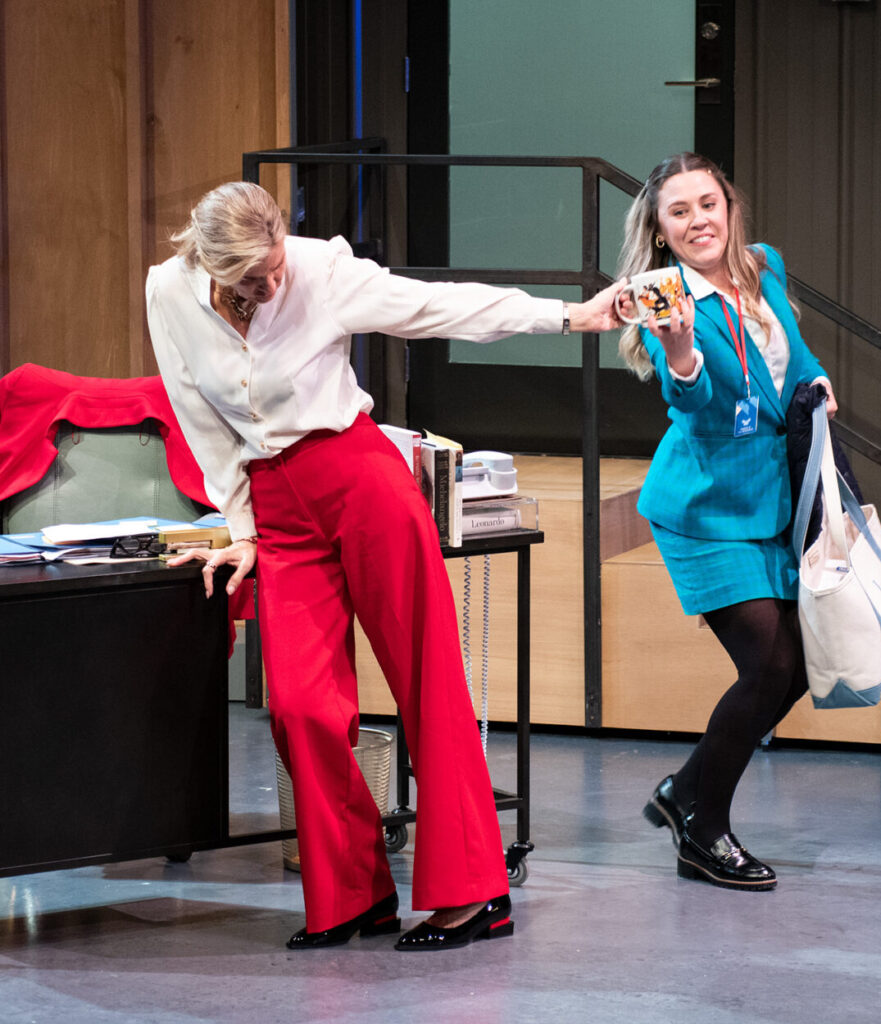
Matthews and Sacco in a rare moment of unity
The direction and staging equals anything you’ll see in regional theater and arguably in New York City. A standing ovation is due co-directors Bari Newport, producing artistic director) , and Jeni Hacker, choreographer, intimacy director and acclaimed actress who won her 49th Carbonell Award last week for her performance in The Mother.
They and the actors have co-created multi-level human beings who reveal inner selves. The directors have staged their staging movements and the considerable scene changes with fluidity. But, again with the actors’ skill, they have paced this adroitly and with virtuoso timing. As Edmund Gwenn or Edmund Kean said, “Drama is easy. Comedy is hard.” But comedy with a message is herculean.
All the actors are giving their carefully-crafted A game. Matthews, who was stunning as Regina in Island City Stage’s The Little Foxes last January, seamlessly slips into a role similar to her art gallery owner in Miami New Drama’s Bad Dog. She manages to create an exterior crust but exposes to us the far different person underneath. As the prime example of the physicality everyone here exhibits, she can twist her tall slender body and arms into more angles than you find in a geometry class.
The veteran Sacco inhabits a Midwestern newcomer striving to fit in this sophisticated world of calculating denizens, but the actress doesn’t make her naïve. Indeed, she convincingly portrays someone struggling to deal with soul-testing issues.
Krogh has served GableStage in many off-stage off=stage roles, but he does a solid job as the self-described floater.
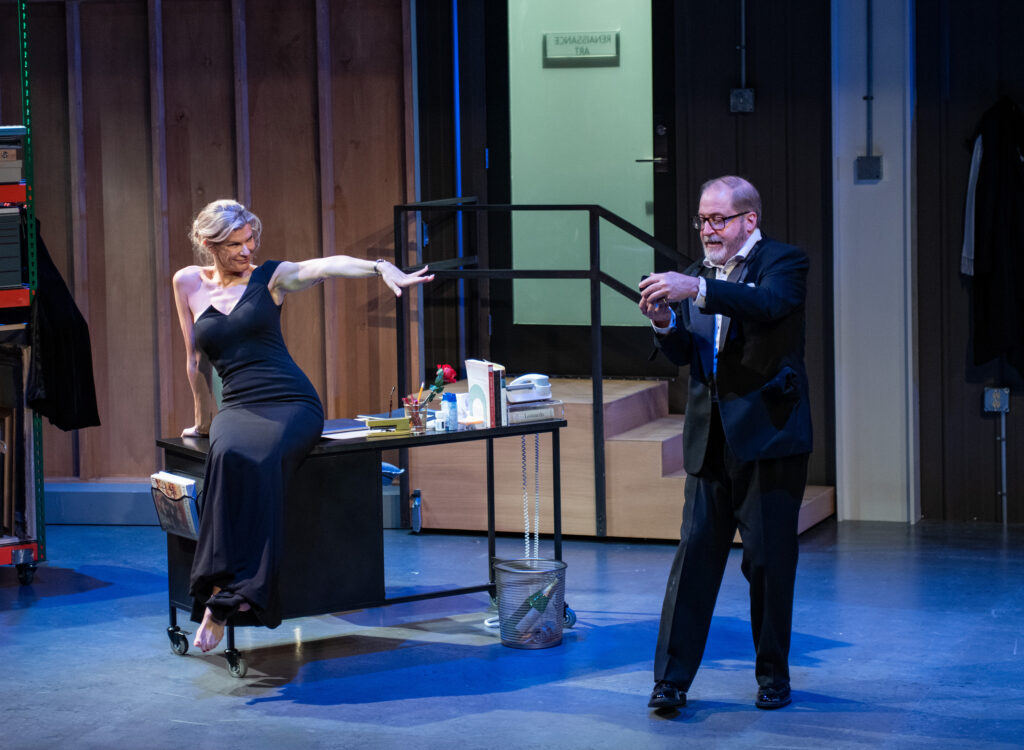
But the highest accolades got to Trovillion, one of the most versatile actors working here. He can be a narcissistic producer in the drag Who Killed Joan Crawford? or George in Who’s Afraid of Virginia Woolf. His chameleon can be charming, mysterious, lovesick, dreaming, scheming, an entire rainbow of colors. Civilians won’t notice and shouldn’t, but his skill set here will impress anyone who knows how this sausage is made.
And the setting designed by Frank J Oliva, light by Tony Galaska, sound by Sean McGinley and the incisively character-revealing costumes by Paula Calvo are nonpareil. Oliva in particular deftly uses an array of sliding panels and furniture to create the offices and galleries. But his proscenium itself is breath-taking: more than 40 period paintings in museum-like frames jammed aside each other to create the sage’s arch. The recognizable masterpieces were copied with permission from digital images and then printed. The program contains a “Visual Key to True Art” identifying 45 of those paintings by numbers on a photo of the set.
And, again, we don’t know if it was Oliva’s idea or Provenz’s or the directors’ but as the audience files in and sits down with the lights still on, six “transition artists” transform the depiction of a cluttered backroom workspace into a museum gallery for the first actual scene. Those six work so hard moving Oliva’s set pieces that we’ll name these stagehands: Janise Contreras, Sean Deam, Maleeha Naseer, Alex Perez, Joan Pco-Reyes and Amy Zamora. They get a well-deserved curtain call.
In the end, Provenz has Jofi lecture at the unveiling why art matters.
“They’ll come to see Michelangelo’s “Leda and the Swan,” because it instills in them a hope. For a fleeting moment, it lets them escape their lives and see something bigger than themselves.”
But then there’s truth.
True Art plays through Dec. 20 at GableStage, Biltmore Hotel, 1200 Anastasia Ave, Coral Gables. Closed Thanksgiving Day. Performances are 7:30 p.m. Wednesday to Saturday, 2 p.m. Wednesdays and Sundays, plus some Saturdays. Running time 2 hours plus one intermission. Tickets $35 (obstructed view) to $95. Box office (305) 445-1119, BoxOffice@GableStage.org or www.gablestage.org.








 A PaperStreet Web Design