




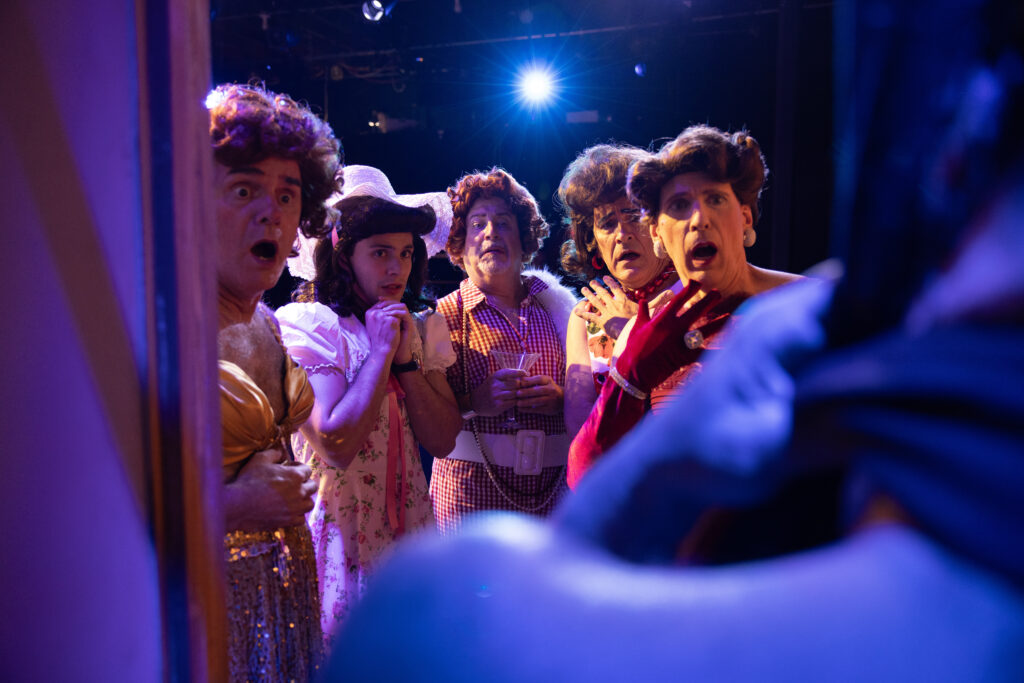
The cast wondering Who Killed Joan Crawford in Who Killed Joan Crawford? at Island City Stage (Photos by Matthews Tippins)
By Britin Haller
The campy over-the-top Who Killed Joan Crawford?, which had its very popular world premiere at Island City Stage in 2016, is back at the theater for a tenth-anniversary revival just in time for Halloween.
And what an outrageous revival it is.
Written and directed by the Tony Award-nominated Michael Leeds, who says he read all of Agatha Christie’s books when he was growing up, Who Killed Joan Crawford? makes no pretense to cure society’s ills. It is a bitchy, exaggerated and deliberately ridiculous fun little play with murder tossed in as the main course, and a twist ending we promise you won’t see coming.
The evening is set in June 1993 at a handsome cabin belonging to soap opera star Trick Rogers, who is about to turn fifty and has invited some of his gay male friends to help him celebrate. But this is no ordinary birthday party because Trick is a Joan Crawford devotee and has instructed his guests to arrive dressed in drag as characters from her films. Before long, the room is crawling with Joans.
Attendees to the festivities include Trick’s press agent, Harvey Goldberg; his ex-therapist Stewart Fry; his wealthy previous lover and now friend, Gene Harlowe; Leo Lawrence, the narcissistic theatrical producer who’s hired Trick to star in his latest production, and David Hoch, a precious young twink whose presence provides the older men with both eye candy and ample opportunity to feel ancient.
Ardean Landhuis’ scenic design, and props by Gustavo Garcia give them an inviting playground in which to unravel. The cabin is detailed without looking cluttered, with a stone fireplace, a baby grand, dry bar, bookshelves, and photographs of Crawford scattered throughout. Posters for Mildred Pierce and What Ever Happened to Baby Jane? make it immediately clear whose shrine we’ve entered. Most importantly, and crucial for a murder mystery, the space also gives the actors plenty of doors and places to disappear once the evening begins looking less like a birthday party, and more like an episode of Clue.
But before the Joans begin dropping, Leeds wisely gives us time to learn who these men are and how they fit together. There are old relationships, current relationships, bruised egos, sexual histories, and things people probably should not confess after several drinks, but inevitably do. Leeds also gives the men plenty of individual reasons to leave the living room, like checking the cooking lasagna in the kitchen, or catching the Tony Awards on the bedroom TV, and the flurry of movement adds to the overall confusion in this well-written play that thrives on collision.
Leeds knows his audience. The script is packed with show-business references, gay humor, and Crawford lore, but it does not require a graduate degree in Turner Classic Movies to enjoy it. Knowing Joan Crawford’s films adds another layer to the jokes, of course, but even if your entire Crawford education begins and ends with wire hangers, it will be easy to follow along.
The first portion breathes as the men drink, needle one another, reminisce, expose old wounds, and become increasingly anxious about the thunder and lightning outside. Of course they are trapped in a cabin during a storm. Where else would a group of gay men dressed as Joan Crawford begin suspecting one another of murder?
A blocked road leaves them stranded with no police presence, the alcohol keeps flowing, and the celebration gradually becomes less festive, if it ever was festive to begin with, that is. Put that collection of personalities together, add booze and regret, and the party begins to resemble the sort of gathering at which the safest strategy is to compliment everyone’s dress and quietly back toward the door.
Exactly who dies, and what any of it has to do with anything, is better left to discover. Leeds builds the second half around suspicion, ricocheting from one character to another, with cranberry vodka drinks, Daytime Emmys, yellow rain slickers, various police calls, and assorted accusations becoming part of the increasingly lunatic machinery. But Leeds is not constructing an intricate puzzle that will send us home comparing clues on a whiteboard. The pleasure is in watching these particular people become increasingly suspicious of one another, while the situation grows more absurd, and fingers start pointing.
In other words, the Joans are having a very bad night.
Together, the actors form a strong ensemble, essential because this play depends far more on their chemistry than on a mounting body count, and the inevitable question of whom, if anyone, you should trust. The murder plot itself is great fun, but Agatha Christie can rest peacefully because Who Killed Joan Crawford? isn’t trying to do anything more than take her recognizable ingredients of creating a mix of people with complicated histories, putting them in a secluded gathering, adding in secrets that refuse to stay buried, and then pouring them into a particularly gaudy, and catty, cocktail shaker.
We don’t want to spoil anything, but the first murder is nothing you’ve seen before on a stage, and the shock value alone had theatergoers discussing the mechanics of it in the bathroom line after the show.
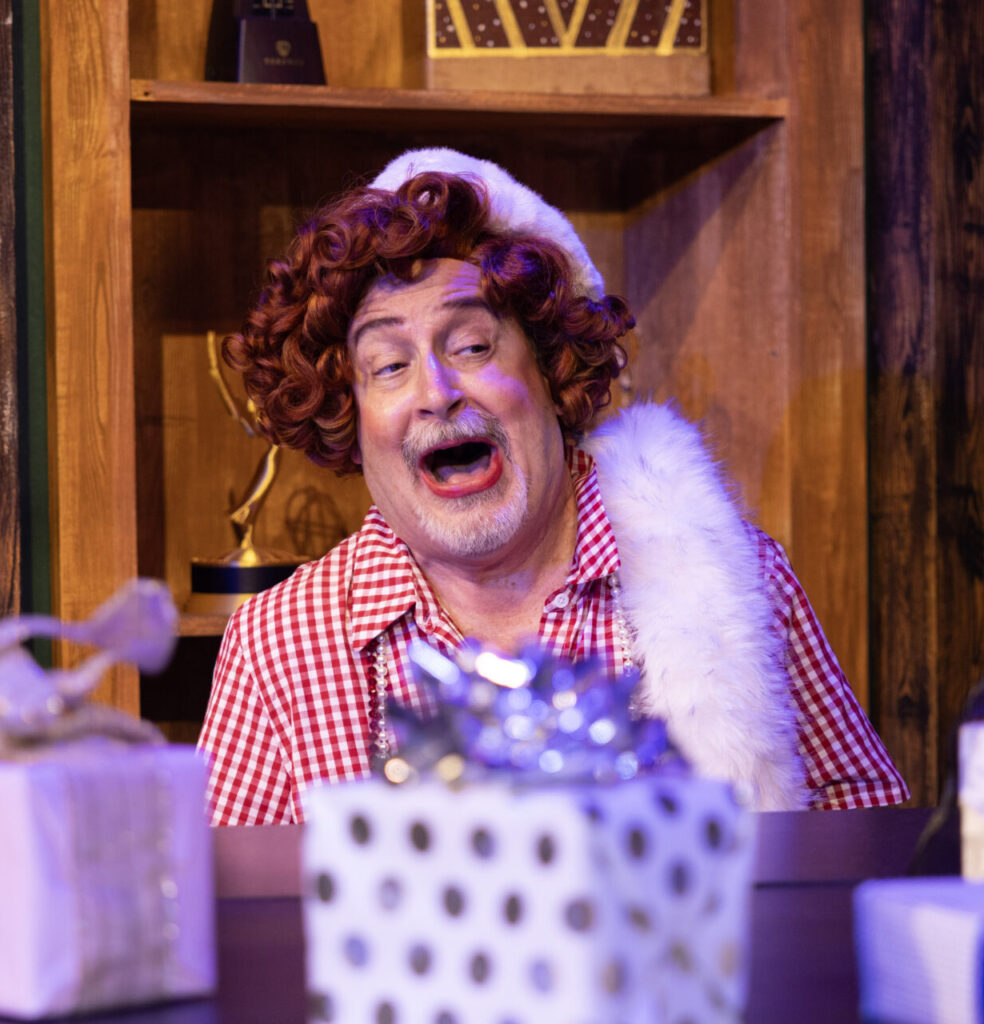
Stephen Trovillion
Dressed as the prostitute Sadie Thompson from Rain, Carbonell nominee Stephen Trovillion’s Leo Lawrence is a standout. After seeing his terrific George in Maltz Jupiter Theatre’s Who’s Afraid of Virginia Woolf?, it’s fun to see Trovillion operating in an entirely different theatrical universe. Leo is a once successful, but now failed Broadway composer with a flair for drama and a complicated romantic history, but Trovillion gives him enough genuine feeling that the egotistical character does not dissolve into caricature.
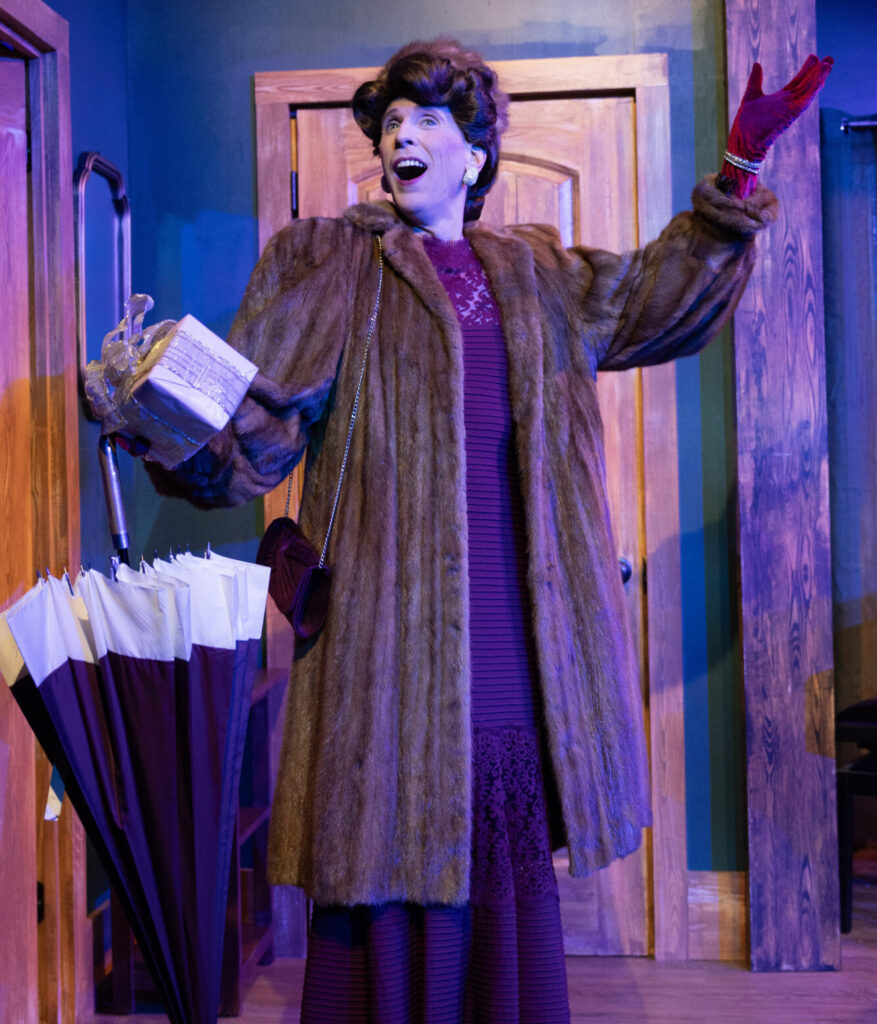
Bruce Linser
Carbonell Award-winner Bruce Linser, a South Florida and Island City Stage favorite, has a grand time as Gene Harlowe, getting the evening’s best entrance draped in fur with a pair of gorgeous red satin gloves completing the look. Linser has a great figure for the dress, which is not a sentence this critic expected to write this week, but facts are facts. Gene has his hands in a lot of different pots; inventor of the plastic toilet seat cover, ex-lover to many with a proclivity for young men under twenty-five, and financial backer to Leo’s new Broadway show.
Luke Di Liddo is enormously appealing as David Hoch, the ghostwriter hired by Leo to help him with his memoir. Dressed innocently as Joan (Faye Dunaway) did at her daughter Christina’s birthday party in Mommie Dearest, David brings lightness to a room full of bitter men, but Di Liddo is not merely there to be young and pretty, although he certainly accomplishes both. With a natural charm, and inordinate sweetness, Di Liddo is definitely one to watch out for.
Carbonell nominee Christopher Dreeson is Stewart Fry, whose profession as a therapist does not make him any better equipped to handle things when a Joan Crawford birthday party becomes a crime scene, and in fact, does not necessarily make him the most emotionally functional person in the room either. Dressed as the gold-digging Crystal Allen from The Women, Dreeson is quite the sight in a sequined gold harem-style gown with a brassiere top and chest hair. Dreeson is, quite simply, a hoot.
Michael Coppola has exactly the right presence, and comedic timing, needed to call him perfectly cast here as Harvey, Trick’s press agent who happens to be nursing a raging UTI, and so is always more or less distracted and halfway out the door on his way to the restroom. As the more-or-less practical one who’s more than slightly exasperated at having to navigate a room full of large personalities, Coppola shines best when the evening starts turning haywire. His increasing annoyance at having arrived dressed as the neurotic Lucy Harbin in Straight Jacket, but being continually confused for Anita in West Side Story, is adorable.
And last, but certainly not least, we actually don’t see much of Trick, who’s dressed as Blanche from What Ever Happened to Baby Jane?, or rather we see a lot of him, but suffice it to say that actor Jay Eisler gives it his all in a bit you have to see to believe.
Emil White’s costumes and Aaron Kinchen’s wigs have painstakingly created some of Joan Crawford’s looks from some of her most memorable film roles. Desirae Merritt’s lighting, David Hart’s sound, and Carlos Jimenez’s projection design effectively sell the storm outside, giving the cabin the necessary sense of isolation once the evening turns dangerous. And thanks to an extremely generous grant to Island City Stage by Warten Foundation, Inc., an upgraded lighting system made its debut on opening night.
Who Killed Joan Crawford? is not a profound evening of whodunnit theatre, and it’s not even remotely bothered by that fact. It’s simply six men in Joan Crawford drag trapped in a cabin while bodies accumulate and everyone wonders who’s next.
By the time the wigs came off, the last-man-standing possibilities dwindled, and the evening had gone completely off the rails, Leeds had managed to wrangle plenty of laughs from a birthday party that did little more than give a group of actors a chance to behave outrageously and keep its audience wondering just how many Joans will still be upright by the end of the night.
And sometimes, that’s enough.
Surrender yourself to the delicious absurdity of Who Killed Joan Crawford? before it’s too late.
Who Killed Joan Crawford? runs through October 25 at Island City Stage, 2304 N. Dixie Hwy, Wilton Manors (south of Oakland Park Blvd.); Thurs at 7 p.m.; Fri-Sat at 8 p.m.; Matinees Sat at 2 p.m. and Sun at 5 p.m.. A Mimosa Sunday Brunch will take place on October 11 while a Women’s Night at the Theatre is on October 23. Running time approximately 75 minutes with no intermission. Tickets start at $55. Call 954-928-9800 or visit islandcitystage.org.
Britin Haller is a journalist, editor, and author who serves on the board of directors for the Mystery Writers of America Florida Chapter. As a celebrity wrangler, Brit regularly rubbed elbows with movie, sports, and rock stars, and as a media escort, she toured with NY Times bestselling authors. After appearing in local musicals and all-state choir, Britin studied theatre at Indiana University (Big Ten) and the University of Evansville (Rami Malek’s alma mater).
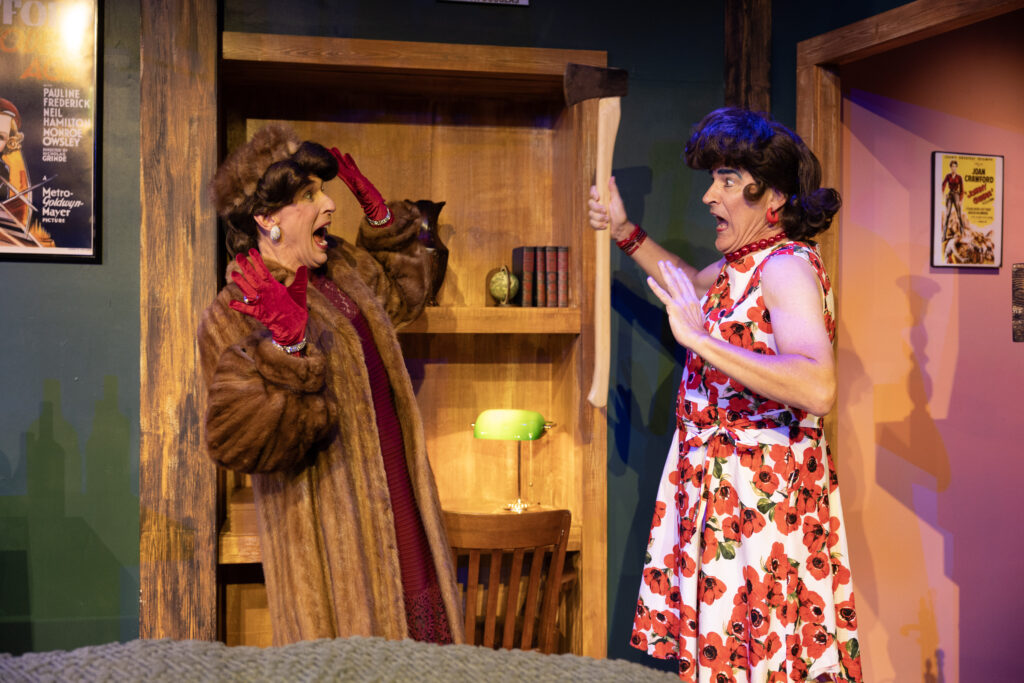
Bruce Linser and Michael Coppola







 A PaperStreet Web Design