





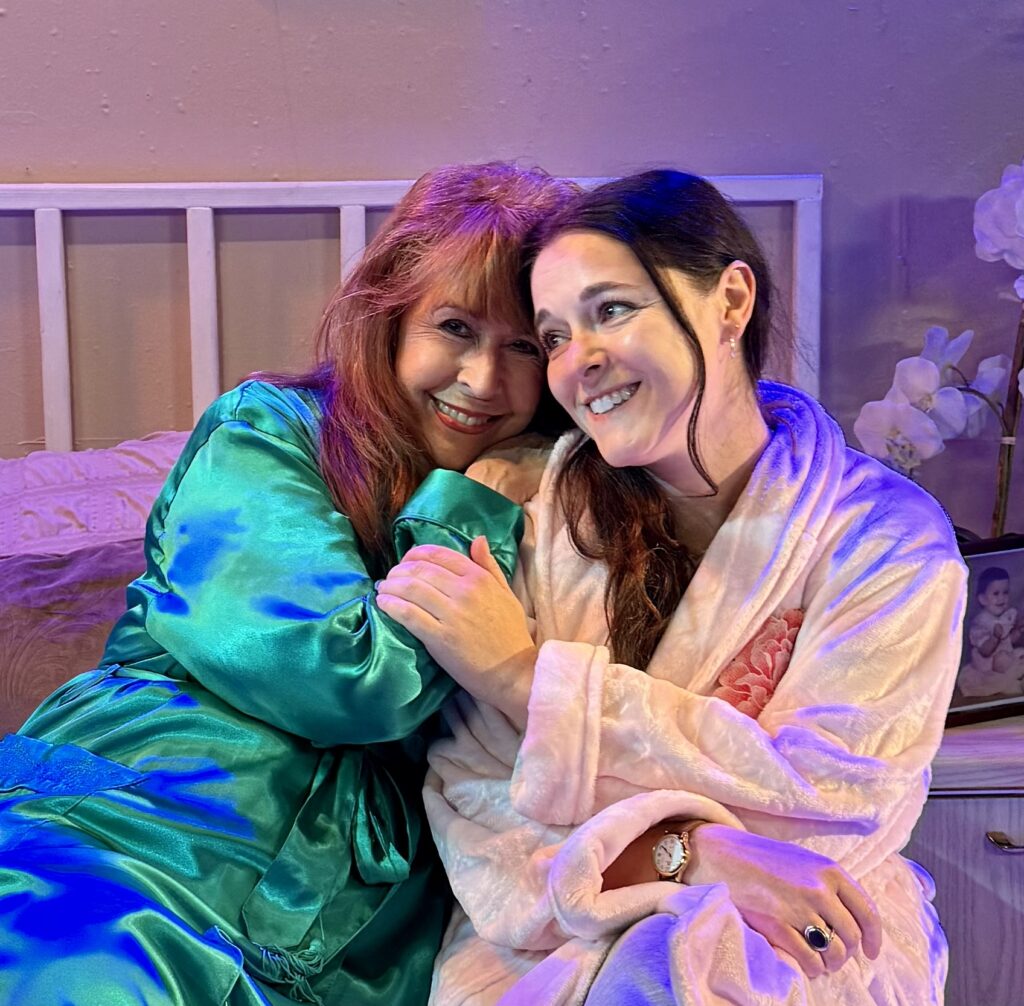
Kris Coffelt and Leah Carolan in Curtain Call Playhouse’s Terms of Endearment (Photos by Victoria Cortellese)
By Aaron Krause
Two women sit next to each other on a bed, their heads touching. They’re laughing nearly uncontrollably. “Tell me about the astronaut!” one of them excitedly urges, and the other happily obliges. Soon, they take each other’s hands.
They might sound like giggling best friends at a slumber party, sharing secrets. But they’re actually a mother and daughter whose bond is as close as it is complicated.
The women are Aurora Greenway and Emma Greenway Horton, two of the central characters in Dan Gordon’s moving and often funny stage adaptation of Terms of Endearment, based on the 1983 film starring Shirley MacLaine, Debra Winger, Jack Nicholson, and Jeff Daniels. The film is adapted from Larry McMurtry’s 1975 novel of the same name.
The tearjerker’s stage adaptation is receiving a heartfelt and convincing professional production through Feb. 15 by Curtain Call Playhouse at the intimate Empire Stage black box in Fort Lauderdale.
Under John Hernandez’s assured direction, the production mostly unfolds seamlessly and stars Kris Coffelt as Aurora, Leah Carolan as Emma, Alan Goodman, Lauren Martino, Alex Gomez and Bob Sharkey. In addition, performers Jack Coffelt, Jacob Piligian, and Susan Lloyd clearly and convincingly provide voiceovers. Wearing Coffelt’s character-appropriate costumes, the actors find their own ways into these familiar roles rather than mimicking the iconic film performances.
In such a tiny space, you worry about sticking your feet out too far if you’re sitting in the front row; one careless move and you could trip an actor. But the advantages of experiencing Terms of Endearment at Empire Stage far outweigh any such concerns. You feel as though you’re sitting in the same room with the characters, allowing the emotions to register viscerally and deepening the audience’s connection with them in ways a larger venue might not.
The story spans 1978 to 1990 and traces the complex, evolving relationship between widow Aurora Greenway, an overbearing yet deeply loving mother, and her stubborn but sympathetic daughter, Emma. They frequently frustrate one another, but their bond remains unbreakable, carrying them through joyful moments and profound loss.
Terms of Endearment, which encompasses short but moving scenes, is like a series of snapshots that come into sharp focus when the characters closely interact. Sometimes tension develops between them, while at other times their fondness unites them in close contact. To his credit, Hernandez positions the actors in ways that reinforce their closeness—or distance. This is true not only for Aurora and her daughter, but also for interactions between the older woman and characters such as Garrett Breedlove, a retired astronaut and womanizing alcoholic.
 Even within Empire Stage’s small playing space, the director uses the area wisely to convey emotion. For instance, Aurora and Emma scream and dance enthusiastically in a circle when Mom learns her daughter is pregnant—a gesture whose circular motion fittingly suggests the life cycle, wholeness, and completion.
Two partners and their children often complete a family. But Emma, her husband Thomas “Flap” Horton, and their children are far from the quintessential “picture-perfect” family.
Horton (Gomez) is Emma’s high school sweetheart but is often inattentive to her needs and philandering. In the film, we saw the effect the couple’s tension had on their children. Unlike in the movie, Gordon has chosen not to include the youngsters onstage. At most, we hear one of their voices via voiceover; the kids remain offstage characters. While this choice may lessen the play’s poignancy, audiences with children can likely picture the couple’s emotionally hurting offspring. Besides, casting child performers—even for one role—can be difficult. This couple has several children.
One thing we never question is Emma’s love for her offspring. When she’s on her deathbed, dying of cancer, she’s in obvious physical pain and emotional distress. As Emma, Carolan’s weak voice and vivid facial expressions deftly convey this young woman’s state. Yet even while hurting and close to death’s door, Carolan’s Emma manages a fond smile. In a letter addressed to her children, she notes that even without her, there are “so many loving people” in their lives. Her next words will break even the hardest heart: “I’m so sorry about dying,” as though it were her fault that she developed terminal cancer. Emma’s mother gently rubs her daughter’s arm and places her arm around her. In Curtain Call’s production, Emma literally dies while lying in her mother’s arm.
The scene would be heartbreaking in almost any production. However, Hernandez and his actors ensure that such moments never sink into sentimentality. Instead, sincere sentiment prevails. And while Terms of Endearment isn’t a musical, this production employs carefully chosen songs to heighten the emotional impact—for example, “I’ll Be Seeing You,” whose slow, contemplative melody neatly fits the moment.
True, Terms of Endearment is a tragicomic play. But while its ending is sad, you sense that Emma will live on in her children and her surviving daughter, and that the kids and their grandmother will keep her spirit alive. Although Emma and Aurora didn’t always agree on everything, Emma’s decision to have her mother care for her children after she’s gone marks a touching reconciliation between the two women.
Fortunately, the show’s creators balance the story’s pathos with enough humor to make experiencing it not only bearable but a satisfying emotional journey. We experience highs such as Emma and Aurora excitedly talking about the latter’s courtship by Breedlove. Of course, we may not condone the fact that Emma cheats on her husband with the retired astronaut. And mainly because of his dalliances, Flap isn’t a particularly likable character for much of the play. Still, we relate to these people, warts and all, because they’re imperfect, like us. We may leave the production reflecting on our own flaws—and how we might do better.
Many people can relate to a mother who, perhaps, cares too much. You sense such a person would gladly give up her comfort (or more) for her children’s benefit. But while she is unquestionably loyal, she can also be controlling to the point that she barely gives her children room to breathe. The play includes the same telling opening scene as the movie, immediately establishing Aurora’s insecurity. The story begins with a brief flashback to Emma’s infancy. In the dark, Aurora enters her baby’s room, insisting she needs to check on the infant to ensure she’s alive. Aurora touches baby Emma, who cries—likely because Mom woke her.
The stage adaptation of Terms of Endearment, which features a tightly written script, doesn’t cover Emma’s childhood. Instead, following the opening scene, it flashes forward to Emma’s young womanhood. She’s enjoying a moment with her girlfriend, Patsy (Martino), while Aurora acts insistent and impatient. Upset that Emma has decided to wed Flap, she makes her feelings known.
As Aurora, Coffelt—patting her arm edgily and gesturing nervously—is intense, but nothing in her performance feels forced. Watching and listening to her, you notice a Sally Field–like emotional mom, constantly worrying and telling her daughter what’s best for her. Yet Coffelt also reveals Aurora’s tenderness. Through affectionate touch and loving speech, she balances the character’s controlling tendencies with warmth. Coffelt also becomes a fierce mother bear toward the end when confronting a flippant nurse (Martino) who seems in no hurry to give Emma her pain medication.
Coffelt and Carolan share strong chemistry as a close-knit mother and daughter who know each other so well they can easily aggravate one another. They transition seamlessly from one emotion to the next: one moment affectionately holding hands, the next irritating each other. Both performers also display deft comic timing.
The play takes place mostly during the 1980s, before cellphones and caller ID. Still, immediately after answering the phone, Emma knows it’s her mom calling. A touch of amusement creeps into her voice, and you may notice an eye roll or two as she greets her mother. Carolan turns in a strong performance as Emma, asserting herself freely and moving with confidence as this independent, lively young woman. You sense her zest for life, particularly when she excitedly asks her mom about her astronaut boyfriend.
Like her mother, Carolan’s Emma can become touchingly tender and vulnerable, especially on her deathbed. Hear the ache and weakness in her voice—and try to stay dry-eyed.
As Flap, Gomez faces the challenge of endearing himself to audiences despite portraying Emma’s distracted and philandering husband. Often, Gomez’s face betrays annoyance or confusion as he absentmindedly goes about life. But when he gently calls his wife “Ems,” a nickname he’s given her, your heart softens. By the end, you even want to comfort him as he lovingly kisses his wife on her deathbed.
Chances are, audiences who saw the film remember Nicholson’s eccentric portrayal of Breedlove, marked by iconic facial expressions conveying charm, slyness, sarcasm, and seduction. To his credit, Goodman makes the character his own. With an informal aura and fun-loving demeanor, Goodman’s Breedlove can become an impulsive smart aleck with little filter. His forced smile suggests someone who’s occasionally uncomfortable around others. But Goodman also finds the character’s charm, endearing himself to Aurora—and to us. He’s especially memorable toward the end when he delivers an ultimatum to the uncaring, arrogant Dr. Maise (Sharkey, cold and clinical). With a deceptively casual tone and even a friendly demeanor, Goodman’s Breedlove sounds pleasant. But as he pats the doctor on the back, the subtext is unmistakable: put Emma on an experimental drug to weaken her cancer—or else.
The actors perform on Jack Coffelt’s cozy, realistic set design of the characters’ residence, illuminated naturally by Stephanie Howard’s lighting. With light-colored walls, white flowers beside family photos, a neatly made bed, plants, and artwork on the walls, the space looks homey, orderly, and spacious. It also suggests that fairly well-to-do people live there.
When the setting changes, stagehands rearrange set pieces to suggest a different locale. For example, a table draped in red-and-white cloth efficiently evokes a restaurant.
A play like this—especially in such a small theater—can immerse us in a recognizable world with characters we don’t want to leave. But when stagehands, visible in bright light, prepare for scene changes, the strong illusion of reality is broken. True, small theater companies may not be able to afford completely seamless transitions. Still, it’s worth exploring alternatives, such as scenery that slides onstage and off, to preserve the production’s emotional momentum.
Overall, Curtain Call’s production is a tender presentation of a humorous and heartbreaking piece. It reminds us to cherish our time with loved ones by being fully present during happy and painful moments.
Terms of Endearment from Curtain Call Playhouse through Feb. 15 playing at Empire Stage, 1140 N. Flagler Drive in Ft. Lauderdale. Performances 8 p.m. Fridays, Feb. 6 and 13; 8 p.m. Feb. 7 and 14, and 5 p.m. Feb. 8 and 15. Tickets: $30-$40. Visit www.curtaincallplayhouse.com. Running time is about two hours, including an intermission.







 A PaperStreet Web Design