





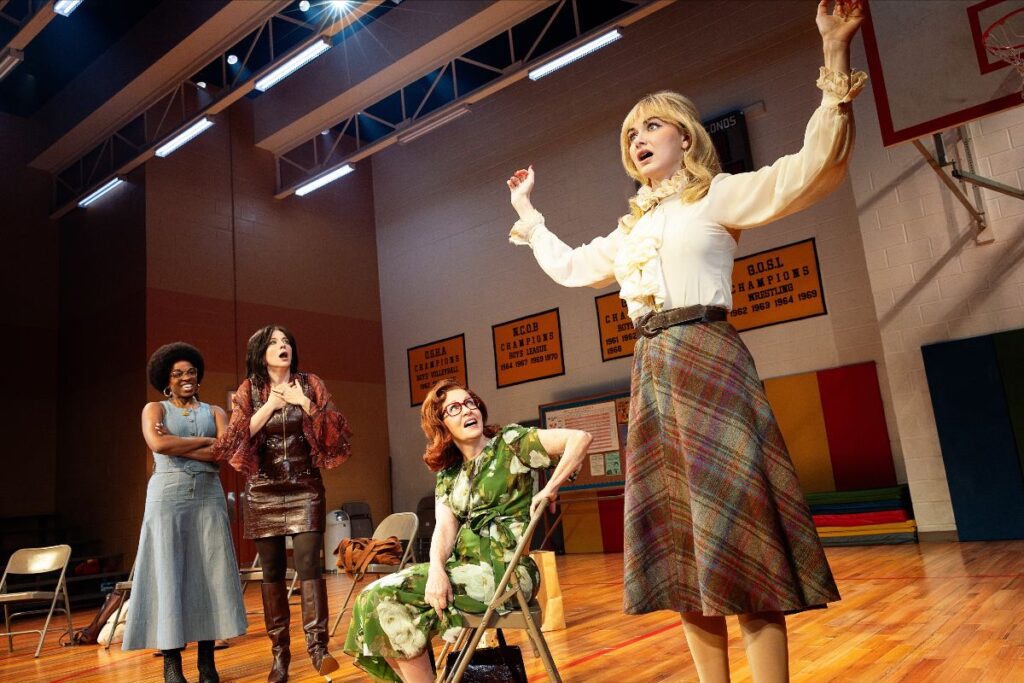
Kristolyn Lloyd, Irene Sofia Lucio, Betsy Aidem and Audrey Corsa in the Broadway production of Liberation by Bess Wohl, directed by Whitney White. (Photos by Little Fang)
By Bill Hirschman
(Once again, Florida Theater On Stage is reviewing current shows playing this winter on and off-Broadway, many of which will be touring locally or mounted by a local company. Today, Liberation, running through Feb. 1. Coming up over this month, reviews of Ragtime; Chess; Oh, Mary, and Little Bear Ridge Road. And we already reviewed Beau the Musical.)
Liberation, like most mind-expanding theater, is simultaneously a mirror and a revelation.
As a male critic, we’re guessing that for women, Liberation is a mirror that celebrates and reaffirms their complex challenges and triumphs dealing with the stereotypical expectations and restrictions of 20th Century society. And if those patrons stare deeply enough, Liberation is an expansion of their continuing self-actualization– replete with an open-end summons for the future.
But for many men, such as myself, Liberation is a profoundly deep eye-widening, educational revelation — even if, especially if you think you already are socially-conscious and aware. Liberation is a discovery of a country some mistakenly think they already have charted.
Playwright Bess Wohl, director Whitney White and an ardent cast pointedly say in the epilogue that there are no universal answers and that the audience is charged with continuing the odyssey.
In short, and we don’t say this often, this should be required viewing for everyone, anyone, of any sexuality.
The very process of inquiry on display fuels our own self-evaluation and constraints by societal tropes and shallow stereotypes. The painfully honest exploration here is liberation for the audience as well as the characters.
And we should stress that it is suffused with dry humor, wry wit and gentle compassion for a generation then feeling around in the uncharted darkness, learning their worth and exploring a desire to empower themselves.
The play opens as current day Lizzie (Susannah Flood) warmly welcomes the audience with engaging charm. She is going to take us back to 1970 when her late mother, also named Lizzie, organized a weekly conscious-raising session in an Ohio town in a basement rec center’s basketball court at the start of the second wave feminism.
Today’s Lizzie needs to discover why her vibrant mother later chose an ultra-traditional path (even sewing costumes for the school play) after having been a national magazine journalist and after starting this group awkwardly discovering self-empowerment and a different future for each.
Lizzie portrays her mother in the flashbacks that make up the bulk of the play. But today’s Lizzie returns repeatedly to make shrewd and droll remarks about what we’re seeing. She even interviews those compatriots who are still living today to examine where their post-meeting paths led to diverse courses.
We watch the group’s evolution over several weeks and then two years later, filled with comradeship and divisions. They question the realities of their somewhat prosaic lives and how to move forward into new territory. Along the way, they scrutinize everything from sexual assault to domestic “standards” to conventional perception of sexuality to racism to workplace inequities.
In the first act, we join Lizzie seeing the situation from above like observers from the future with a gentle smile. But in the second act, the gravity increases. Among a half dozen memorable moments occur such as when Lizzie’s colleagues become upset when she reveals her engagement and the likelihood of a traditional future.
And then there is the stunning poignant penultimate scene that we don’t want to spoil but which attempts to investigate the interior of the mother-daughter relationship.
Wohl, White and company depict a cross-section from the period without a sense of stereotyping, although they intentionally represent recognizable sorts.
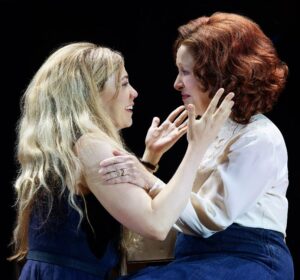
Susannah Flood and Betsy Aidem
Margie (Betsy Aidem) is a classic house-centric wife with whose retired spouse is driving her up the wall and she vents her regret at her current choice.
Celeste (Kristolyn Lloyd) is a Black book editor who has left the Big Apple to care for her mother. Now in modest town Ohio, she needs some source of sophisticated mental stimulation to feed her activist bent.
Isidora (Irene Sofia Lucio) is a scrappy Italian who married an American solely to get a green card. The adjective “fiery” was invented with her in mind.
Susan (Adina Verson) is a gay veteran from the battlements of student protests, but she is dead broke, living out of her car and still hoping to rouse Ohioans to kick back against the status quo.
Dora (Audrey Corsa) is a classic white secretary abused by her boss and who has had one too many passing relationships. She arrived thinking the assemblage was a traditional knitting circle. But we will see she may develop further than any of them, becoming a self-assured career woman.
Later in the play, Joanne (Kayla Davion), not a member of the circle, comes looking for her son’s gym bag who plays basketball in the rec hall. But she will be drafted by today’s Lizzie into representing crucial players.
Daughter Lizzie is puzzled why her mother abandoned this forward motion to marry a lovely man Bill (Charlie Thurston) with the unlikely hope that they will forge a more untraditional collaborative partnership – which we know they don’t.
Over the 2 ½ hour running time (including intermission) the personalities evolve along with costumes and wigs.
And, as has been well-publicized, the second act opens with a lengthy brightly-lit meeting in which the women are naked discussing, among other things, body types. (Every patron must safely surrender their cellphone at the door).
Catch it on Broadway at the James Earl Jones Theater through July 5 because while it might tour, it’s a question whether it will be seen widely regionally due to the nude scene.
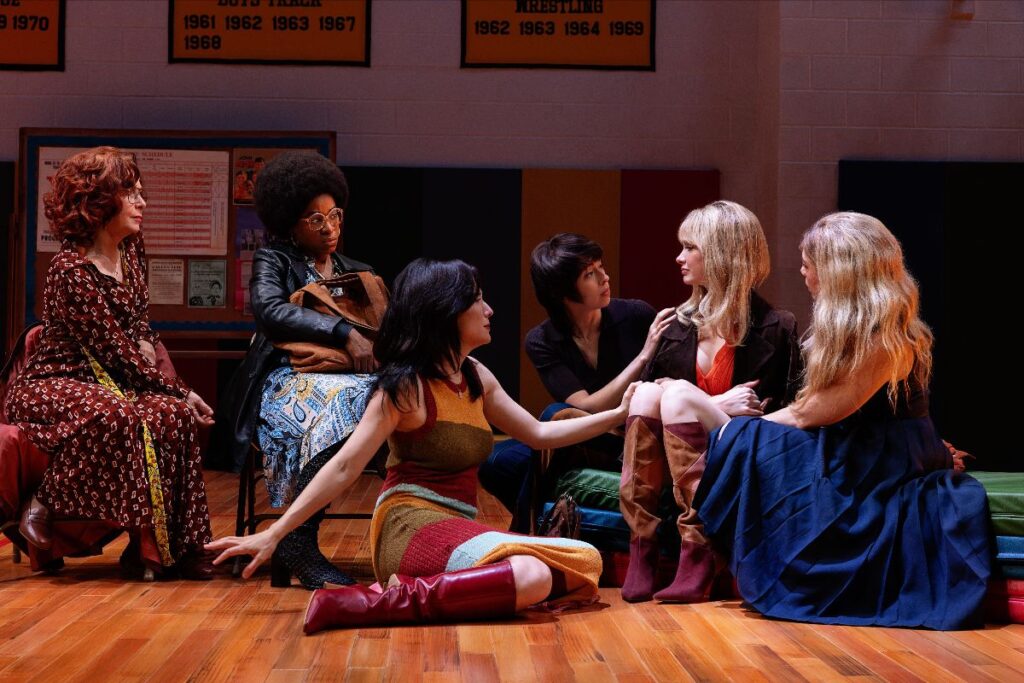
Betsy Aidem, Kristolyn Lloyd, Irene Sofia Lucio, Adina Verson, Audrey Corsa and Susannah Flood







 A PaperStreet Web Design