



 By Britin Haller
From the West Boca Theatre Company comes The Last Romance, a four-character (well three-character really), play by Joe DiPietro (Memphis) that does exactly what it’s supposed to do; remind us that love can find us long after we’re sure that door has closed.
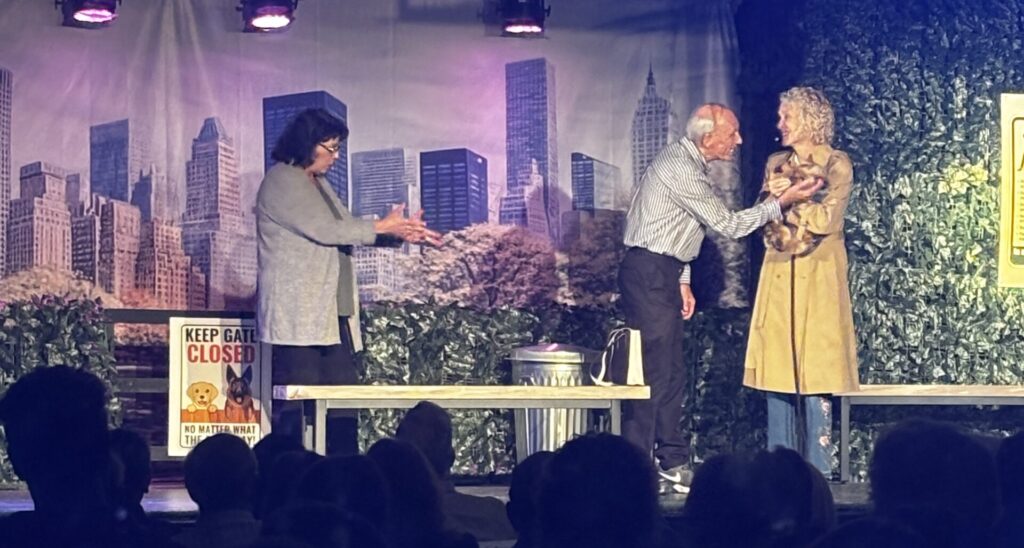
It’s present day in Hoboken, New Jersey (of all places) where we first meet Ralph Bellini on a dog park bench near his house. We know it’s a dog park because there’s a sign with some doggie rules, a pick-up after your pet plastic bag dispenser, and the sound of canines barking.
Ralph is minding his own business when a woman (Rose) with an apron and a ladle (a spatula would be funnier) twirls in like the Tasmanian Devil giving Ralph what-for for being in a dirty dog park when he doesn’t even have a dog.
Rose wants to know why Ralph is wearing his good shirt and why he’s not home for dinner because she made roast beef. Poor Ralph, we think, having to put up with that shrew would send anyone packing to the nearest tree-filled spot to soak up a little peace and quiet, even if he has to listen to a constant yap, yap, yap.
It’s obvious that Rose uses food to control him. “You want me to eat alone?” she asks him, brandishing the ladle like a weapon. It’s also obvious that Ralph is trying to get rid of Rose quickly, and just when we think we wouldn’t blame Ralph if he is there to meet another woman, we learn that Rose, minor spoiler, is his sister, not his wife.
Ralph isn’t there by accident, rather he wants to meet a woman he’s been watching from afar. Ralph is lonely, you see, because his wife Anna died twelve years ago, and he “hasn’t touched a woman since.” But Rose is not going to make this easy, and there’s the rub.
Don Bearden portrays Ralph, the Italian-American widower with the heart of gold who wears it on his sleeve. He’s practically begging to be seen, okay, he is begging, desperate to give love one more chance. For a second there, he borders on stalker, but then the dialogue corrects itself, and we see he’s just a kid at heart with a gentle wit and a huge capacity to love.
Bearden’s comedic timing is crisp, and he allows Ralph’s vulnerabilities to peek through at just the right moments. Ralph is a retired railroad man, but oh boy, did he have big dreams once, before life and family obligations got in the way.
As a young man, Ralph suffered a profound loss and a missed opportunity (all will be revealed), and he’s not going to let that happen again, no matter what his sister Rose has to say about it. Because the heart doesn’t age as fast as the body, and in his mind, Ralph is still that younger version of himself. Bearden gets us to root for Ralph right from the first beat.
As Carol Reynolds, the mysterious woman in the park who is moved by Ralph in spite of her best intentions, Lory Reyes hits just the right blend of push-me pull-me that Ralph needs to keep on pushing. She comes across as cold at times, for which there is a good reason, but Ralph is so charming and handsome (inside joke) she ultimately can’t resist, especially after Ralph scours the city to locate her dog Peaches who has gone missing.
Ralph’s memory of himself as a young man when he loved opera is represented by Ryan Townsend. He couldn’t be more wonderful. Not only does he present a lovely professional image in his black slim-fit suit, but his operatic voice is like butter. His scenes add genuine magic, projecting Ralph’s vulnerability and a tremendous longing for something he could never have. Townsend, who has performed with the Florida Grand Opera, is also the musical director here.
Either intentionally or unintentionally, there’s always a scene stealer in every show, and in this one, it’s Louis Vuitton Budney, Director Holly Budney’s Yorkshire Terrier who stars as Carol’s dog Peaches. Louis is only on stage briefly, but he makes the most of it, even trying to wriggle his way out of Carol’s arms so he can walk around and show everyone how gorgeous he is.
Clearly he’s a pet, who must be fed constant treats as a distraction, and not a trained stage animal, which is fine, but Reyes seemed quite uncomfortable trying to keep him from getting down, prompting us to wonder if he could get hurt. A cute animal bit isn’t worth taking away from the very sweet moment of Peaches being found by Ralph and being returned to Carol, so this part needs work. Maybe try putting Peaches down immediately after Ralph walks in with her and see if Louis likes that better?
Louis Vuitton Budney promised in his bio not to upstage the actors. He lied.
Louis aside, it’s Elizabeth Digati who’s the real star here as the sister who is carrying the weight of the world on her shoulders. Rose’s husband of twenty-two years wants a divorce (they’re separated). Her religious beliefs conflict with what she knows in her heart is right: She’s established herself as Ralph’s primary caretaker even though he doesn’t really need one, and she’s trying to do penance for something that happened when she was a young girl.
That’s a lot for one person to carry. And she deals with it with a sarcasm that’s sharp enough to slice Italian pastrami. Seriously, how do we get Rose her own spin-off tv show because this woman is everything.
Rose is that woman who gives and gives, and then gets taken for granted because she’s reliable. She’s the patron saint of putting guilt trips on others, all the while feeling a huge amount of guilt herself. But the ultimate irony is that Rose isn’t bossy to be bossy; she’s terrified of being left alone, because if Ralph finds a new life, what happens to her?
Rose is that role that doesn’t come along often, but when it does, an actor needs to make every moment count. And Digati does, never more so than when she reads a letter from her husband that breaks her heart, and ours. Mercifully, the playwright never paints Rose as a villain for the sake of conflict, rather only as a means of self-protection.
Direction by Holly Budney and Mark Hernandez has just the right touch of gentle and unfussy because a story like this doesn’t need much movement. There were lovely small details like Rose watching from a distance long before she interrupts, and that sweet scene with Rose and Carol in the park. “Ralph’s quite a catch,” Rose tells her. “He can still drive at night.”
The scenic design by Budney is charming and warm with subdued pink lightning and green shrubbery. Our only complaint is that when they’re in Ralph’s apartment, the actors’ shadows are visible on the city scene backdrop. Sound is generally fine except during the soft moments, the actors, especially Reyes, are hard to hear at times.
Despite having been at numerous productions in the West Boca Theatre, this was a first for us. During intermission, two of the actors (with their mics still on) came out from behind a side curtain and strolled right past us on their way, seemingly, to the restroom because WBT doesn’t have backstage facilities. Not only was this a glaring way to break the fourth wall, but when one of them was trying to make his way back, a patron stopped him in the hallway for a compliment, and the actor responded “Thanks, but I’m losing my voice.” Look, everyone understands when you gotta go, you gotta go, but surely the theater could make alternative arrangements so this kind of thing doesn’t have to happen.
And please people, for the love of God, if you run into an actor for whatever reason who’s in the middle of a theatrical production, do not think that gives you the right to speak with them. They are in character and in a delicate mental space. You wouldn’t interrupt a surgeon in the middle of a medical procedure to ask a question, would you?
Never mind, don’t answer that.
So in the end, The Last Romance won’t be everyone’s cup of tea. It’s quiet, demands patience, and embraces simplicity. There is nothing flashy, rather the focus remains firmly where it belongs, on the characters, their dialogue, and their emotional connections.
But the payoff is big, asking us to take a chance no matter our age, and reminding us that sometimes letting down the armor we’ve spent a lifetime building up is the only way to go.
If there’s a message running through this play, and there are several, it’s not just that love is still possible as we grow older, it’s that we’re allowed to choose happiness even when others don’t understand our reasons. There is a deep kindness in the script, and this cast honored that kindness at every turn.
If you go to see The Last Romance, and we hope you do, you may even find yourself thinking of someone you love, or someone you once loved, or someone you hope to meet someday. Because this story belongs to anyone willing to show up, take a chance, and beieve that a new beginning can arrive, even in the last chapters of life.
As Dean Martin would tell you “When the moon hits your eye like a big pizza pie, that’s amore.”
Britin Haller is a journalist, editor-for-hire, and an author who serves on the board of directors for the Mystery Writers of America Florida Chapter. As a celebrity wrangler, Brit regularly rubbed elbows with movie stars, sports stars, and rock stars, and as a media escort, she toured with New York Times bestselling authors.
The Last Romance from the West Boca Theatre Company runs through December 21 at the Levis JCC Sandler Center, 1050 95th Avenue S., Boca Raton (south of Glades Rd, west of Lyons, be prepared to present your driver’s license at the guard gate); 7:30 p.m. on Saturdays; 2 p.m. on Wednesdays and Sundays. Running time is approximately 105 minutes with a 15-minute intermission. Tickets starting at $40 for non-JCC members. Call 561-558-2520, or visit levisjcc.org.
Britin Haller is a journalist, editor-for-hire, and an author who serves on the board of directors for the Mystery Writers of America Florida Chapter. As a celebrity wrangler, Brit regularly rubbed elbows with movie stars, sports stars, and rock stars, and as a media escort, she toured with New York Times bestselling authors.





 A PaperStreet Web Design