





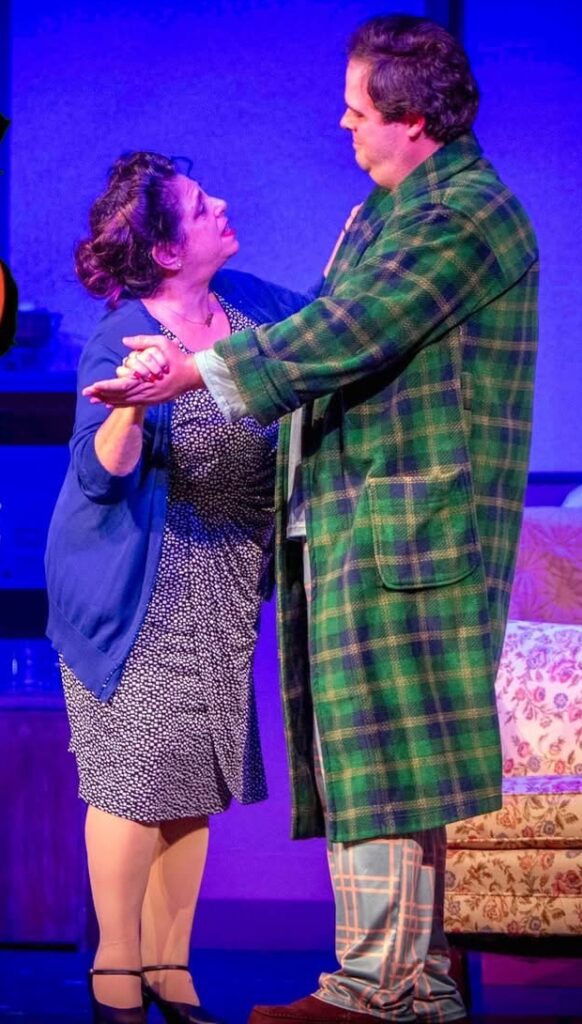
Rosie Prieto and John Henry Parks in a tender moment of Broadway Bound from Pembroke Pines Theatre of the Performing Arts
By Mariah Reed
Pembroke Pines Theatre of the Performing Arts has mounted a genuinely moving production of Neil Simon’s Broadway Bound, written in 1986, before an enthusiastic audience that clearly finds the subject matter and its richly drawn characters close to their own experience.
The play stands as the third and concluding chapter of Simon’s autobiographical Eugene trilogy, a series that opened with Brighton Beach Memoirs and continued through Biloxi Blues. Taken together, the three works follow the maturation of Eugene Morris Jerome through markedly different seasons of his young life: his teenage years in Brooklyn, his time in military service during World War II, and at last, his tentative first steps toward a life as a professional writer.
Upon its debut, Broadway Bound earned recognition as a finalist for the Pulitzer Prize in Drama in 1987 and garnered a Tony nomination for Best Play, along with several additional honors.
The action unfolds within a Jewish family’s home in Brighton Beach, Brooklyn, during the winter of 1949. Eugene and his older brother Stanley, a character modeled on Simon’s own brother Danny Simon, who later built a successful career writing for television comedy, are pouring themselves into their first comedy sketches with one goal in mind: cracking radio writing and earning a place at CBS.
All of this unfolds against the quiet dissolution of the family around them. Eugene’s parents’ marriage, long strained, is coming apart at the seams, while his politically minded grandfather, sharing the same crowded household, faces a wrenching choice: accompany his wife to Miami, where the warmer climate may ease her declining health, or remain in Brooklyn to stand by his daughter as she navigates the painful discovery of her husband’s unfaithfulness.
In their hunger for material, the brothers reach into the very household that shelters them, drawing on the people they love most for their comic sketches. Those same people, upon recognizing themselves, feel exposed and diminished. This painful collision between creator and subject gives the play its moral spine: the question of what we owe the people whose lives we borrow in the service of art, and the isolating price that ambition exacts.
Rosie Prieto brings an effortless authority to the role of Kate, anchoring the production with a performance of quiet, accumulating power. She plays a woman whose intelligence and emotional depth have long been channeled almost entirely into the care of others, a choice made without bitterness, though not without cost.
In one of the evening’s most quietly luminous scenes, Prieto’s Kate recalls a night from her youth when she danced with movie star George Raft at a local ballroom. The memory lights her face from within, and yet something wistful moves just beneath the surface, the faintest shadow of a life that might have taken a different shape. It is a beautifully layered moment, and entirely characteristic of a performance that holds warmth and longing in careful balance throughout.
John Henry Parks brings an easy, grounded charm to the role of Eugene. His comic instincts are sharp and well-calibrated, and his concern for the people around him registers as genuine rather than performed. Parks handles Simon’s funnier lines with confident restraint, allowing the humor to emerge naturally rather than pressing for laughs. The result is a fully inhabited portrait of a young man trying to find his footing as an artist while remaining tethered, by love and conscience, to the family he is simultaneously learning to leave behind. His Eugene is a real mensch of a character, one we find ourselves wanting to cheer for and comfort in equal measure.
Aaron Bravo approaches the role of Stanley with infectious, propulsive energy. He plays the older brother as a force of nature, someone whose conviction in the brothers’ eventual success is so total it becomes its own kind of momentum, drawing Eugene (and the audience) forward in its wake. Bravo’s urgency is dramatically effective, lending the production a welcome sense of drive. Where there is room to grow, it lies in expanding the character’s emotional range; Stanley’s tendency toward confrontation and correction dominates his scenes, and a few softer registers would lend the performance additional dimension and make him an even richer presence on stage.
Larry Bressler brings controlled force to the role of Jack, Eugene’s father, a man whose considerable defensiveness serves as a shield around a core of unacknowledged shame. Bressler plays Jack’s confession not as a moment of catharsis but as an act of deflection, and it is precisely this refusal of remorse that makes the character so painfully recognizable. Yet even here, Bressler allows just enough vulnerability to surface that we do not simply write Jack off. We understand how a man of his particular formation could arrive at such a place, and feel something close to sorrow for it.
Dana Fredebaugh gives Blanche an affecting quality of suspended uncertainty, caught as she is between devotion to her husband and an uneasy awareness that the prosperity she has attained sets her apart from the family whose approval she still craves. As the grandfather Ben, Rick Prada is a consistent source of delight, delivering the character’s sardonic, left-leaning commentary on his grandsons’ commercial aspirations with the timing and ease of a natural comedian.
Director Jerry Jensen brings a sure hand to the material, guiding his ensemble through blocking that feels motivated and unforced, shaping the spatial dynamics of family conflict and rare tenderness with equal attentiveness. The production’s pacing is confident and emotionally alive where it needs to be. Jensen takes care in the production’s quieter passages to let character breathe and deepen.
The sense of family that emerges from these performances is among the production’s most meaningful achievements: these people feel as though they have a history together that extends well beyond the edges of the stage. When grandfather Ben implores his son-in-law to find his way back to the woman he has wronged, it lands with genuine force. And when the family that has spent the evening talking around the things that matter most finally finds the courage to say “I love you,” the moment earns every bit of its emotional resonance.
PPTOPA’s staging of this enduring Simon work unfolds on a set that is at once spare and surprisingly resourceful. Scenic designer John Blessed has conjured three distinct rooms of a family home distributed across two levels, achieving through ingenuity what a larger budget might have accomplished through sheer scale.
Michael Graham’s lighting design does quiet but essential work, drawing the eye to the evening’s most charged moments while washing the stage in a gentle amber glow that suggests a home well-lived-in and warmly remembered. Geoffrey Mergele’s costumes speak fluently to both period and circumstance, placing each character precisely within the economic and social world they inhabit.
Behind the scenes, stage manager Lisa McFadden-Murphy keeps the production’s many technical elements in close coordination, contributing to a flow so smooth that the two-and-a-half-hour running time passes with surprising ease.
At a time when so much feels uncertain and fraught, there is something genuinely sustaining about spending an evening in the company of a family of modest means and complicated hearts who discover, through struggle and honesty, that the most enduring sources of peace and meaning are the people who stand by us and believe in what we might become. Pembroke Pines Theatre of the Performing Arts has chosen wisely and well, and this production of Broadway Bound is one that deserves to be seen.
BroadwayBound plays through March 29 from Pembroke Pines Theatre of the Performing Arts at the Susan B. Katz Theater of the Performing Arts at the River of Grass ArtsPark 17195 Sheridan Street | Pembroke Pines. Performances 8 p.m. March 27 and 28, 2 p.m. March 29 amd 29. Dates: Tickets: $40 adults, $30 students and seniors Running time 150 minutes. Accessible parking is available and the facility is wheelchair accessible. For more information: 954-890-1868 or www.pptopa.com
Mariah Reed is an Equity actress, produced playwright and tenured theatre professor.







 A PaperStreet Web Design