




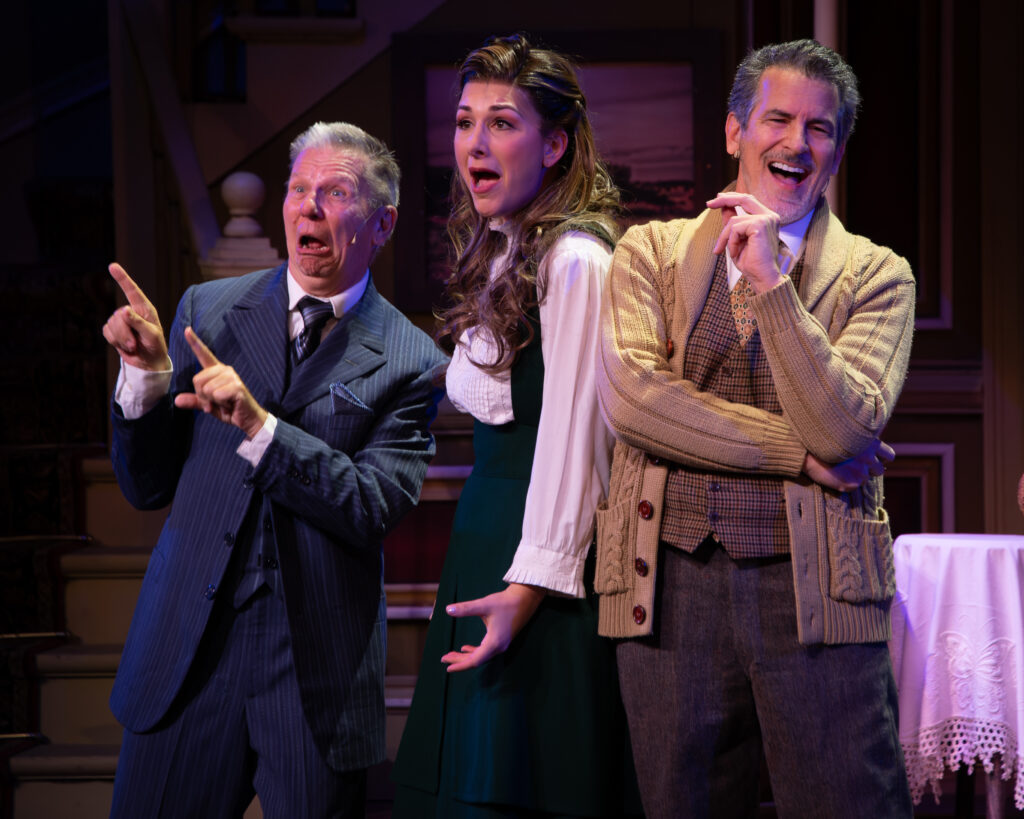
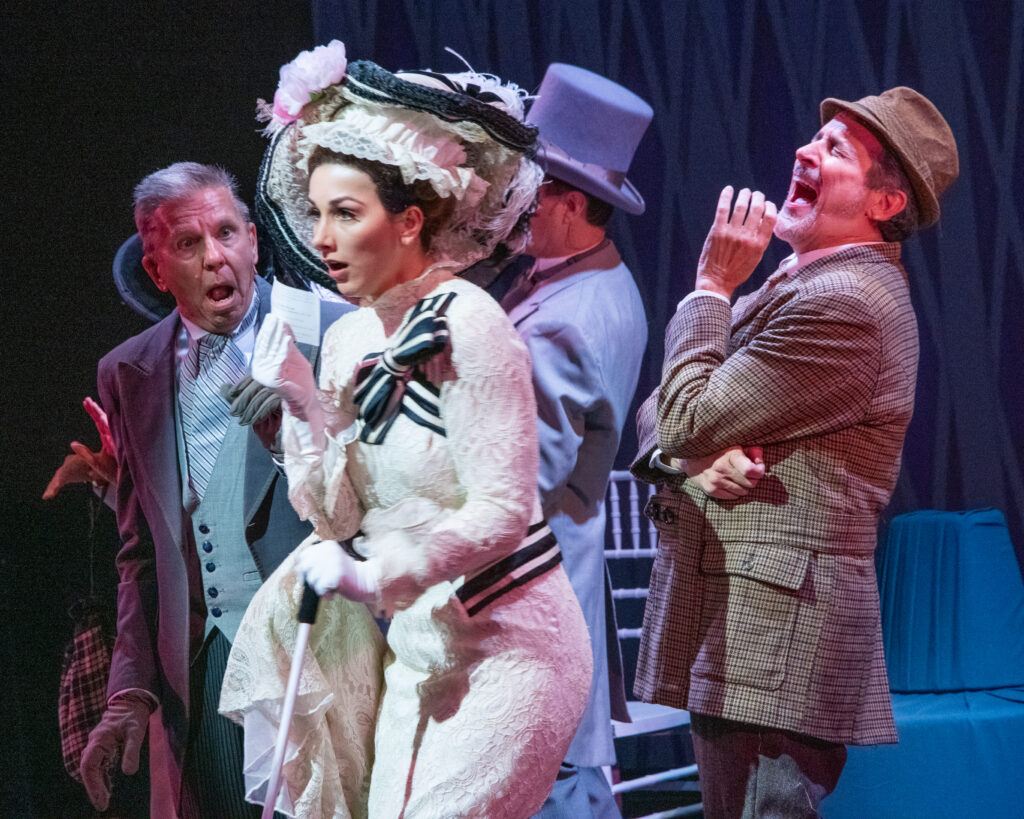
The rain in Spain….. at The Wick Theatre’s My Fair Lady (Photos by Amy Pasquantonio)
By Britin Haller
My Fair Lady, the beloved musical with a memorable score by the legendary Lerner & Loewe, has been around so long it should run on autopilot. You should be able to mount this show with two folding chairs and a piano and still get something resembling delight.
And yet … (as Henry Higgins likes to say), we spent the entire evening at The Wick Theatre waiting for the spark that never quite got there, instead bearing witness to a production that managed to drain most of the joy out, a museum-quality display, nicely arranged and neatly preserved. The kind where everyone hits their marks, but no one seems particularly invested in what they were doing.
We don’t want to take the wind out of their sails because the performances are serviceable, the singing mostly fine, and the audience polite. But politeness is not what My Fair Lady requires. It needs electricity. It needs chemistry. And without these, the result is an evening that felt less like a romantic comedy-satire and more like a very long, very well-funded nap.
And it wasn’t until later that we figured out why.
Based on George Bernard Shaw’s Pygmalion, My Fair Lady tells the story of Eliza Doolittle, a cockney flower girl in London’s Covent Garden in the late Edwardian Era (1910-ish), who becomes the subject of a wager between the arrogant (and wealthy!) phonetics professor Henry Higgins, and his old friend Colonel Pickering. Per the bet, Higgins must transform Eliza into a lady who can pass muster at the King’s annual Embassy Ball in six months. Sort of a period piece Trading Places, if you will.
But Higgins’ job isn’t easy as Eliza gives him grief every step of the way. As well she should since her drunkard father basically trafficked her to Higgins for five pounds before heading off to the pub for a pint.
What follows is a charming, nostalgic, but bizarre, “Battle of the Sexes” rom-com, with an ambiguous closure that possibly undercuts the rest of the story, depending on whom you talk to. We, however, like to believe the last two lines are spoken in jest after a certain person has been won over but is still needing to hang onto to the last shred of their perceived dignity. And instead of the other person making a quick getaway, à la Kim Basinger’s character in 9½ Weeks, the dynamics suddenly shift, and we get that happily-ever-after ending after all.
When done properly, My Fair Lady exposes the ridiculousness of privilege while allowing us to laugh at the absurdity of it all. But comedy works best when the characters who generate chaos are exaggerated, and the characters who observe chaos are restrained. You would never stage The Odd Couple where Felix and Oscar are subdued, and the neighbor is the one mugging in the background.
And so, in our humble opinion, Director Norb Joerder has it backwards, flipping that logic into something that feels lopsided. Joerder tells us himself, in his Director’s Note in the Playbill, when he says “My Fair Lady is a musical, not a musical comedy, although it has its share of humor.”
As a critic, it would be easy to say this show just didn’t land with us, instead of saying that our reaction is based on a specific directorial premise we disagree with, one that changes our criticism from performance to interpretation. And while Joerder’s serious, grounded approach may resonate with some, we missed the wit and buoyancy traditionally associated with the piece. Imagine being cast in this legendary musical and then not being allowed to have fun with it.
Full disclosure, this critic was a former ensemble member and featured dancer in My Fair Lady, so the bar for us is high. When we didn’t leave the theater humming the songs, nor have any pesky earworms to contend with days later, we took that as a sign it didn’t resonate.
Just because a show has serious themes doesn’t mean it can’t be funny. If anything, making people laugh while quietly confronting them with uncomfortable truths is a staple in American theatrical history. Comedy is the sugar that lets the medicine go down.
Indeed, if serious themes disqualified something from being a comedy, then half the golden age of Broadway would need to be reclassified as therapy sessions with tap dancing. When you remove fun and funny on purpose, My Fair Lady is no longer a classic romantic musical comedy, rather a social drama where people sing and dance. You sideline much of the joy that traditionally makes My Fair Lady an enduring crowd-pleaser.
So, it appears this particular production is not accidentally low on pizzazz, rather is committed to being low on pizzazz. It’s a musical that’s built on charming and exasperating larger-than-life characters, and even rich and colorful caricatures, that is neither rich, nor larger-than-life.
Even the Wick’s usual showstopper, Troy Stanley, felt oddly restrained as Eliza’s father, Alfred P. Doolittle. His big numbers, “With a Little Bit of Luck” and “Get Me to the Church on Time” landed, but they felt performed rather than inhabited, as though Stanley never let loose emotionally. When even the built-in comic relief feels guarded, it’s hard to get excited about the rest of the show.
Two others we can generally count on for a good time are Billy Vitucci and Eytan Deray, who play Doolittle’s drunken pals, but they are just lukewarm here too.
On paper, one would think Michael Coppola was a natural to play the role of the pompous fussy Henry Higgins after appearing as Max, the pompous fussy law partner who seemed almost human at times in Pigs Do Fly Productions’ The Long Weekend. But we don’t believe he’s really irritated in “Why Can’t the English,” rather only mildly smug and vaguely sarcastic.
Part of the comedy and charm of “Why Can’t a Woman (Be More Like a Man)” comes from the fact that Higgins doesn’t realize how ridiculous he sounds. Higgins should be infuriating, brilliant, emotionally stunted, and weirdly magnetic all at once. He is meant to be compelling, but any sharp edges that might have once been on Coppola’s Higgins have been sanded down so thoroughly he feels like less a force of nature and more a grumpy professor whose sweater shrunk in the wash.
Even “I’ve Grown Accustomed to Her Face,” a song that should quietly devastate as we realize Higgins doth protest too much, did not feel earned. While nicely sung, there was no sense that the professor had actually undergone any internal shift, so it played more like a charming reflection than a reckoning. And when your 11 o’clock emotional climatic number feels optional, that’s a clear indication something is missing.
We adored Allyson Rosenblum as the milliner Irene Molloy in LPAC’s Hello Dolly, calling Rosenblum’s Carbonell-nominated performance “raw” and “haunting.” And we love the irony of her switching from selling hats to selling flowers. But her transformation from a “heartless guttersnipe,” as Higgins calls her, to a perfectly poised lady capable of wowing a king, only seemed to prove you can take the girl out of Covent Garden, but you can’t take the Covent Garden out of the girl.
Because while the circumstances of her “rescue” and entry into formal society were tacky at best (and illegal at worst), Rosenblum’s Eliza didn’t sufficiently sell us on the kindness and compassion the role is known for. Her high soprano is otherworldly though, and we did enjoy “Just You Wait” where Eliza tells Higgins exactly what she’ll do if he ever asks her to fetch a doctor double-quick.
We also adored the hilarious Charles Baran as Uncle Jimmy in last season’s No, No, Nanette at The Wick. We know if the part is right, Baran will bring the goods all day long. But much as is the case with Rosenblum, we didn’t love Baran as Higgins’ friend, Colonel Pickering.
Pickering shouldn’t feel like someone Higgins can steamroll, but that’s exactly what happens here, and it drains the character of his entire function which is to challenge Higgins in an intellectual way. So when Higgins just walks all over him, the triangle collapses. Eliza loses her advocate, and we lose the alternative model of masculinity.
Britte Hammeke, as Higgins’ housekeeper Mrs. Pearce, has the unenviable job of mugging her way through watching poor Eliza be sacrificed to the linguistic professor and his culpable friend. Hammeke, a Wick favorite, and one of the most talented consistently working actors in South Florida, has little to do but reaction shots.
Once a director decides “this is not a comedy,” they unconsciously flatten the leads from being heightened comic engines to serious characters with issues, and relocate the comedy to side characters through reactions, hence why Mrs. Pearce’s face can’t stop moving.
In that time period, a woman in Mrs. Pearce’s position would never be openly disrespectful to her employer, especially not through visible eye-rolling, mugging, or overt-contempt. Her power would be quiet, internal, and expressed through competence, not attitude.
We question why Alfred Doolittle and Henry Higgins aren’t exaggerated, but the housekeeper who is meant to be the sensible, emotionally intelligent presence in Higgins’ household and likely wants to remain employed, is in the corner rolling her eyes.
On the other side of the spectrum, Elaine Levin, as Henry Higgins’ aristocrat mother, is wonderful and rescues every scene she’s in, even managing to almost give Pickering a personality. For a brief moment, they feel like they wandered in from a much more enjoyable production, providing us with the closest the show comes to genuine comic chemistry. And she’s glamourous in her stunning attire.
Pre-recorded music tracks are understandable if that’s the limitation a theater is working with. There’s no doubt though that this inhibits the singer who must perform their songs every show virtually the same way because the tempo controls their performance, rather than the other way around which is the case with a live orchestra. The performer must concentrate on staying with the beats, rather than allow themselves to feel the emotion, resulting in what often feels like flatness.
The singing was often beautiful, but it rarely told a story. Most of the songs felt detached from the characters’ inner lives, delivered as musical obligations rather than emotional necessities.
There was no sense that these characters were truly affecting each other, changing each other, or even particularly noticing each other. They existed in the same space, but never quite collided. Theatre thrives on collision, but because this production kept everyone in their own lanes, the result was simply safe.
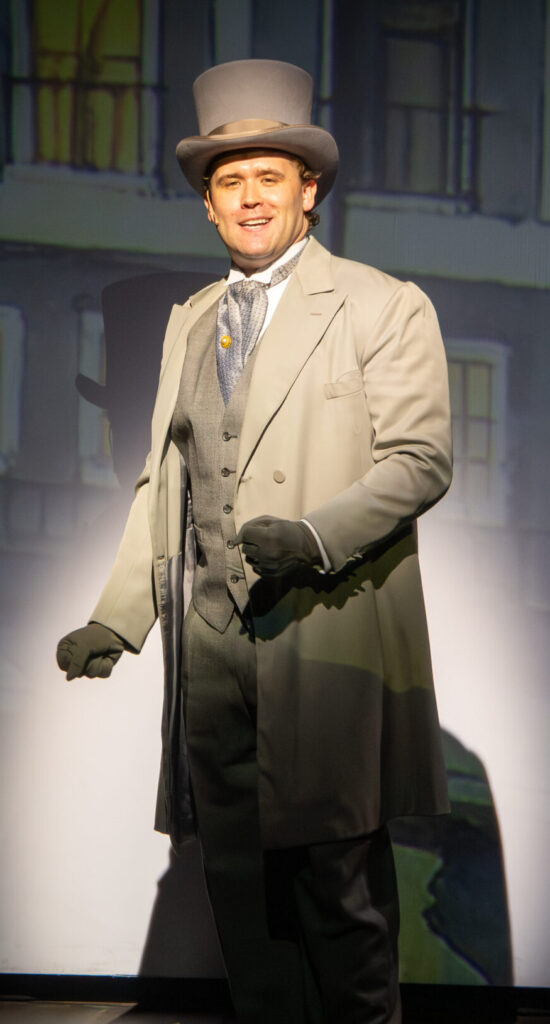
Brady Ryan Phillips,
But there’s an exception to every rule. Enter Brady Ryan Phillips, as Freddy Elynsford-Hill, who clearly understood the OG assignment with his rendition of “On the Street Where You Live.” With his leading man looks and velvety vocals, this was Phillips’ moment, the one time in the entire production that felt alive, a performance that delivered the commitment and feelings the rest of the show mostly avoided. And the audience responded in kind.
Iambic pentameter is on full display with a lush score of Broadway canon songs that are part of the must-know repertoire for any aspiring boards’ auditioner, or trivia expert. The Wick’s in-house musical director, Bobby Peaco, is reliable as ever in bringing the Lerner and Loewe classic score to life. Twice the volume seemed to unexpectedly rise in the middle of a song, possibly manual fader bumps occurring in the booth.
Choreographer Jeremy Benton has done a lovely job, with the skirt swishes, chorus line, and ballroom dancing our personal favorites. Just wish there was more step in their steppin’ so it looked more like movement erupting from people and less like people executing movement. Songs about euphoria should not be staged in stillness and denied oxygen because the cast wasn’t given permission to be broad, silly, or exuberant.
The lighting and sound design by Clifford Michael Spulock and Justin Thompson (respectively) did exactly what good technical work should do, guide our eyes and ears so smoothly we almost forgot it was there at all. The wig design by Tanner Pippert thoughtfully reflected Eliza’s transformation, moving from her loose, natural hair to an elegant updo that perfectly suited the world of the Embassy Ball. Cockney and proper English dialects by Joel Rodriguez are accurately annoying, a compliment indeed, except would someone please ask Rosenblum to work on her pronunciation of the words “arse” and “loverly” which came out “ass” and lovely.”
Costume Designer Kimberly Wick did what she was born to do, create replicas of the iconic Broadway attire from the actual dresses that The Wick showcases in their costume museum. This is one area where they never let us down. Especially lovely is the tangerine dress with the chiffon sash worn by Mrs. Higgins.
Wick is also credited with the production design that centers its physical world in Henry Higgins’ stunning home at 27A Wimpole Street in the Marylebone area of London, while the rest of the settings emerge through minimal props. But it was the evocative use of projections by Josieu Jean and Kacey Koploff which emerged as the real star, creating a vivid sense of place and carrying us straight into the streets and society venues of 1910’s London.
Except for when the opening backdrop of a streetlamp and building moved every time someone walked past it, and for a show already a week in, that didn’t exactly start things off on the right foot.
Adding to the problem was the staging, which made a bold decision to plant Henry Higgins’s house so far upstage that Timbuktu comes to mind. The set itself was handsome, but its placement created a strange visual disconnect from intimacy. This became especially noticeable in the more personal moments, where it felt as it they were projecting across a gulf of empty space.
This fixed, far-upstage sealed aquarium, also known as Henry Higgins’ house, created an odd spatial rule that trapped Eliza in a chair for most of “I Could Have Danced All Night,” a staging problem that drained the number of any real sense of energy or release. Clearly patterned after the Broadway on Tour version which did something similar, this is a prime example of a bad idea that’s now been entered into canon and franchised.
But just because you’ve been given permission to do something doesn’t mean you should, especially when it actively undermines the song. Did anyone in rehearsals not say, “Hey, maybe Eliza would like to move around more here?” instead of sitting politely through a song about losing her mind with joy.
And then, when Eliza finally breaks the production’s own fourth wall and wanders into a downstage area supposedly reserved for street and venue scenes (although this jarring break also occurred at least two other times in “The Servants’ Chorus” and “The Rain in Spain”), we wonder didn’t it flag anyone’s mind, an actor or stage manager perhaps, that the characters are now stepping into a space we’ve established isn’t the house?
A simple solution for Eliza to dance during a song about dancing, and to make it fair to the audience, would have been to let Eliza and the others travel up the visible staircase, exit via the unseen back stairs, and then re-enter from the side to a pre-set bed and nightstand, effectively establishing her bedroom without breaking the spatial logic.
The Wick literally just finished staging A Christmas Carol which had Scrooge’s four-poster Victorian bed, now likely languishing in a dark corner backstage whispering “What about me?” while Eliza is theoretically walking through walls because no one wanted to wheel him out and create an imaginary bedroom space for her to play in.
The Embassy Ball scene felt misplaced as the Act One finale, and given that later productions shifted it to the start of Act Two, it seems our instincts were not off-base. Everything within us wanted a fade-to-black when Eliza appeared at the top of the stairs dressed for the Ball. Really, how much more of a cliffhanger can you get, but instead we go to intermission already armed with the knowledge of what happened. Seemed anticlimactic.
But still and all, even with all our reservations, this is still a well-performed, thoughtfully produced My Fair Lady, and audience members looking for a polished, traditional evening at the theatre will likely leave satisfied, especially if they’re not too familiar with the show.
So what will happen? Will Eliza learn to say “rain” in plain English? Will her wanna-be suitor, Freddy, convince her to leave Professor Higgins? Will Eliza really dance all night?
We’ve grown accustomed to the feeling of family at The Wick. We wish them more than a little bit of luck, because we all benefit when they’re the best they can be. And there is absolutely nothing that should discourage you from heading out from the street where you live to attend a showing of a production that practically swept the 1957 Tony Awards, going on to become one of our most beloved musicals of all time.
But for Gawd’s sake, wouldn’t it be loverly if you could get yourselves to the theater on time? At 7:40, people were still strolling in like Henry Higgins had just asked Eliza to fetch him a doctor double-quick.
Last note: This isn’t the first time we’ve caught significant misspellings in The Wick’s Playbills. Please do better. The cast, crew, and characters are counting on you.
My Fair Lady plays through February 22 at The Wick Theatre & Museum Club 7901 N. Federal Highway, Boca Raton FL; 7:30 p.m. Thurs-Sat; Matiness 2 p.m. Tues, Wed, Thurs, Sat & Sun. Running time approximately 155 minutes includes an intermission. Tickets starting at $99. Call 561-995-2333, or visit thewick.org.
Britin Haller is a journalist, editor-for-hire, and an author who serves on the board of directors for the Mystery Writers of America Florida Chapter. As a celebrity wrangler, Brit regularly rubbed elbows with movie, sports, and rock stars, and as a media escort, she toured with NY Times bestselling authors. After appearing in local musicals and all-state choir, Britin studied theater at Indiana University (a Big 10 college) and the University of Evansville (Rami Malek’s alma mater).







 A PaperStreet Web Design

2 Responses to My Fair Lady At The Wick Theatre Is Fair To Loverly