




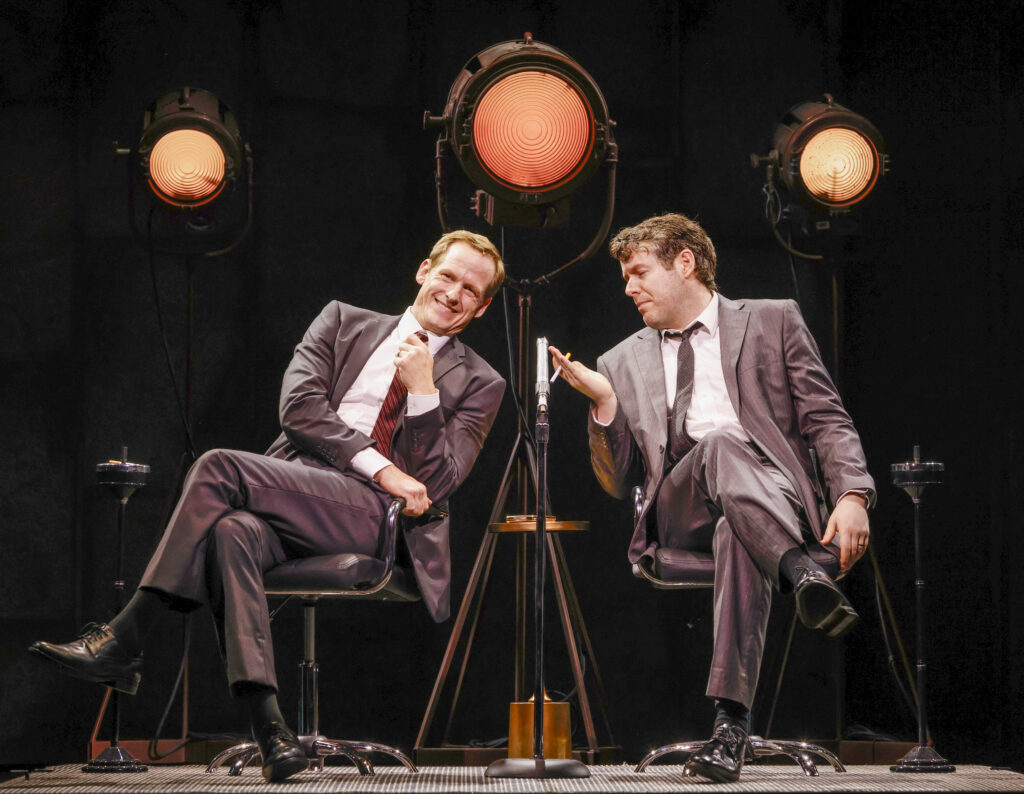
Corey Brill as Jack Paar spars with Max Roll as Oscar Levant in Maltz Jupiter Theatre’s Good Night, Oscar (Photos by Jason Nuttle Photography)
By Bill Hirschman
It’s always puzzling how the pain and struggle of life, how watching the tragic descent of human beings can mesmerize us, perhaps because it reminds us that we are not alone coping with tragedy.
So, while the protagonist in the drama Good Night, Oscar is in a doomed downward spiral, audience watching this compelling production at Maltz Jupiter Theatre cannot look away from an unrelenting arc a bit like Death of a Salesman.
The first-class production fascinates with copious slashes of humor as it takes us into the soul of an outsider living among society’s insiders, indeed accepted as an insider by them, yet not by himself.
It helps immeasurably that the central character in the darkness is Oscar Levant, the real life ubiquitous famed humorist of the 1940s and 1950s celebrity circuit, popular as a sardonic whip-cracking wit who slung quips and stinging zingers with social barbs.
The ride in playwright Doug Wright’s darkness is rife with Levant’s gallows humor depicting the end game of a brilliant but fatally damaged artist who could not see past his self-perceived shortcomings and failures rather than his lauded accomplishments.
Levant, for those under 50 years old, was also an actor, radio quiz show regular, and acknowledged as a master of music from composing to conducting to performing, especially as a virtuoso classical pianist. He appeared in clubs, films, concert halls and was a staple of late night talk shows.
A few Levant-isms in this script: “My behavior is impeccable; I’ve been unconscious for last six months…. You know what a politician is, don’t you? A man who will double cross that bridge when he comes to it.”
He not only did not hide his crippling drugs, alcoholism, depression and mental illnesses, he incorporated them in his crafted public persona. This play and these artists deliver an accurate behind the scenes portrait painted with unvarnished observation.
There is considerable courage in centering a work on a self-pitying, self-disgusted protagonist who has already lost his fight for a life with any sense of self-worth or even a reason for living, yet he continues to breathe.
Wright, director Bill Fennelly and lead actor Max Roll deliver a person with decaying self-esteem which in turn corrodes in on itself deeper, rotting his liver and willpower.
This edition of Levant is the kind of artistic genius who accumulates nouns and adjectives: irascible, hyper-articulate, raging, depressed, obsessed, haunted, hulking, sulking, ribald, inconsolable, blustering, insolent.
Therefore, one of the huge challenges with this story is getting the audience to spend a full no-intermission evening following someone you’re not sure you care about. Fortunately, human empathy on our part wins out. You care just enough to hope he rebounds even though he clearly won’t. But the audience has a responsibility to work at it.
The premise is that Levant’s devoted wife June has lied to check him out of an enforced psychiatric hospital ostensibly to see his daughter graduate. Actually, she is pressuring him toward a single shot appearance on Jack Paar’s live The Tonight Show. While this play is fictional, a similar situation occurred. Levant often appeared on his friend Paar’s shows and his condition depicted here is unforgivingly accurate.
Wright’s acute talent has Paar, network president Bob Sarnoff and June rightfully agonizing for 15 minutes of initial stage time wondering whether Levant will show up. This skillfully preps us with a clear sense of Levant’s true behind-the-scenes condition and his history of deterioration. Fennelly and the cast drive this material with such angst that you don’t realize you are subtly being given necessary backstory.
Levant does show up along with medical orderly Alvin. As he stumbles about and issues sharp quips, everyone including the audience wonders whether he will be able to appear on the live broadcast.
We see his hallucinations physicalizing his complicated idolizing relationship with George Gershwin. Levant excelled in interpreting and performing Gershwin’s work, notably “Rhapsody In Blue.” He says, “I may not have wrote it, but it fit my fingers like nothin’ I ever played.”
But even though he is in ultra-demand for playing it, the piece unjustifiably makes him feel a second-rating sidekick to Gershwin even though has written a considerable oeuvre himself, what he calls the sweet spot where Tchaikovsky and Jelly Roll Morton meet. Gershwin “showed me the limits of my talent…. I gave up living my life so I could be a footnote in his.”
He does the TV show shown in on camera banter between Levant and Paar, punctuated with acerbic even acidic witticisms between a grinning Paar and drug-addled Levant. These actors have it flowing so fluidly that it seems like a well-rehearsed vaudeville routine as Wright wants, even with Levant’s befuddled lack of clarity.
And while Levant refuses in advance to finish his set with his customary piano performance, we all know that he will – which provides the highlight of Wright’s theatrical roadmap.
Leaning uncharacteristically toward playing his own work on TV for once rather than the expected “Rhapsody in Blue,” Levant struggles in a hallucination with Gershwin who challenges Levant’s own inability to judge himself worthwhile for his own work. Levant’s proposed “Concerto No. 1” loses.
So, Levant – and yes, Roll himself – succumbs and plays “Rhapsody in Blue.” Roll superbly invests the rendition with Levant’s torment that what he is most famous for is not his original work, but his interpretation of someone else’s.
Roll, an understudy in the 2022 show on Broadway and in a regional production, has immersed himself inside this creation. With power and technique, he convincingly ranges across this character’s kaleidoscope. Roll’s committed earnestness depicts Levant’s vulnerability buried just a thin layer of bluster and blunted nerve endings.
He and Fennelly’s courageous risk-taking sometimes lands exactly on the mark, sometimes it feels a bit of actors’ textbook technique, sometimes its veers close to being over-the-top. But look at YouTube videos of Levant on The Tonight Show. Roll and Fennelly have faithfully come much closer than you want to remember in depicting Levant at his worst.
Natalie Cordone at first creates a June whose delivery resembles one of those 1950s TV sit-com Jewish wives. But this may have been intentional because as tension mounts, Cardone deftly pulls back layer after layer to reveal a character with more courage, devotion, iron will, strength and love — over and beyond the call of vows — than anyone else in the story.
Corey Brill is a warm off-stage Jack Parr who is loyal and on camera show biz pragmatist perfectly willing to induce Levant to sound off of verboten topics on air.
Others in the troupe are local veteran Ben Sandomir (a terrific Tevye in Zoetic’s Fiddler) as Sarnoff, Elisha Lawson as Alvin, Aaron Idlis as an all-too-classic caricature of an over-eager young production assistant Max, and Harris Milgram as an impossibly elegant and self-assured specter of Gershwin.
Fennelly’s ability to get these performances is enhanced by his blocking; especially when he has Gershwin’s taunting ghost sprawl all over Levant’s piano. And even though Levant doesn’t appear for some time, Fennelly has the production driving from the start. Granted, when Levant/Roll gets into the deepest paralysis of depression, the pace slogs.
The environment of a 1950s TV show dressing room dominated by racks of stage lights above and an on-air talk show set complete with the classic NBC logo was designed by Michael Dchweikart with lighting by Douglas Hamilton and sound designed by Ernesto K. Gonzalez.
The period perfect costumes by Siena Zoe Allen include an intentionally grey washed out casual garb for the pre-show Levant that reflects the no-man’s-land emptiness inside.
Wright has been writing the books for musicals, but he is justifiably honored for the brilliant Pulitzer and Tony-winning I Am My Own Wife (Tom Wahl did Zoetic Stage’s production in 2012) and Quills (Florida Stage in 1999).
Good Night, Oscar plays through March 1 at the Maltz Jupiter Theatre, 1001 East Indiantown Road, Jupiter. Performances 7:30 Tuesday-Friday, 8 p.m. Saturday, 2 p.m. Wednesday and Saturday. Running time 1 hour 45 minutes with no intermission. Tickets at the theater or (561) 575-2223 or https://www.jupitertheatre.org.
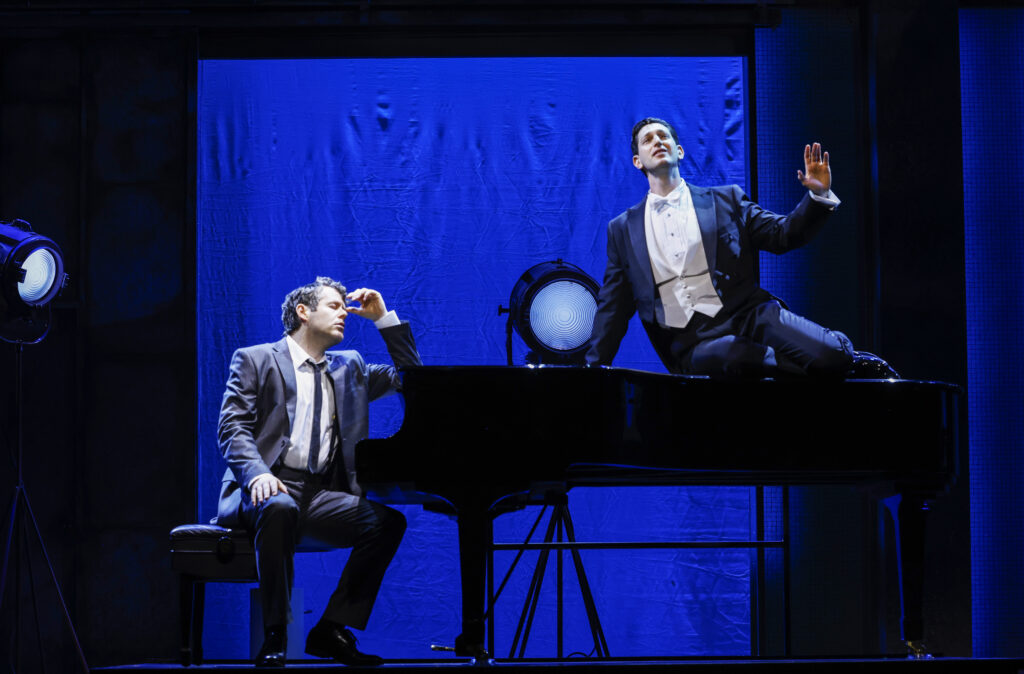
Max Roll as Oscar Levant listens to Harris Milgrim as George Gershwin’s image in a hallucination.







 A PaperStreet Web Design