





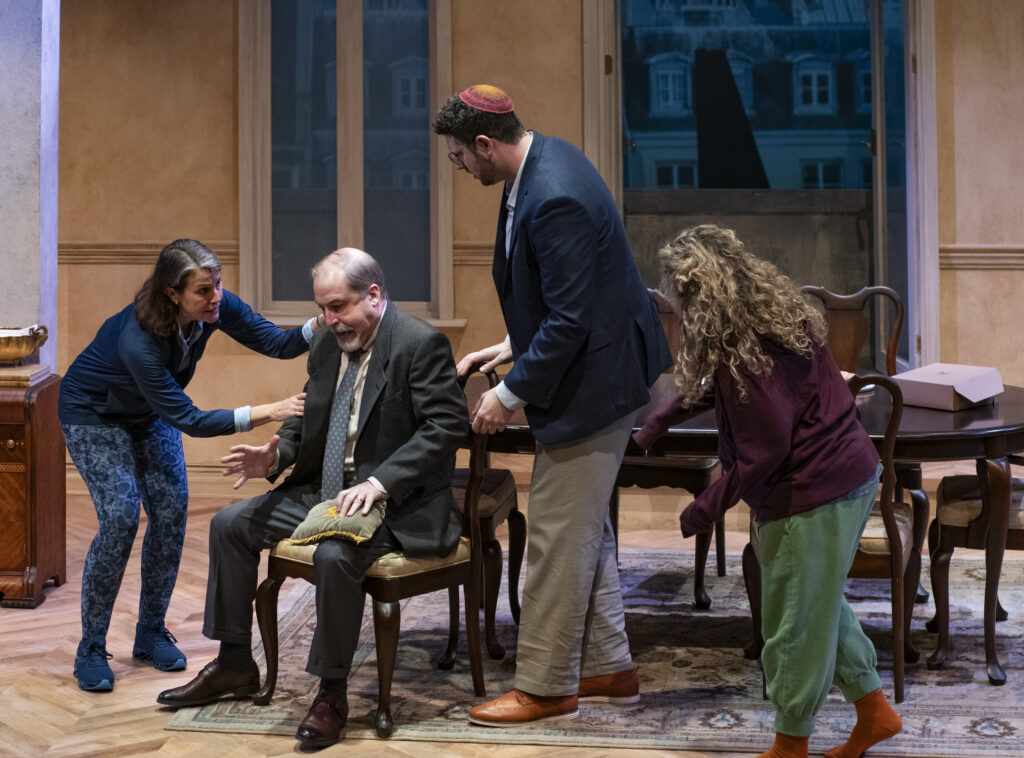
The family wrestles with troubling decisions in Prayers for the French Republic at GableStage (Photos by Magnus Stark)
By Bill Hirschman
Who are we? How do we define ourselves? Would we abandon our history, our nationality or our faith to maintain another part of our identity if we faced fatal danger or just overwhelming social prejudice?
The coup of GableStage’s production of Prayer for the French Republic is it does not ask those questions in some abstract philosophical manner. It depicts a recognizable family like your own struggling to sort out these issues as specific and inescapable as life and death.
Joshua Harmon’s fact-rooted script posits a Jewish family in 2016 Paris trying to deal with a vicious swell in antisemitism that ranges from neighbors’ sneers to beatings to knifings to car bombings to murder. We also witness how their ancestors 75 years earlier dealt with the same issues during the Holocaust.
The growing violence and hatred is forcing each family member to re-examine the priorities of their values. Do they hide their religion, do they fight back, do they leave their homeland of hundreds of years in favor of Israel or any other land?
Indeed, one underlying theme is that the same dilemmas have coursed through the Jews’ existence – and that of many other cultures. Plus, antisemitism and even broader evils persist in every land today.
Harmon deserves praise dissecting the myriad elements in seemingly unreconcilable conflicts. But it is this outstanding cast under Bari Newport’s superb direction and staging that delivers this tangible tactile reality. Although factoids, philosophies, options and opinions by the scores are being offered from Harmon’s page, this ensemble embeds them in anguish that makes the potential costs concrete. It is only in one section late in the play when you can hear Harmon prescribing directly to you.
The messages genuinely apply to all human beings, especially all Americans who have grappled with for more than two and half centuries to preserve their differing cultural, ethnic and religious identities in this self-styled melting pot.
But for Baby Boomer Jews like myself, this play may be far more disturbing. Most of us grew up with antisemitism as something baked into your consciousness because of Nazism. But for a majority of us in our personal lives in the 20th Century, antisemitism was something we read about in a newspaper article, or something happening in another neighborhood, another county, another state.
Prayer does two things: It forces it into our direct contemplation as a palpable threat that can and does and will affect us. And it inescapably invests it with recognizable flesh-and-blood people and agonized emotions.
And it does so with welcome wisps of humor.
This intentionally multi-generational tale is complex enough that the GableStage program grants us a family tree.
Quickly: Adolphe (Bruce Sabath) and Irma Salomon (Patti Gardner) are a couple in their 70s during the Nazi occupation in Paris 1944. Their son Lucien (Jason Peck) was arrested two years ago and other relations have disappeared. Their daughter escaped to Cuba. Later in the play, a damaged Lucien returns with his young son Pierre (Holden Peck).
Our narrator in 2016 is Pierre’s son, a drolly sarcastic Patrick (Michael McKenzie). His psychiatrist sister Marcelle (Elizabeth Price) is married to Charles Benhamou (Stephen Trovillion) one of the thousands of Algerian Jews who emigrated in the 1960s. Their children in their 20s are Elodie (Irina Kaplan) a brilliant vociferous manic-depressive, and Daniel (Jeremy Sevelovitz), a math teacher with a two-year obsession to live a more devout Jewish life than his parents. Visiting from America is a second or third cousin Molly (Casey Sacco). Finally, there is the modern day 80-year-old Pierre (Don Bearden).
The menace invades after a cheery warm meeting as Marcelle greets French-speaking Molly on her semester abroad. Suddenly, Daniel bursts in with a bleeding nose and blood spattered over his clothing. Marcelle stresses this is the second time people have attacked the young man wearing a yarmulke. But while the family wants him to go to the hospital, he forcefully insists they hold Sabbath service because it is almost sundown. Then the tumult explodes.
MARCELLE: Why can’t he be private? Religion is not something to advertise, that’s not how we – He wasn’t raised that way.
ELODIE: Don’t you think it’s a problem, that a person can’t go outside wearing something on his head for fear of being attacked?
MARCELLE. Of course, it’s a problem but you don’t solve a problem by exacerbating a problem…. Even just a baseball cap, something to cover his — In a dangerous world, self-preservation is not incidental.
But the amping up brutality changes minds. Marcelle, who originally refused to consider moving, lays out the collision.
“Part of my brain tells me I am as French as anyone, and no one and nothing is going to push me out of my own country. When you feel like you’re under attack, when your country is quite seriously considering electing a woman from … (a) party that refers to Nazi gas chambers as a quote unquote “point of detail,” when you find yourself in that situation, you stay and you fight, because you have a right to live in your country as much as anyone, anyone, and while there may be a few bad people, that’s not a reason to leave. Because guess what? There are bad people everywhere. But. But. Part of my brain also reminds me, we grew up without a grandmother, without aunts, with almost no cousins to speak of and why? Because they didn’t leave when they could.”
Because another key element of the evening is the lessons preaching about being willing to learn from history or the cost of ignoring it.
“Everyone has become completely ahistorical!,” Elodie says. “They have no memory, and that is my point, because what happened to us is documented, it’s all documented, there’s a reason they call us the people of the book.”
Patrick remands in his usual sardonic tone, “I mean, what is history, but a bunch of stuff other people tell you to get over already? So you do. You stop remembering. And eventually, everyone forgets. Even when you write it down, they forget! Or maybe they want to forget. Or maybe they need to forget, just to put one foot in front of the other.”
Charles notes that the prayer of the play’s title asks God’s protection for the Jews in France. “Every week they say it, every week for two hundred years, through Dreyfus, through Vichy, every generation, even when… and frankly, I’m tired of praying for someone else to protect me. I’m tired of it. And, to be totally honest, I don’t think it’s working.”
Several scenes provide moments of pure theater. One brilliantly acted and paced is Adolphe and Irma sitting dully at their table devastated at the loss of their family who disappeared or moved overseas before the purge. While they know full well that most are likely dead, Irma playfully imagines they have escaped to Cuba.
Adolphe initially dismisses the silliness. But the vision beguiles him and he joins in joyously fantasizing their lives together again in a mountain retreat with ever more vivid details – a dream they and we expect is impossible.
Newport shapes the parts into a captivating whole, adding grace notes not specified in the script. For instance, the script opens Act Three with the family already at the Seder table at Passover. But as the intermission is still ending, Newport has the entire family spend several minutes spreading the lace tablecloth, setting out dishware, filling wine glasses, laying the food before smoothly slipping into the lighting of the candles – confirming the family’s underlying solidarity despite the previous squabbling.
The truly ensemble cast is a gift. While they interact as closely as any family would, Harmon gives his characters extensive monologues to bare their insides.
Notably Kaplan floods one scene in a nearly non-stop seven-page tirade ricocheting a score of conflicting arguments swirling in a cyclotron. If this doesn’t earn her a Carbonell nomination for supporting actress then there is no justice.
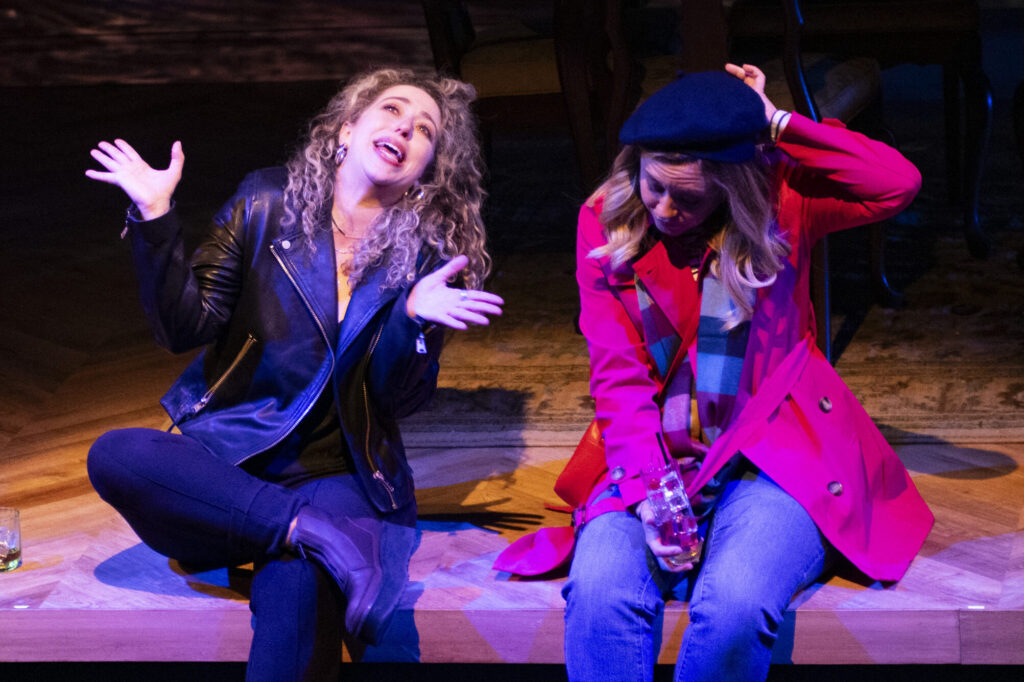
Irina Kaplan holds forth as Casey Sacco tries to listen
And the esteemed Elizabeth Price has never been better, convincingly charting the steps as Marcelle evolves on a reluctant path. And the ultimate pros Patti Gardner, Stephen Trovillion and Michael McKenzie are, as always, nonpareil.
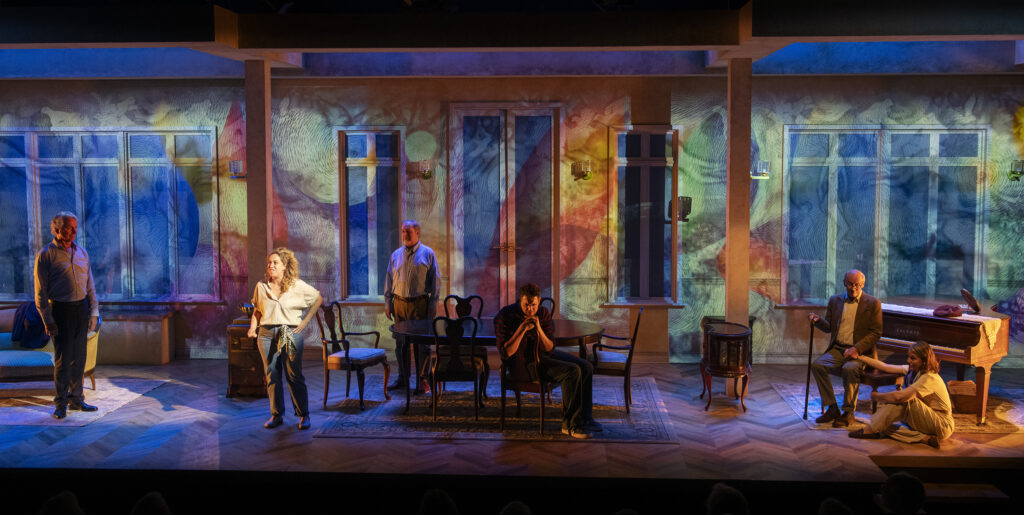
As usual, GableStage has gathered a first-class team of designers and staffers. Top of the list is Jamie Godwin whose projections range from a Parisian rooftop skyline that changes with the time of day, plus enveloping abstract designs in motion.
Then applaud Sean McGinley’s sound which allows for the audience to clearly hear the characters’ offstage conversations, Frank J Oliva’s apartment design, Jessica Windward’s lighting, Jennifer Wake’s period props, Marina Pareja’s costumes, all under production stage manager Katie Ellison and assistant to the director Bailey Hacker.
The work won the 2022 Drama Desk Award for outstanding play and Outer Critics Circle Award for outstanding Off-Broadway play, and nominated for the Best Play Tony. Harmon’s play Bad Jews was produced at GableStage in 2014 and Main Street Players in 2017.
Several important notes: First, the running time is a shade over three and half hours including two intermissions. Second, performances start a half-hour earlier than usual.Third, the City of Coral Gables has installed paybyphone parking throughout Biltmore Hotel’s parking lot. The church across the street allows parking by GableStage patrons unless there is an event in progress.
Prayer for the French Republic plays through April 19 from GableStage based at the east side of the Biltmore Hotel, 1200 Anastasia Ave., Coral Gables. Shows 2 p.m. Wednesdays and Sundays, 7 p.m. Tuesday, Thursday, Friday, Saturday; 1 p.m. Saturday, Running time 3 ½ hours including two intermissions. Tickets $60-$95. Call 305-445-1119 or go to gablestage.org






 A PaperStreet Web Design