






Gabriell Salgado, Sara Morsey and Claudia Tomas exchange letters at a crucial moment in Nilo Cruz’s Sotto Voce at GableStage (Photos by Magnus Stark)
By Bill Hirschman
Our haunted past never leaves us. Facing crippling tragedy – not suppressing it, not hiding from it – is the only way to come to terms with it.
Such a theme may seem almost too familiar, but in Nilo Cruz’s Sotto Voce at GableStage, that truth, especially that first clause, sinks deep in an audience’s viscera with bottomless profundity and pain.
Further, the 2026 resonances in the premise, in the dialogue itself of this 2014 drama immerse us in immigration, expiring visas, racism, fascism, Cuba, Judaism, and a refusal to accept responsibility, all that and far more emanating from a real-life tragedy in 1939. That nightmare doesn’t echo our times, it depicts them.
The script tracks a young Jewish Cuban writer Saquiel Rafaeli (Gabriell Salgado) on a student visa in 2020 trying to interview an 80-year-old German novelist Bermadette Kahn (Sara Morsey) in New York.
She has first-hand insight for his work documenting the horror when Cuban and American officials refused to let German Jews off a ship seeking refuge from the oncoming Holocaust – resulting in the deaths of hundreds when they returned to Europe. Among the refugees that were denied entry was the sister of Saquiel’s grandfather who wished that she “not to be banished from history.”
The writers’ cautious interaction – without ever physically meeting each other – results in a slow evolution as she, a Gentile, reluctantly revisits how her Jewish lover and his sister boarded the boat and were never heard from again. Her inaction suffused her with such guilt that she withdrew inside herself and away from the outside world once she moved to America herself.
It resonates as well for Bermadette’s friend-maid-companion Lucila (Claudia Tomás) a Colombian who may not be here legally, but who won’t visit her home for fear being unable to return.
The interplay of all three intensifies and steps into near fantasy as Bermadette’s recollections stimulated by Saquiel’s questions force her where she has aggressively repressed.
In relating the themes, it’s difficult to adequately communicate the depth and pungency that this production delivers with passionate performances, imaginative staging and even a touch of humor.
Of course, Cruz’s direction is invaluable guiding the cast to find his unique voice (difficult to nail for some troupes) – everyday language that somehow slips convincingly into near poetic imagery. But casual theatergoers might erroneously overlook his deft skill at physical staging, including grace notes such as an agonized Bermadette launching her body across a table. Or the visual of everyone using their arms and hands to emphasize their comments. Or a choreographic exchange of letters in mid-air.
The two writers never meet physically because Bermadette is agoraphobic and has never left her apartment. So Cruz convincingly has the characters build their relationship across from each other on the stage on the phone, in emails, and especially in fantastical co-reimaginings of her past.
Keep in mind, this is theater with unabashed theatricality. For instance, Bermadette’s surrender of her intransigence seems a bit sudden simply motivated by a gift bouquet. And the finale would seem a bit pushing plausibility if this was a naturalistic work, but as theatrical storytelling, it is perfectly appropriate.
But again, what slams your soul over and over are the words that shake your soul, such as Bermadette’s anguished “I can’t believe how this is happening again.”
Passages written 11 years ago seem painfully prescient.
Lucila: And how can we gain back our discretion, Ms. Kahn?
Bemadette: Maybe through a little fear. But nowadays I don’t know anymore. Nowadays no one is afraid of anything. We have lost our fear.
Lucila: What kind of fear are you talking about?
Bemadette: Fear that everything will fall into a state of disorder and ruin. In the old days we used fear as a way of bettering ourselves. Wars used to remind us of our own demise.
This is not meant in any way to be a documentary of the tragedy. Indeed, other than a short memory flashback, the play does not spell out what happened in 1939 until quite late in the first act. While there is a dramaturg’s note in the playbill, knowing a touch more yourself about the tragedy underlines what you see and hear on the stage until Bermadette walks us through in a memory monologue.
The trio of actors, the script and direction flow with a gentle drive echoing the title – a quiet delicate voice sometimes too quiet to be heard easily.
Salgado, memorable in Zoetic Stage’s Frankenstein and Clyde’s, lives inside the gentle if persistent Saquiel fervently seeking answers. Tomás delivers an effervescent lifeforce.
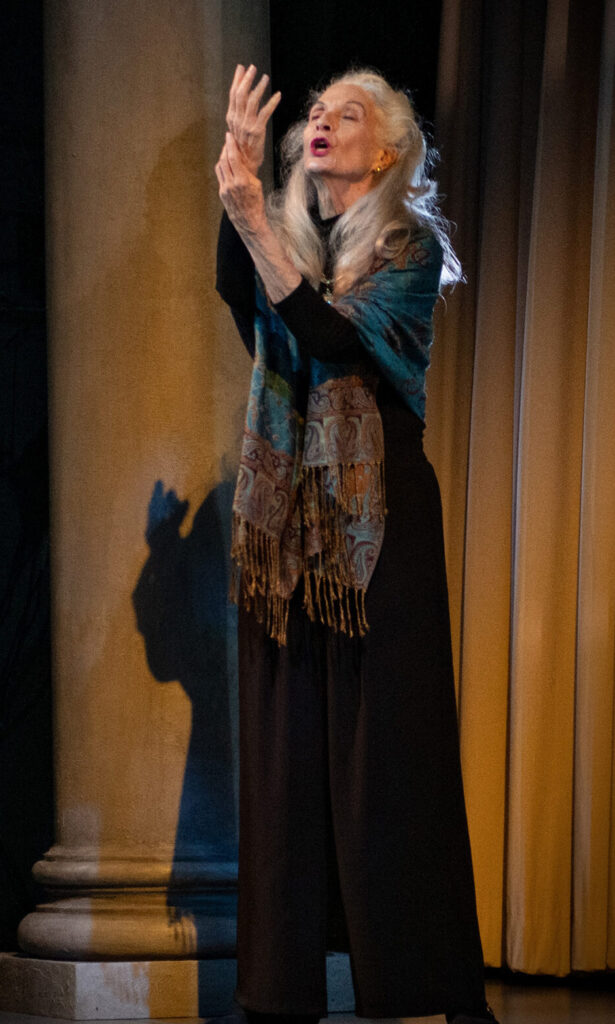
Sara Morsey
But we regret having waited this long to spotlight the gift of Morsey. Cruz and Morsey create a persuasive evolution of Bermadette’s gradual emergence. She begins as a someone with a crisp defensive layer which occasionally cracks a millimeter to show us the darkness inside. That Morsey triumphs depicts her step by step gradual emergence to a liberated spirit is an acting challenge – not just in its range but that you don’t notice it has been happening subtly.
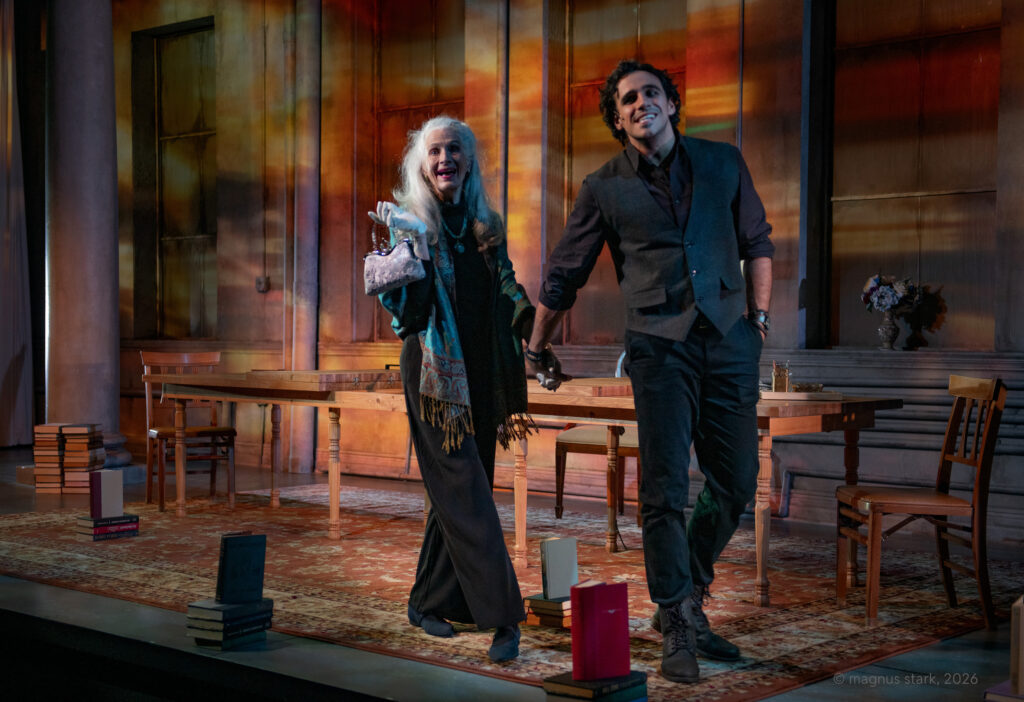
The production values are excellent: Tony Galaska’s evocative lighting, Erik T. Lawson’s underscoring sound, Frank J. Oliva’s scenic design and notably Jamie Godwin’s stage-wide projections including the tumultuous seascape, blown-up letters and the interior of Bermadette’s mind.
Miamian Cruz is one of Florida’s best nationally known theater figures, due in part to Anna in the Tropics which premiered at Coral Gables’ New Theatre even before it won the Pulitzer Prize in 2003. But his work – much of which bowed here — is produced across the country’s major regional theaters and overseas. El Último Sueño de Frida y Diego, the opera he wrote the libretto for about Frida Kahlo and Diego Rivera, will be mounted in May at New York’s fabled Metropolitan Opera.
This is the kind of theater in which audiences can spend the next couple of days analyzing, reanalyzing and relating to their personal past that it resonates with.
The late irreplaceable critic Christine Dolen, in reviewing the very brief production here in 2014, wrote in the Miami Herald, “Sotto Voce is a play with a future.” More telling than we knew at the time.
Sotto Voce from GableStage Theatre Company plays through Feb. 15 at its tht at 1200 Anastasia Ave, Coral Gables, 7:30 p.m. Wednesdays-Saturday, 2 p.m. Wednesday and Sunday. Running time is 2 hours 15 minutes including an intermission. Tickets at www.gablestage.org or boxoffice@gablestage.org Or call 305-445-1119. A Q&A with the cast will follow all Wednesday matinees.
Important note: Parking is no longer free on the Biltmore grounds. The City of Coral Gables owns the lot and told the hotel this would be the case. Visitors can use ParkMobile or another pay-by-phone service to pay. Free parking is available at the church across the street if there is not an event in progress. Free parking is also available one block away in the tennis court lot along Cordova Street. Valet parking provides a 10 percent discount if you show your GableStage ticket. When we parked by phone for five hours, it cost about $25. Valet would have been $23.
An interview with Nilo Cruz can be found at https://www.youtube.com/watch?v=cENw5ARluhA






 A PaperStreet Web Design