

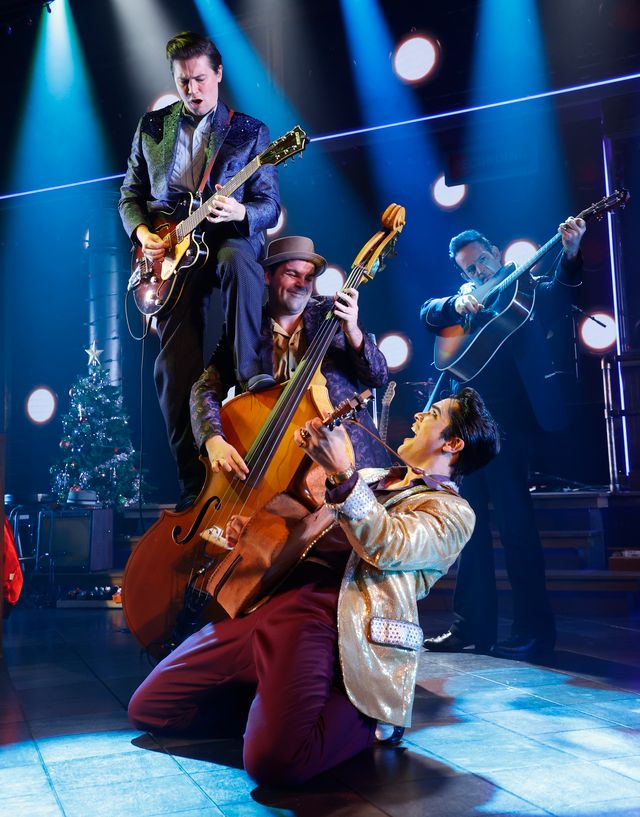
Lettin’ loose at the Maltz Jupiter Theatre’s Million /Dollar Quartet (Photos by Jason Nuttle. )
By Britin Haller
Jukebox musicals are not this critic’s thing, but as they go, Million Dollar Quartet, now playing at the Maltz Jupiter Theatre, is pretty good. The opening night audience didn’t go away disappointed.
Thanks are due to Tony Award-nominee Director Hunter Foster (who played Sun Records’ founder Sam Phillips in the original production on Broadway), the technical team at the Maltz who performed a show-saving move mid-song, and the insane and insanely over-the-top performance of Sean McGibbon as Jerry Lee Lewis.
The Maltz’s Producing Artistic Director/Chief Executive Andrew Kato knows his patrons and had no doubt that jukebox musical, or no jukebox musical, Million Dollar Quartet would be a guaranteed hit.
Knowing the songs, and yes, even singing along during the concert portion of the evening is part of the fun, so if you don’t know a hound dog from a great ball of fire, this may not be the show for you.
While the plot is loosely, and we do mean loosely, based on a real day in history (Dec. 4, 1956) when music legends Elvis Presley, Carl Perkins, Johnny Cash and Jerry Lee Lewis found themselves in the Sun Records recording studio in Memphis all at the same time, it sometimes feels like a priest, a rabbi, and a minister walk into a bar running gag. Reports are varied as to what really happened that day, but for the purposes of story, we’ll just go with it.
Phillips, “The Father of Rock and Roll,” is in a pickle. The previous year, he needed money fast so he sold Elvis’s contract to RCA Victor. Jerry Lee Lewis is a new talent and not yet famous, Carl Perkins is having a career slump and a confidence crisis, and Johnny Cash is interested in sowing his oats, although Sam doesn’t know that yet.
While Philips has them there together all in one place, he decides to have an “unplanned” jam session, the recordings of which weren’t discovered, or released, until decades later when the new owner of Sun Records was going through some files and made the monumental find. Oh, to be a fly on that wall.
All four main actors have a history on stage with the show and/or the respective legend they play, and so any critique of the actors’ impressions by us doesn’t seem appropriate. This isn’t a cop-out, this is just us being fair, although we will say that after watching videos and obtaining factual (can’t be disputed), information on the real artist, one individual doesn’t quite have the moves down pat.
Sky Seals plays Johnny Cash, “The Man in Black,” as he has done over a reported 1000 times since 2016. Chance Michael Wall is Carl Perkins, “The King of Rockabilly,” coming to the stage after music directing Million Dollar Quartet elsewhere and now doing the same here. Daniel Durston, a former contestant on Big Brother, is an Elvis, “The King of Rock and Roll.” Durston is a tribute artist in Las Vegas with a cool replica of Presley’s Martin D-28 mahogany carved guitar.
 But it’s Sean McGibbon, who starred in the 1st National Tour of Million Dollar Quartet, who makes this show one to remember with his portrayal as wild man “The Killer,” Jerry Lee Lewis. McGibbon makes the stage his own as he plays the pie-an-a, as Lewis called it, upside down, backwards over the piano bench or standing on it with one foot, with his feet, with his elbows, or standing on top of it. And when Lewis tires of the piano bench, McGibbon just kicks it away.
As the drummer Fluke, and the bass player and Carl’s brother Jay, Cason Day and Isaac Foley add some nice moments and some great musicality. As Elvis’s girlfriend “Dyanne,” Katie Rodgers is both sweet and sultry, even laying back on Foley’s bass while singing during “Fever.” The name Dyanne is in quotes because the woman with Elvis was really a dancer he met in Vegas named Marilyn Evans who reportedly did not sing that day, but again, loosely based.
Despite all the greatness in the room, it’s iconic music man Sam Phillips who’s the heart and soul of Million Dollar Quartet, and Vince Wingerter in this role does not disappoint. But how much better could the “plot” have been if creators Colin Escott and Floyd Mutrux remembered that?
RCA Records wants to buy Sam out, but he has to give them an answer that evening, or the deal is off. Sam has just been told some things he wasn’t prepared to hear, so he goes outside to think and smoke (don’t worry, it’s simulated), has a nice moment with Dyanne (so nice we wonder if they’re going to get together because she has more chemistry with Sam than Elvis), and then snaps a photo of the four legends of music surrounding the piano.
But just when Wingerter has us in Sam Phillip’s pocket in a touching and tender moment that is based on real history, just when we are still all up in our feels with zero transition or justification, suddenly, we are at a FLASHY ROCK CONCERT with everyone in the cast on stage in bright costumes! This results in the audience members who haven’t been following along in their Playbill, i.e. everyone but us, jumping to their feet for a curtain call standing ovation.
“The show’s not over,” we said to our companion, pulling at her jacket to try to get her to sit back down. “Yes, it is” she said, obstinately remaining standing.
As a critic, this is our biggest nightmare because to take notes, you have to be able to see the stage, and when everyone in the house is vertical, it’s impossible to see the action. And taking notes while standing doesn’t work either.
Glaring daggers into the back of the heads of the crowd in front of us seemed to do the trick as finally people started to get the drift and sit back down. But what the h-e-double hockey sticks happened to the plot? And are these still the characters, or are the actors doing bows?
Four energized songs, one adorable moment when Elvis flirts with a woman in the front row, and a “Whole Lotta Shakin’ Goin’ On” later, we get the real curtain call.
Jukebox musicals invariably, and fairly, get the complaint that the plot is thin, but just when we started to think this one was different and had a real throughline, our hopes were dashed.
And it didn’t have to happen that way. If Sam had simply stepped into the spotlight, spoken from his heart and framed this as his fantasy of the concert that never happened, then when the lights exploded into rock and roll mode, it would have felt earned and intentional instead of boom, concert, deal with it.
We would have felt an emotional payoff, instead of a narrative abandonment. After all, it’s been Sam’s story all along, so why are we cheating him in the very end? Instead, the idea of Million Dollar Quartet goes down as one more jukebox musical storyline that failed us. Couldn’t Sam just be happy for a few minutes before the world takes his stars away from him one-by-one?
But listen closely here, and we mean this in the nicest possible way, we are not your average theatergoer who just wants to be entertained for two hours. We are a student of theater and novel writing who expects more and is often disappointed.
And let’s face it. The mostly older crowd were not there for the plot. They were there to hear the music that defined them. And that they did, albeit shortened versions of the hits they know and love. And they laughed at clever lines that played into history like when Elvis said he’d never play Vegas again, because needless to say, he famously did.
The staging by designers Adam Koch (scenic), Wheeler Moon and Kirk Bookman (lighting), Lauren T. Roark (costumes), Scott Stauffer (sound) and Bryce Cutler (projections) worked in tandem to create a 1950s environment in what’s a slightly claustrophobic recording studio, perfect for ratcheting up the tension in the room.
A few notes:
The King’s heavy pancake makeup made him look more like Vegas swan-song Elvis and less like the hunk of burning love he would have been in 1956.
A technical glitch right after intermission in the second act resulted in a seismic breaking of the fourth wall when a tech guy from 2025 walked into Sam Phillips’s 1956 recording studio to change out the MIDI interface in Jerry Lee Lewis’s piano so it could Bluetooth. We get issues can happen, but since it’s a known possibility, why not at least have the techie dressed as a recording studio employee circa 1956, and not as the Geek Squad member you see at Best Buy? And of course it happened during our favorite song in the show “I Walk the Line,” and totally took away from Johnny Cash’s (and our) big moment. But that’s show biz.
Major kudos to Kent James Collins and Zoe Steenwyk for springing into stage manager action when triage on the piano guts were necessary to avoid a potential musical disaster later. Certainly not something they ever want to have happen, but it does, and they handled it like the pros they are.
So here’s the bottom line. There are two types of jukebox musical audience members. People who genuinely go for the nostalgia, who will clap at the first two notes of every song, and who say “I love it when they sing all the hits!”
And then there’s us. People who would rather have a root canal than sit through another jukebox musical. But on the plus side, this one at least has real musicians. Everyone is playing live and that has to count for something.
And we learned things like Johnny Cash wrote “I Walk the Line” for his first wife Vivian who had concerns he would stray on the road. Jimmy Swaggart and Jerry Lee Lewis were cousins. Carl Perkins wrote “Blue Suede Shoes” and was mad that Elvis got the glory for it.
Does the Maltz Jupiter Theatre really deliver with Million Dollar Quartet you’re probably wondering. We have to admit they do. And if you don’t believe us, just ask the audience members who couldn’t sit still in their seats or contain their big goofy smiles as they, and Elvis, left the building.
So go and have a good time, just don’t look too closely for a plot.
Million Dollar Quartet plays through December 14 at the Maltz Jupiter Theatre, 1001 East Indiantown Road, Jupiter, FL (immediately east of A1A); Shows are nightly Tues-Fri @ 7:30 p.m. and Sat @ 8 p.m. Wed, Sat and Sun matinee @ 2 p.m. Limited tickets still available. Running time approximately 135 minutes includes a 15-minute intermission. Prices starting at $78. Call 561-575-2223, or visit jupitertheatre.org.
Britin Haller is a journalist, editor-for-hire, and an author who serves on the board of directors for the Mystery Writers of America Florida Chapter. As a celebrity wrangler, Brit regularly rubbed elbows with movie stars, sports stars, and rock stars, and as a media escort, she toured with New York Times bestselling authors





 A PaperStreet Web Design