




THE NEXT THREE SEASONS IN FLORIDA THEATER

Aloysius Gigl and Jeni Hacker in Zoetic Stage’s Sweeney Todd (Photos by Justin Namon )
By Bill Hirschman
(This is the second of an in-depth three-part series about the future facing Florida theater over the next three seasons, examining everything from what you’ll see to what it will cost patrons and artists to whether it will survive at all. Today focuses on the extreme problems caused by climbing costs and funding losses. The first part examined from what you’ll see to what it will cost patrons and artists to whether it will survive at all ran on Sunday. It can be seen at https://tinyurl.com/3xhj9ckp. The third part will be posted Thursday, Jan. 8 focusing on who is available to act, direct and design future productions, whether there even are enough experienced and/or talented artists in the local pool.)
IT DEPENDS ON WHAT YOU PAY
“With so little to be sure of.…” – Anyone Can Whistle
The future of theater over the next three seasons will continue to be the result of the fragile juggling of balancing artistic vision and balance sheets.
SMU DataArts, a national arts and culture research center at Southern Methodist University, reported in The New York Times that from 2023 to 2024, theater attendance fell 19 percent and income fell 37 percent.
But part of the troubled aspect of the “artistic” equation is operating, administrative and production costs have risen steadily in recent years, said Andrew Kato, Producing Artistic Director/Chief Executive of the Maltz Jupiter Theatre.
And there is no sign of abating, from renting space to buying plywood. Equity union minimum paychecks have inched up. That has led to smaller casts and simpler sets. Sometimes there are internal staff pay cuts like those from resulting from federal National Endowment for the Arts cuts that cost staffers and require the expense of training less expensive replacements.
Audiences always savor conspicuously expensive complex sets and costuming. Maltz Jupiter Theatre has added a full-stage LED screen. And yet expect to see simpler, more evocative elements requiring the audience to use more of their imagination to fill in the minimalist visuals.
Fare on stage relies heavily on the tickets paid for by the audience, different types of sponsors and government support. For some, overall income from the past two seasons has been strong, such as the Maltz with 65 percent coming from ticket sales and other merchandising.
Maltz with a fight or flight attitude since battling its way back has whittled its $6.2 million debt from a massive building/programs expansion; now it owes about $1.4 million counting pledges and promises.
But most theater leaders are more profoundly uneasy than ever before about the next three seasons and even beyond.
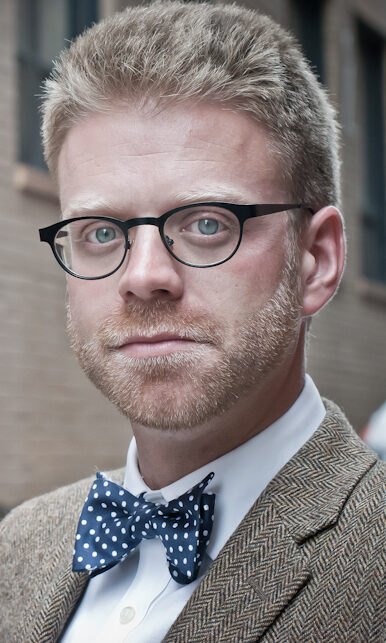 In other geographic regions in the past, about 60 percent came from grants and donations, 40 percent came from ticket sales. But here, those figures are flipped, said Phillip Dunlap, director of the Broward County Cultural Division. Both elements that are essential in figuring budgets a year in advance are unpredictable right now.
Fortunately, ticket sales have risen (but noticeably not quite) toward pre -COVID levels for many companies here. Individual ticket prices are only inching up this season from $2 to $5, with a rare $15 bump.
While a single performance may sell out this season, the numbers for a complete run or a season are far different. Several are hitting 70 percent of the available seats. The Maltz aims for 90 percent seats filled and came close last season with 85.5 percent. They made the financial goal by selling tickets for one play at a lower price once subscriptions were sold.
But “there’s an over-dependence here on earned revenue (such as ticket sales), which means that our arts organizations have a less developed philanthropic basis of support,” Dunlap said. “There’s a lot of (potential donor) money here, but this is a lot of people’s second, third, fourth home. So when they come here, they’re not necessarily looking to donate to an arts organization or to be on a board, right? They’re here to play on the yacht or have fun… and tourism drives the boat.”
That situation may be worsening due to what GableStage’s Producing Artistic Director Bari Newport, calls “donor fatigue.” Some theaters continue to have moderate healthy donor support. But others like the Maltz Jupiter Theatre have seen some donors spreading out their usual theater contributions among a wider array of needy organizations. Some companies are seeing fewer donors, yet who are giving more. PH
“How many times can you go back to the well?” said Newport “We’re lucky that we live in a community that has philanthropy to give. But it’s not just individuals who make the Ferris wheel go around. It’s also foundations who are often quite fickle in terms of their giving priorities, and they can change at any time.”
While Tim Davis, producing artistic director of New City Players in Wilton Manors treasures the generosity of five-digit donations, he fears what will happen if one or more disappear. So he is leaning harder to attract donors “of $1,500, $2,000, $3,000, the middle-class donor or the upper-middle-class donor who can’t write a check for 10 grand, but they could do 100 bucks a month. They could do $1,000 at the end of the year because that’s sustainable.”
GOVERNMENT: THE ROOM WHERE IT (MIGHT) HAPPENS
Baubles, Bangles And Beads — Kismet
Still, everyone agrees the most controversial, and arguably the scariest, development in the past two years is that most federal, state and county underwriting has either vanished, shrunk or wobbled – unreliable levels that Dunlap decried as “freaking yo-yos.”
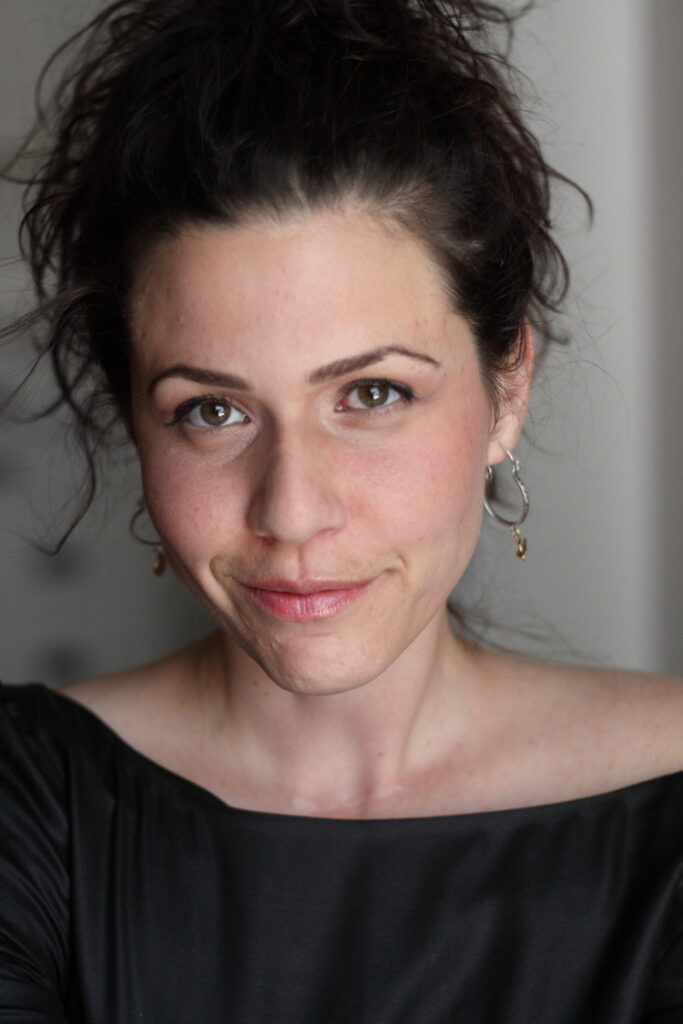
Bari Newport
To Newport, “The days of there being an assumption that arts and culture would always be funded from at least the state level or at least the county level, that assumption cannot be made any longer.”
Last year, Gov. Ron DeSantis vetoed more than $32 million in art and culture affecting 577 arts programs and 33 facilities. He cited “sexual” Fringe festivals (reportedly one in Tampa), with content that he said would not be age-appropriate for children and families to attend. He said at a press conference, that was the arts were “too much into the DEI, into the woke stuff.” PH?????Newp
This calendar year, he proposed $27 million for cultural and museum grants, but wants language in Florida law to ensure the funds can’t be used for programs or activities depicting sexual content, sexual excitement or anything “harmful to minors.” What was passed and signed was $18.7 million.
This year, 184 got everything they qualified for (up to $150,000 for large budget concerns) and the other roughly 500 got nothing. In ‘23-24 the figure was $43.1 million; it was $59 million in ‘22-23 and $26.7 million in ’21-22.
This year, Broward theater and facilities sponsoring theatrical performances only three received grants: Broward Performing Arts Foundation, Performing Arts Center Authority and the only pure theater company was Fort Lauderdale Children’s Theatre. Ignored were New City Players, Thinking Cap Theatre and Slow Burn Theatre.
In Palm Beach County, only three received help and none were theater companies. In Miami-Dade six benefited and only one pure theater company, Actors’ Playhouse. Ignored were GableStage, City Theatre, Juggerknot and Zoetic Stage. All of the ignored companies had earned the 80 points that has historically been the cutoff.
This year, President Donald Trump cut some funding and called to eliminate funding for the National Endowment for the Arts, an independent federal agency that provides hundreds of millions of dollars to fund arts and culture nationwide.
This past summer, Miami-Dade County — one of the most generous underwriters of a local arts scene in the nation — proposed a budget for fiscal year 2025-2026 that halved cultural grants by $12.8 million and eliminated its Department of Cultural Affairs. But a protracted vociferous protest by agencies and patrons dissuaded the elected officials. The revised budget restored most of the funding, allocating $11.5 million for grants while maintaining the department of Cultural Affairs.
POLITICS AND POKER
One large unanswered question is the mass of confusion and ever tightening timeline from the state Division of Arts and Culture about the grant process for the coming fiscal year. – and its troubled past. Sit down for this saga.
In the past, the application was due around June which allowed theaters to budget for the 2026-27 period being budgeted by local theaters traditionally in the summer. But in June the state announced it only would accept those requests in the first two weeks of July – usually 600 to 800 applications for all arts funding.
Scoring panelist assignments were distributed on August 19. One local non-profit company was scheduled for a panel review on September 12.
And then ……on September 5, the state cancelled the panels for the 600-plus application filed. The officials wrote pause was needed “updating its grant application to better align with our mission and objectives” which presumably mirror DeSantis’ socially conservative morés. Applicants were told to expect a revised grant application in the future, but did not give a date.
“Beginning immediately, the Division will revise the guidelines, application, and scoring rubric. Once completed, we will provide additional information, new panel dates and instructions for updating grant applications. We fully anticipate having the process finalized before the 2026 Legislative Session that begins in January,” the notice read.
And then…. In mid-November, theaters received an email saying their applications have been placed in “request for information status” with revised grant application questions. The due date for submitting the revised application was December 5. Now the state wanted to know whether any programs were “pornographic;” every grant must be for a project that is “age-appropriate” although it’s not clear what violates that. What upset DeSantis two years ago, for instance, were events like Fringe Festivals that referenced LGBQ+. One event reportedly lampooned the governor.
The scoring adjudication began Dec. 15. The Legislature convenes Jan. 13. The governor recommended $5 million in the line item for Cultural and Museum Grants — a cut of more than $15 million from the current budget. He cut the overall arts grants recommendation from more than $41 million in the current budget to $7 million. The legislature is statutorily responsible for building the budget with some that input from the governor.
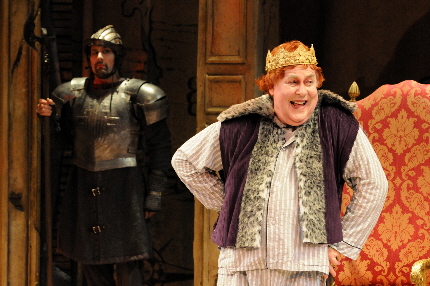
Colin McPhillamy in Palm Beach Dramaworks’ Exit The King (Photos by Alicia Donelan)
The damage of all these wounds is significant: “Upwards of 20 percent of our (government funding) budget is now either gone or in question in the last two seasons,” said Miami’s City Theatre’s Executive Director Gladys Ramirez. “Even with the resumption, I’m also being told that these funds aren’t guaranteed any more years moving forward.”
Andy Rogow, artistic director of Island City Stage in Wilton Manors knows one company leader “who’s told me personally in Miami-Dade that if the (county) funding had been cut 100 percent, they would have just closed shop. And maybe that may happen to some anyway, even with a 50 percent cut.”
Newport cites a variety of arts organizations that have shuttered or are in danger of doing so. “We really are leaning on our individual supporters to make sure that the next 30 years, the next 10 years, they have these centers for imagination to push forward.”
For Island City Stage, Rogow said, “I think it would be very difficult to make up what we would lose from the county if that ever went away. It would clearly affect how many shows we could produce, the size of them…. We would probably have to do less challenging work, things that are more familiar.”
Ironically, observers stress that locally-generated art like theater fuels the broader economy multiple zero places, in part thanks to employment and dining. Yet for years officials seem to have given it fourth or fifth priority below infusing tourism whose patrons rarely dovetail with attendance at theaters and museums.
Some contend that government cuts are a not-so-subtle move by conservative governmental bodies to dilute, discourage, even dissolve liberal-leaning arts organizations or those who support them. “There’s a lot of pressure on both the local government and on the organizations to bow down to what amounts to propaganda or else there will be no funding. That’s just the reality. There’s a lot of fear amongst lots of organizations,” Newport said.
Margaret Ledford, artistic director of City Theatre, likened it to attempted censorship. “Looking ahead, none of this happens in a vacuum, right? …. Ron DeSantis was the first one to cut us, and then it followed nationally, and then now in Miami-Dade County. That immediately puts thousands and thousands of cultural workers’ whole existence into question.”
When Miami-Dade and other local governments cut tax incentives for film and television companies in Florida in 2016, the companies moved lock, film stock and barrel to North Carolina and Georgia.
“I think when our civic leadership, when our political leadership does not value the arts and the humanities and libraries and museums and the spaces where we maintain our culture and the spaces where we champion what it means to be human…we’re a society in decline,” Davis said. “I think it will have trickledown effects. Who knows when the state wants to start meddling in the counties’ ” arts funding?
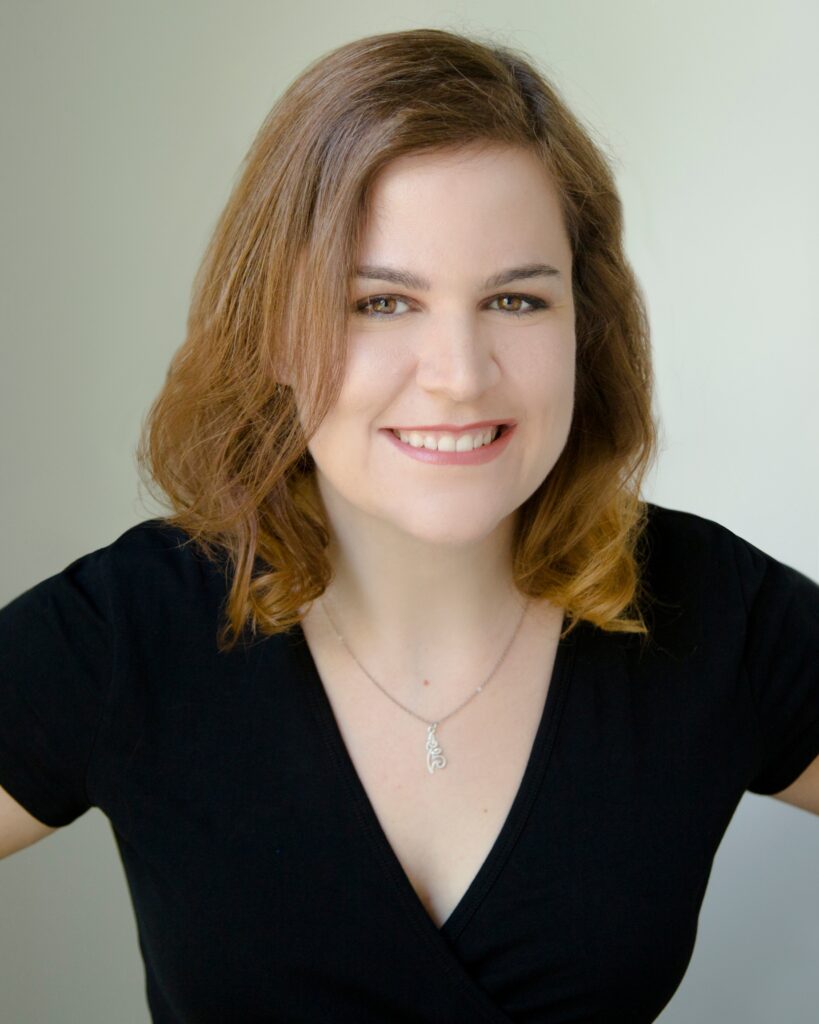
Andie Arthur
But the success of that public outcry in Miami-Dade this year may hold hope if arts organizations locally and across the country join in socio-political action. Andie Arthur, executive director of the South Florida Theatre League noted “Because we’ve got to solve the immediate crisis, is this how we should do arts advocacy all the time so we’re not just doing it in” emergencies?
“It’s just like, how do we look at it long term? You can’t be effective if you’re always just meeting the crisis of the moment. You have to think about what’s coming next, and you have to do it in a way that you personally can sustain it.”
City Theatre’s website proclaimed last year, “When Florida cut arts funding, we got creative. This year’s festival is the loudest, fastest, and funniest way for us to say we’re defunded, not defeated. Get your tickets now before we sell out, or get banned!”
Companies, inherently always seeking increased income, are re-tripling their emphasis on donors, matching grants and contributions.
Grant writing is increasingly aimed toward both governments and foundations. Some companies have hired a full-time grants writer or added that task to an existing administrator or hired a professional firm. Foundations are being asked to ease their restrictions on funds that had been limited only to operations or to administration or to productions.
But some philanthropists keep filling the gap. The Our Fund Foundation, which focuses on LGBT+ groups, just announced gifting $370,000 to 19 arts groups including Island City Stage, Brévo Theatre, Kutumba Theatre Project, Inc., Lesbian Thespians Theater, Zoetic Stage, Thinking Cap Theatre and Plays of Wilton. Ronnie Larsen Presents Plays of Wilton received in just two weeks last month a check for $6,000, another for $20,000, and another for $20,000 and yet another for $10,000.
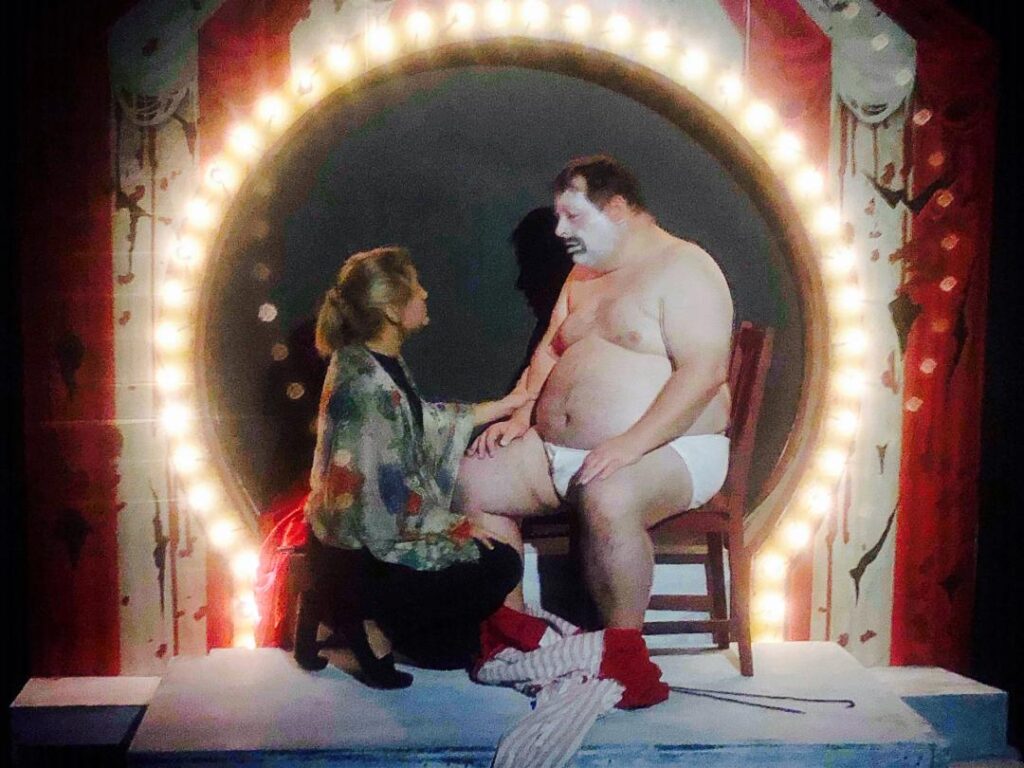
Playwright Ronnie Larsen stars as the title character in An Evening With John Wayne Gacy Jr. at Infinite Abyss (Photos by Fernando Barron II)
A majority of theaters have an increasing number of “sponsors” or “co-producers” or “presenters” listed in their playbills’ front pages. GableStage lists 18 “sponsors” for its current season, not to mention a “transformational” gift from Jessie Fox Wolfson naming its facility GableStage / Wolfson Family Theatre.
Miami New Drama, among others, is finding “commercial partners:” profit-making producers whose contributions reserve them the rights to produce Miami New Drama’s work in new editions elsewhere as they did with its musical “A Wonderful World” about Louis Armstrong that it staged in 2021 and was moved to Broadway in 2024.
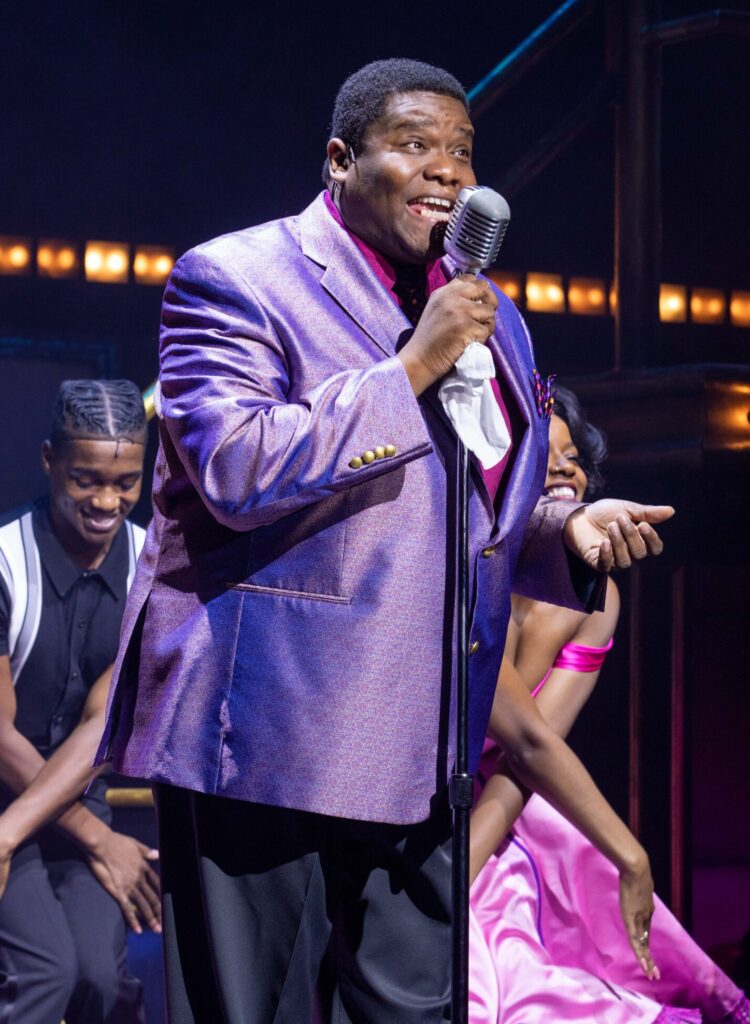
A Wonderful World, Miami New Drama starring Juson William, (Photo by Stian Roenning).
But some original companies resent that people balk at current theater ticket prices for a “one-time event” when they don’t remotely compare to one-time event tickets to a Taylor Swift event or even current Broadway fares.
“You know what else is really expensive? Going to a live sporting event. You know what else is really expensive? Going to a live concert,” said Matt Stabile, producing artistic director of Theatre Lab. “So we have to start thinking in terms of like these live events, and that’s what makes them special because people are accustomed already to having to pay more to enjoy something that is so temporary.”
Audiences may savor complex sets and costuming. But expect to see simpler, more evocative elements requiring the audience to use more of their imagination to fill in the minimalist visuals.
CO-OP COPING
“Together we go…” – Gypsy
During COVID several theater leaders met in frequent strategic profession-wide conversations that intensified the sense of a single interdependent community crossing city and county borders.
While those meetings have receded, several theaters have maintained a sense of cooperation. For instance, the young Brévo Theatre, Island City Stage and GableStage last season co-produced two co-productions of the Pulitzer-winning Fat Ham in Broward and Miami-Dade. Other companies have resumed the courtesy of loaning props, costumes and other equipment to each other.
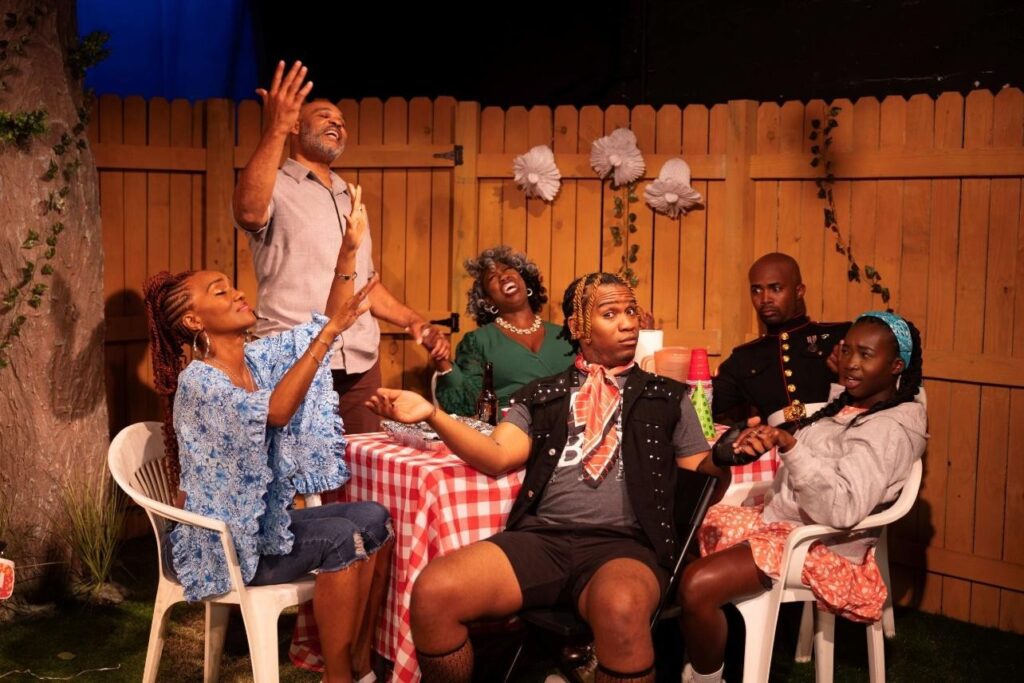
Island City Stage’s Fat Ham with Brevo Theatre, co-produced with GableStage (Photo by Matthew Tippins)
Over the years, the Maltz Jupiter Theater has hand-in-hand co-produced shared productions with the Asolo Repertory in Sarasota, Cleveland Playhouse, Fulton Theatre in Lancaster, and a premiere of Thoroughly Modern Millie with all aspects shared with Papermill Playhouse as early as 2013.
While that only saves about 18 to 20 percent of the expense, that’s significant when major productions can cost $700,000 to $800,000, Kato said. “It’s a new conversation across the country. Now the prevailing thought is that we (will be) doing this two or three seasons out. It’s the number one thought for survival: How we are going to manage these escalating costs.”
Yet another option is for a theater to allow other companies to “present” their own fully-produced show on the theater’s stage for a rental fee.
And theaters like GableStage mention other productions like those at Thinking Cap Theatre in their mass emails.
STILL EXPANDING
“And make our garden grow.” – Candide
And, once again, conversely, some projects on the drawing boards reportedly are moving steadily to fruition.
First, the former Young At Art building in Davie south of I-595 – currently the home to a Broward Library branch – is in the design development phase to create a $25.9 million multi-art facility tentatively called the West Broward Cultural Center headed for completion in 2027 or early 2028. Dunlap said it will serve the growing population in the western half of the county where few public spaces are available.
Second, Miami New Drama is developing a second stage separate from its home at the Colony Theatre on Lincoln Road which it manages for the city, said Michel Hausmann, artistic director. With the city, it plans to take over a 17,000 square feet space on the first floor of a parking garage at Collins and 23rd Street. The space would house a 200-seat black box theater, an art gallery, a community space and a restaurant. The estimated $8 million bill will be paid out of the $164 million cultural general obligation bond that Miami Beach voters passed in 2022.
“Part of my idea as well is try to create smaller theater companies that, in a way, are orbiting us so that may be a couple of Spanish language theater company, maybe an English language company,” Hausmann said.
Third, work continues on plans to build a modern theater behind the still standing façade of the Coconut Grove Playhouse to be managed by GableStage. The bulk of the prior building has been torn down. Previous plans are being redrawn. One GableStage officer said that while the county talks about a 2027 opening, insiders believe the curtain won’t rise until 2028.
Last October, the Gulfshore Playhouse in Naples moved from its very intimate house it had rented since 2004, now into its own massive $72 million performing arts center and education center thanks to such gifts as two $10 million donations.

(The third of an extensive three-part series set to be posted Thursday Jan. 8, examines who is available to act, direct and design future productions, whether there even are enough experienced and/or talented artists in the local pool. To read part one of the series, click here.)
(Please feel encouraged to comment on these pieces at muckrayk@aol.com or in the comments section below.
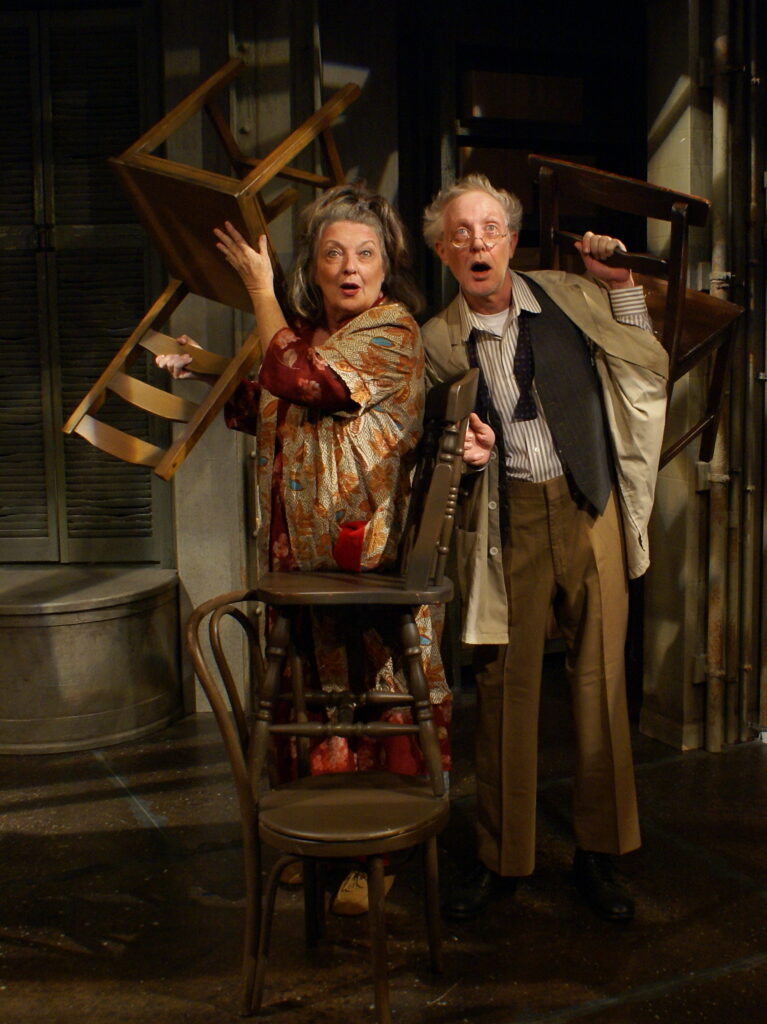
Barbara Bradshaw and Dan Leonard in Palm Beach Dramaworks’ The Chairs





 A PaperStreet Web Design